News dated
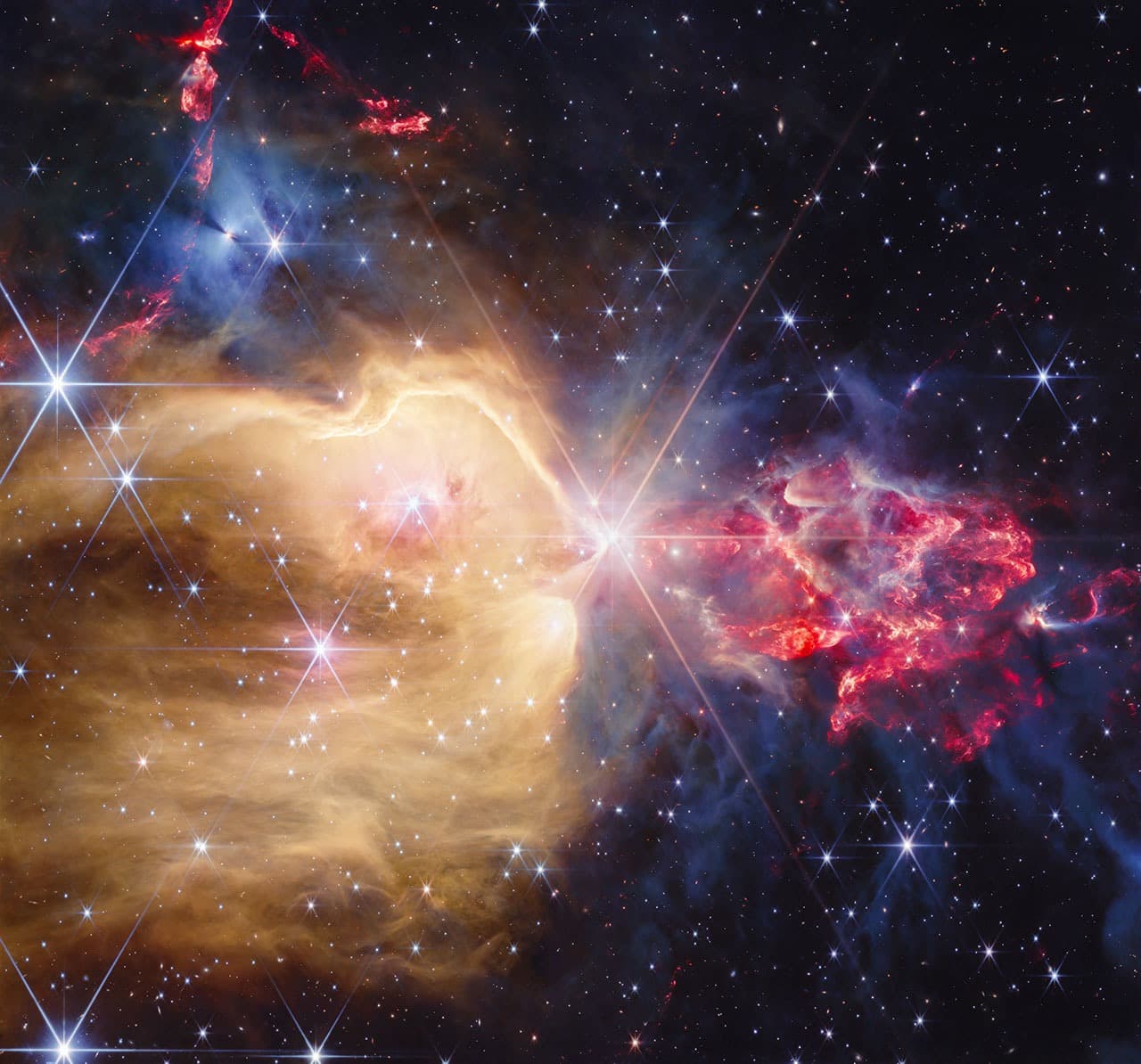
On 6 October 2026, NASA released a new NIRCam image of NGC 7129, a star-forming region about 3,300 light-years away. Webb observes in infrared light, revealing structures and stars hidden by dust. The display colours are assigned: gold marks hot atomic hydrogen, while red represents cooler molecular hydrogen affected by shocks from protostellar jets. [1]
The central star, LkH(alpha) 234, has an estimated mass of five to eight times the Sun’s and is still in the pre-main-sequence stage. Nearby are younger protostars, gathering matter and ejecting jets. The image provides details of different stages of star formation; it does not show stars born on publication day. [1]
Spitzer had already observed NGC 7129 in infrared light: one of its images is dated 12 February 2004. Different wavelengths were also translated into visible colours then. NASA highlights finer details in the new Webb image. Our editorial reading advice is to consult each image’s colour explanation, without inferring physical change from the different palettes alone. [2][1]
The bright side
The new observations let researchers study in greater detail how young stars interact with surrounding gas and dust, building on work by earlier telescopes. [1]
One idea, in simple words
Stars can form inside large clouds of gas and dust. Webb studies one such region, called NGC 7129, about 3,300 light-years away: a light-year is the distance light travels in one year. The image released on 6 October 2026 shows stars at different stages of growth. Some very young ones send out jets of material. Webb collects infrared light, which our eyes cannot see, and the data are represented using visible colours. [1]
Spitzer had also studied this cloud: the image mentioned here dates from 2004. To understand the colours, imagine an example from our editors: we colour rivers and roads differently on a map so we can tell them apart. Colour helps us read information. It does not mean our unaided eyes would see exactly those colours in space. [2]
A little discovery to keep
What did you discover?
Straight from the source.
- NASA’s Webb Captures Commotion From Nebula’s Stellar Jets NASA / Goddard Space Flight Center · 6 Oct 2026
- Reflection Nebula NGC 7129 NASA / JPL-Caltech / Spitzer · 12 Feb 2004
Original reporting summaries prepared with AI assistance and accessible sources. Our editorial method.