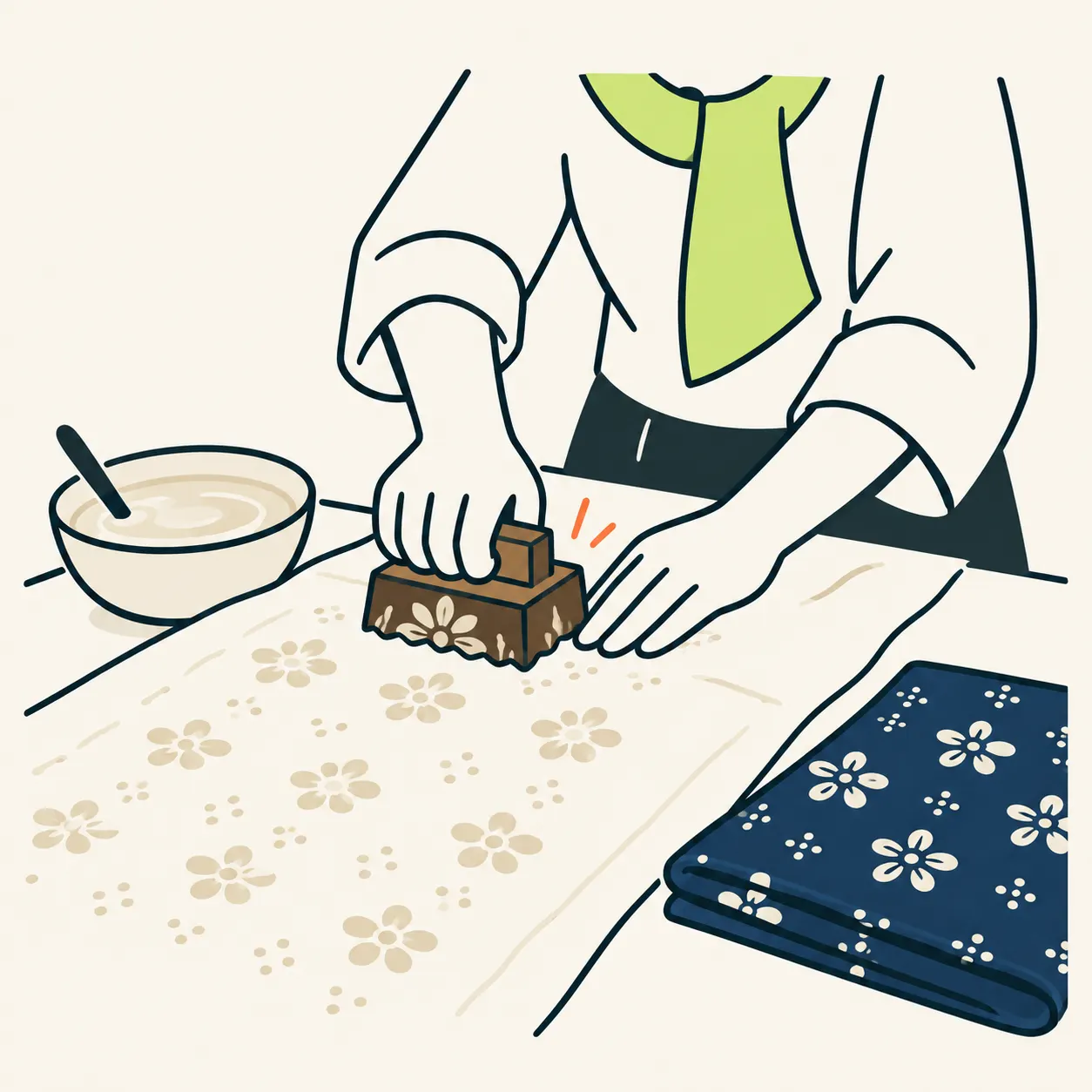
Small white patterns appear on a blue cloth. It would be easy to imagine a pale brush applied at the end; in the Blaudruck described by the German Commission for UNESCO, the sequence is different. Before dyeing, a paste is printed to protect some areas of fabric. Colour does not penetrate there as it does in exposed areas. The central discovery is this resist process: the design is prepared by deciding where blue must not go. [1]
The workshop of Joseph and Miriam Koó in Austria’s Burgenland describes its own process: prepare the paste called Papp, print it and let it dry, then dye with indigo. After dipping and subsequent stages, the paste is washed away. The light areas we see are therefore reserved cloth, rather than necessarily white colour added over blue. This account concerns a real practice in this workshop; it does not provide one universal recipe for every dyer or every textile tradition. [3]
The Austrian Commission for UNESCO also documents Blaudruck in the Mühlviertel region. Here, the account connects handwork with workshops, the transmission of skills and regional patterns. Recognising two colours is therefore insufficient to assign a cloth to one specific community. We need provenance, technique and context. In our editorial interpretation, a repeated motif can be read as a trace of learned movements, without automatically making it a symbol with one identical meaning for everybody who produces or uses it. [2]
In 2018 this shared tradition was inscribed on the Representative List of the Intangible Cultural Heritage of Humanity, involving Austria, Czechia, Germany, Hungary and Slovakia. The German account highlights handmade blocks and learning through observation and experience. The list recognises a practice and its supporting knowledge: it does not certify every blue object sold with white patterns. The broad name includes local circumstances, people and ways of working that deserve to remain distinguishable, rather than being flattened into a single decorative style. [1]
Try a comparison proposed by our editorial team: drawing a shape by adding colour, or leaving a shape untouched while colouring its surroundings. The result might look similar, but the problem to solve changes. In Blaudruck, the resist is prepared before the dye bath. Our illustration shows only this technical idea; it does not copy an identifiable historical motif or claim to reproduce every step, the exact inside of a workshop, or one particular maker’s method in full. [3]
When you encounter a decorated cloth, ask which part was added and which part preserved. The question does not replace the work of people who understand materials and processes, but it makes looking more attentive. The documented tradition lives beyond the finished pattern: it includes tools, observation and knowledge passed on through practice. Looking at the light space becomes a way to recognise work that we might otherwise attribute, too quickly, to the dominant colour alone. [1][2]
Take this with youFacing a light pattern on blue cloth, look for the sequence of work: the design may be an area protected beforehand.
One idea, in simple words
Blaudruck is a tradition of printing and dyeing textiles, found in several regions of central Europe. To create a light pattern on blue cloth, makers do not necessarily paint white onto fabric that is already dyed. They first apply a paste to particular areas. This paste acts as a resist: it protects the places meant to stay light. The fabric is then dyed with indigo. In the process described by the Koó workshop, the paste is finally washed away. As a comparison, imagine leaving a shape untouched while colouring the surrounding space. The result depends on earlier preparation. UNESCO sources also describe tools and skills passed on through observation and practice. Every workshop has its own history: two similar colours are not enough to identify it. [1][3][2]
A little discovery to keep
What did you discover?
Read the sources (3)
- Blaudruck, Blockdruck und Indigofärbung in Europa German Commission for UNESCO · accessed 21 Oct 2026
- Mühlviertler Handblaudruck Austrian Commission for UNESCO · accessed 21 Oct 2026
- Original Indigo Blaudruck: the workshop and process Joseph and Miriam Koó · accessed 21 Oct 2026
Original writing and illustration made with AI assistance. Our editorial method
More in Cultures & peoples