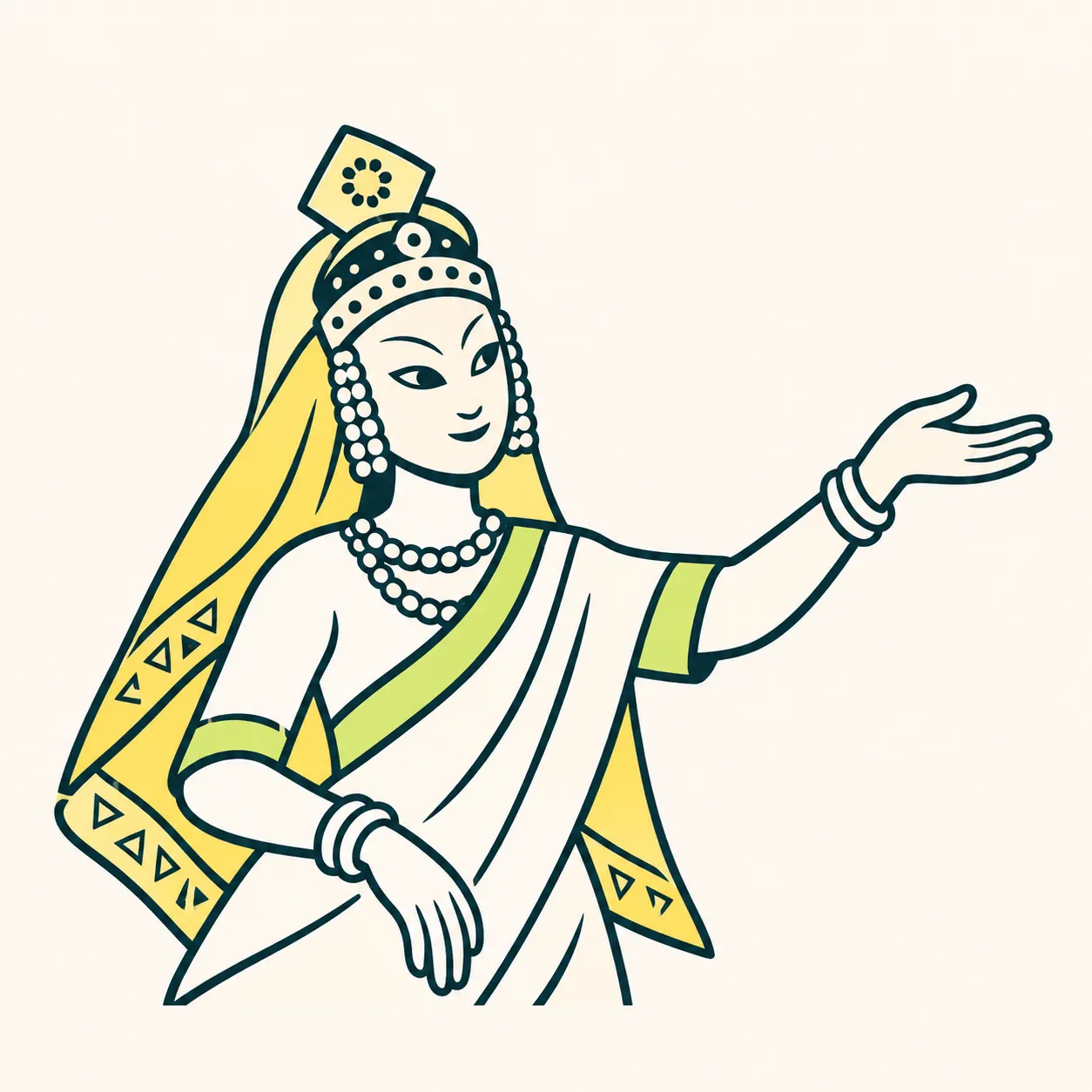
We often look for emotion in a face. What happens when a mask keeps its expression unchanged while the body dances? Some forms of Chhau, a tradition from eastern India, invite us to redirect our attention. This is not one uniform dance: the Sangeet Natak Akademi distinguishes the styles of Seraikella, Purulia and Mayurbhanj. The first two use masks; the third does not. That detail already prevents the word Chhau from becoming an overly simple label for everything we might see. [1]
The distinction between styles is essential: not every Chhau performance covers the face. The international UNESCO centre devoted to martial arts describes a tradition in which physical skill and movement participate in storytelling. For masked forms, our initial question can become an observation method: watch how the head, torso and direction of a step contribute to what we perceive. This is an editorial suggestion for looking, not a universal code that automatically assigns a particular emotion to every gesture a dancer makes. [2][1]
Themes include episodes from the Mahabharata and Ramayana, local narratives and abstract subjects. Sangeet Natak Akademi documentation also connects the movement vocabulary with martial practices, stylised animal gaits and everyday actions. The interesting shift is this: a gesture can become theatrical language without remaining a literal copy of the action it draws upon. Recognising a similar movement, however, is not sufficient to reconstruct its meaning. We need the context of the performance and the knowledge of people who practise the tradition. [1]
West Bengal’s official tourism page places Purulia Chhau within local festivals and rituals, emphasising the combination of masks, clothing and physical abilities. A mask displayed alone may attract attention, but it cannot replace a dance. For an editorial exercise, imagine describing a photograph without using the word exotic. What posture do we see, what relationship between bodies, what elements of costume? Precise questions keep us closer to the work than an adjective that mainly announces our own distance from it. [4]
INTACH documents the tradition through dedicated research and collaboration with scholars, a useful reminder to seek specific voices and places. UNESCO recognition, granted in 2010, does not turn Chhau into an unchanging object or a symbol of all India. For an initial observation, choose attributed documentation, check its style and origin, and follow a few seconds of the relationship between rhythm and movement. There is no need to imitate demanding figures. The first step is learning to look without making a mask speak instead of the person who wears it. [3][1]
Take this with youName the Chhau style before generalising. Then observe body, rhythm and context: a mask belongs to the practice, but cannot provide its complete explanation.
One idea, in simple words
Chhau is a dance tradition from eastern India. It includes three styles called Seraikella, Purulia and Mayurbhanj. The first two use masks, while Mayurbhanj does not. It is important to distinguish them. A mask keeps the same expression while a dancer can move their head, arms and body. Looking at the face alone is therefore not enough to follow the scene. Dances can tell episodes from major works, local stories or abstract themes. Imagine describing a scene by noticing posture and movement instead of only saying the costume is beautiful. This is our exercise for looking more closely. It does not let us guess every meaning: we need information about the style and the people who practise it. [1][2][3][4]
A little discovery to keep
What did you discover?
Read the sources (4)
- Chhau dance Sangeet Natak Akademi, Ministry of Culture, India · accessed 8 Nov 2026
- Chhau International Centre of Martial Arts under the auspices of UNESCO · accessed 8 Nov 2026
- Chhau Dance — research documentation Indian National Trust for Art and Cultural Heritage · accessed 8 Nov 2026
- Festival Chhau Nach Department of Tourism, Government of West Bengal · accessed 8 Nov 2026
Original writing and illustration made with AI assistance. Our editorial method
More in Cultures & peoples