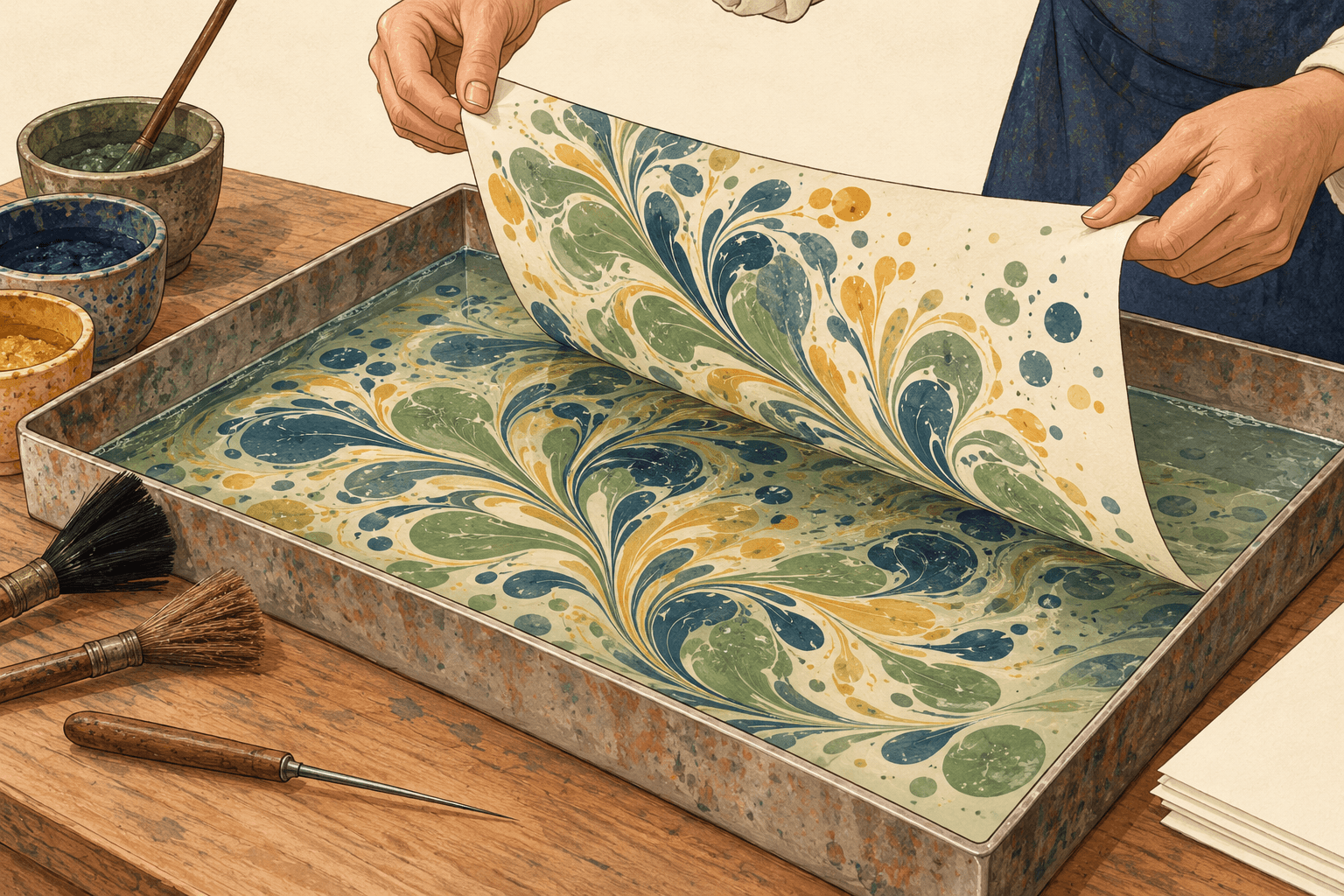
A sheet can receive a picture that began somewhere else. In ebru, the Turkish art of marbling, pigments are arranged on a liquid surface and then transferred to paper. UNESCO inscribed the practice on its Representative List of the Intangible Cultural Heritage of Humanity in 2014. The recognition concerns a tradition and the people who transmit it, rather than claiming that every swirling pattern must have one single origin. [1]
The Turkish Ministry of Culture and Tourism explains why this is not simply paint poured into tap water. The bath is prepared with a thickener, traditionally tragacanth gum, and pigments are treated to remain at the surface. Slender tools let the maker change shapes before transfer. These details explain the principle; they are neither a home recipe nor a measure of the expertise needed to produce a controlled piece of work. [2]
A preserved object makes the technique concrete. The Robert C. Williams Museum of Papermaking at Georgia Institute of Technology presents a sheet made by Mustafa Esat Düzgünman in 1977: red and white tulips against blue-green marbling. The museum describes placing paper over the pattern and lifting it away. The example shows that ebru is not merely random blotches: it can include figurative motifs made by a named person with a particular history. [3]
Here is an editorial example to imagine, not a technical demonstration. Draw two frames on a sheet: in the first, the pattern is still on the tray; in the second, it is on paper. Which do we call the original? The question is not meant to decide which surface matters most. It reveals a stage that a photograph of the finished work conceals: making involves arranging, waiting, transferring and observing, rather than simply filling a page. [2]
Finally, we invite readers to distinguish observation from cultural membership. Watching a video or trying a similar effect does not mean representing everyone who practises ebru, or everyone in Türkiye. We can appreciate a particular gesture without turning it into the character of an entire country. To continue exploring, look for the maker’s name, the work’s date and a description of the process: three details that restore precision to a decorative image. [3][1]
Take this with youWhen looking at marbled paper, look for the gesture behind the pattern. Asking who made it and how it was transferred is already a more attentive way to observe.
One idea, in simple words
Ebru is a Turkish art of decorating paper. The pattern begins on a prepared liquid in a shallow tray. Pigments, the substances that give colour, remain at the surface and are arranged with tools. A sheet is then placed on top and lifted: the pattern moves onto the paper. This differs from drawing directly on a sheet with a pen. [2]
Here is an editorial example: imagine two photographs, one before transfer and one after. Find the pattern in each. This helps explain the step but does not teach the entire technique. Some works include recognisable flowers: a museum preserves a sheet with tulips made by Mustafa Esat Düzgünman in 1977. Behind a decoration is the work of a person. [3]
A little discovery to keep
What did you discover?
Read the sources (3)
- Ebru, Turkish art of marbling · nomination 00644 UNESCO · Intangible Cultural Heritage · accessed 7 Oct 2026
- Marbling · Decorative Turkish Arts Republic of Türkiye · Ministry of Culture and Tourism · accessed 7 Oct 2026
- Turkish ebru marbled paper Robert C. Williams Museum of Papermaking · Georgia Institute of Technology · accessed 7 Oct 2026
Original writing and illustration made with AI assistance. Our editorial method
More in Cultures & peoples