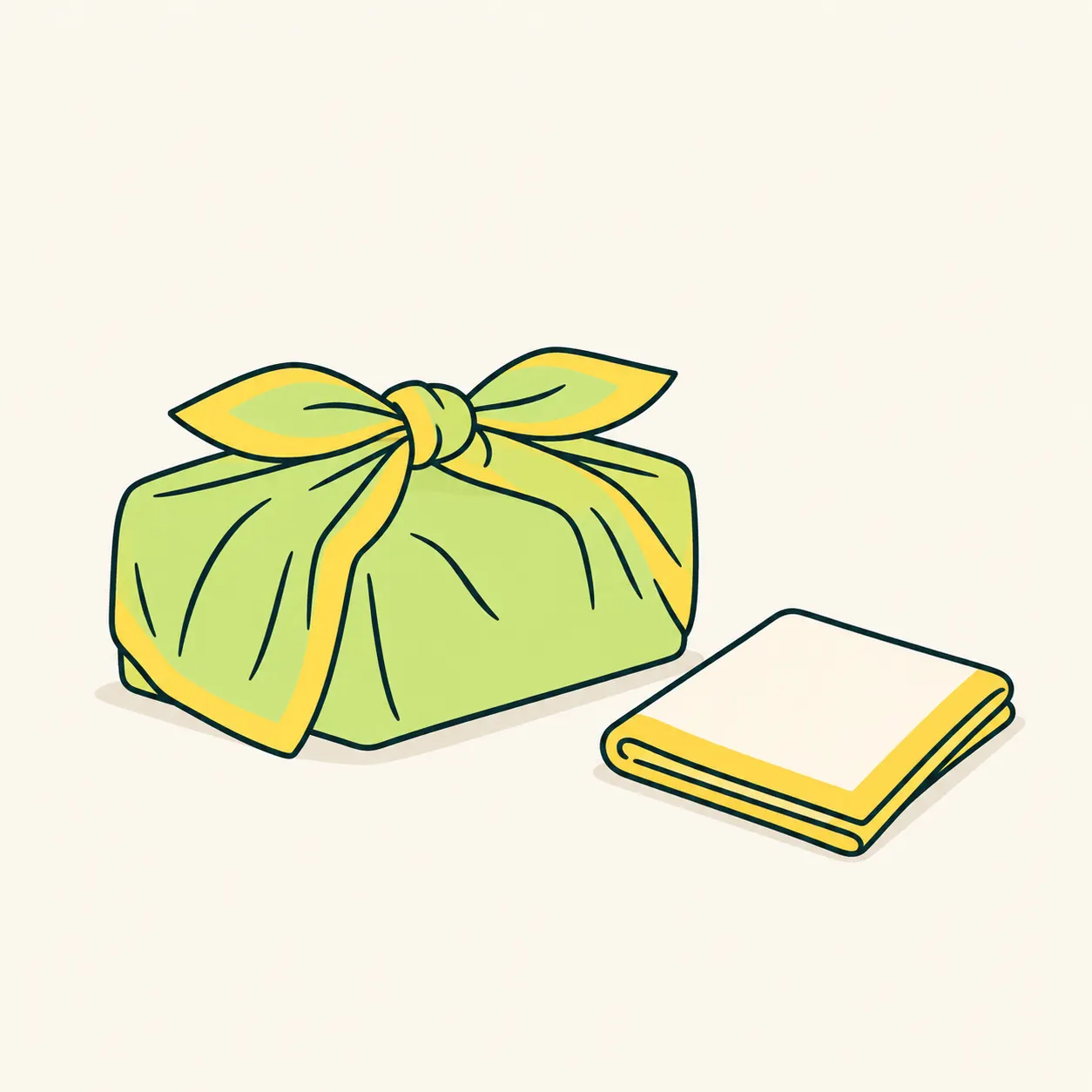
On a table, it is a square of cloth. Wrapped and tied, it becomes a way to contain and carry an object. Furoshiki, described by Japan’s embassy as cloth for wrapping, storing and carrying things, invites us to notice this transformation. The wrapping has no rigid shape fixed once and for all. Its contents, folds and knots organise the space differently each time it is used. [2]
Its history cannot be reduced to one gesture invented on one precisely known day. Institutional sources and the interview published by IHCSA distinguish old practices of wrapping possessions from cloth uses connected with bathing. The name furoshiki refers to that latter setting; the spread of public baths during the Edo period contributed to its popularity. Connecting these strands does not justify turning a complex tradition into one perfectly linear origin story. [3][2]
Japan’s Ministry of the Environment presents examples of cloth adapting to differently shaped objects and being folded away when no longer needed. The observable principle is reversibility: undo the knot and the container becomes cloth again. This does not mean that any fabric and any knot will suit every weight. We are describing a cultural and material principle, not certifying safe transport or offering instructions for carrying fragile objects. [1]
In the 2020 interview, Etsuko Yamada of Musubi discusses workshops teaching furoshiki uses and the development of contemporary designs. This is testimony from a professional in the field, not a survey of every Japanese person’s habits. It nevertheless helps us see a living practice. A cloth’s usefulness depends not only on its printed pattern, but also on knowing concrete ways to use it and bring it into service again. [3]
Imagine an editorial example: a book placed in the centre of a cloth, alongside an identical cloth still folded. One suggests a volume; the other takes little space. There is no need to assign universal spirituality to this gesture or the same meaning for every person. We can simply observe the relationship between surface and object, asking how much of the container belongs to the material and how much comes from action. [2][3]
Reuse is a real possibility, but we assign no numerical environmental saving to furoshiki without an appropriate comparison. Material, production, washing and number of uses belong to an assessment beyond this reading. Today’s discovery is more precise: wrapping can be arranged to become available again. The gift is opened and the cloth remains. Its working life does not necessarily have to end at the very same moment as the first bow. [1][3]
Take this with youLook at wrapping after opening it: can it become a surface again, hold something different and serve another purpose? Furoshiki makes that question tangible.
One idea, in simple words
Furoshiki is a square cloth used in Japan to wrap, store and carry objects. Folds and knots let it adapt to different shapes. When you untie it, it becomes a cloth again and can be reused. Sources describe a history involving old textiles for storing possessions and uses connected with bathing. People do not all use it in the same way. Today there are also new designs and workshops for learning. Imagine a book wrapped in cloth: after opening it, the cloth need not be thrown away. This is our editorial example. Reuse is possible, but calculating an environmental benefit would require more data. A cloth does not automatically make every weight or knot safe. [2][3][1]
A little discovery to keep
What did you discover?
Read the sources (3)
- Furoshiki — wrapping and reuse Ministry of the Environment, Japan · accessed 3 Nov 2026
- Furoshiki Embassy of Japan in Georgia · accessed 3 Nov 2026
- Furoshiki — An old but new eco-friendly product IHCSA Cafe — interview with Etsuko Yamada · accessed 3 Nov 2026
Original writing and illustration made with AI assistance. Our editorial method
More in Cultures & peoples