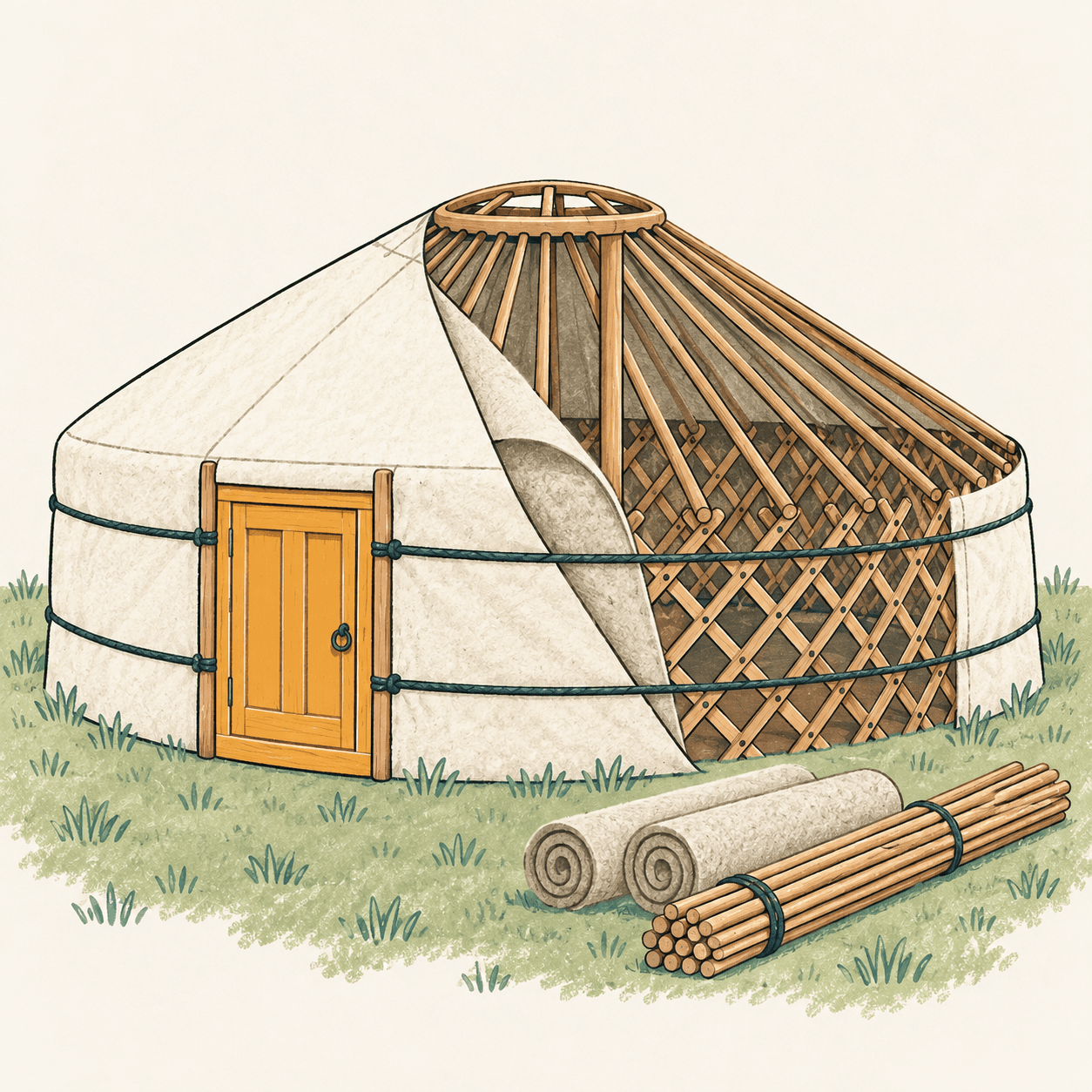
How can a home be designed to accompany a move? The Mongolian ger answers with a circular structure that can be taken apart and assembled again. Wood, felt, canvas and ropes perform different jobs within a portable whole. In 2013, traditional craftsmanship of the ger and its associated customs joined UNESCO’s Representative List of the Intangible Cultural Heritage of Humanity. Attention therefore includes the knowledge held by people, as well as the dwelling’s recognisable shape. [1][2]
The ICHCAP description allows us to look beneath the covering. We find lattice walls, a door, roof poles, a central crown and supporting pillars. The walls can fold; poles connect the top to the perimeter structure. Making parts that fit together requires precise work. The report distinguishes woodworkers, decorators and people specialising in sewn coverings. Looking only at the outer profile therefore hides an interesting part of the story: several kinds of expertise must meet for the parts to work together. [1][2]
Felt also has a history of shared gestures. Mongolia’s National Center for Cultural Heritage describes preparing wool, laying it in layers, wetting and rolling it, followed by spreading and drying. It documents collective work among households and the exchange of knowledge between generations. Felt is also used for ger coverings. Behind an apparently uniform surface, we can therefore look for operations, materials and people: the finished material preserves the result of a sequence of actions. [3]
Here is an editorial exercise: draw a very simple ger with three hands beside it. Connect the first to the wood, the second to the felt and the third to sewing the coverings. This is neither a complete list of crafts nor a plan for building a house. It is a way to shift attention from the object to the relationships that make it possible. We can then add an arrow between two people: it marks someone demonstrating a gesture and someone learning it. [2][3]
This tradition includes differences rather than a single unchanging script. The Mongolian centre describes regional variations in feltmaking and the transmission of knowledge through associations, gatherings and workshops. The report on the ger also documents specialised skills and craft apprenticeships. For the editors, recognising these differences helps avoid a shortcut: using one kind of home to explain every person in a country. Discovery can begin with a particular object and continue with the names of the people who make it. [3][2]
Take this with youWhen looking at a ger, seek three levels: its structure, the materials covering it and the skills bringing them together. This editorial observation exercise makes a familiar point tangible: a shape becomes more interesting when we make room for people.
One idea, in simple words
A ger is a traditional Mongolian home with a circular structure. It can be taken apart and assembled again for transport. It has wooden lattice walls, roof poles and coverings made of felt and canvas, secured with ropes. The parts must fit together. Making them takes different skills: working wood, preparing felt and sewing the coverings. [1][2]
Mongolia’s heritage centre explains that feltmaking can bring households together and help people share knowledge. Practices differ between places and communities. Here is an editorial example: draw a home and, beside it, the hands of people preparing its materials. Add one person teaching another. The picture reminds us that an object can also tell a story about people’s work and learning. [3]
A little discovery to keep
What did you discover?
Read the sources (3)
- Living Heritage: Wisdom of Life · Mongolia · Traditional Craftsmanship of the Mongolian Ger and Associated Customs ICHCAP · accessed 9 Oct 2026
- The Intangible Heritage List of UNESCO · Traditional craftsmanship of the Mongol ger and its associated customs, pp. 54–57 ICHCAP · Mongolia country report · accessed 9 Oct 2026
- Traditional Feltmaking Custom and Practice National Center for Cultural Heritage of Mongolia · accessed 9 Oct 2026
Original writing and illustration made with AI assistance. Our editorial method
More in Cultures & peoples