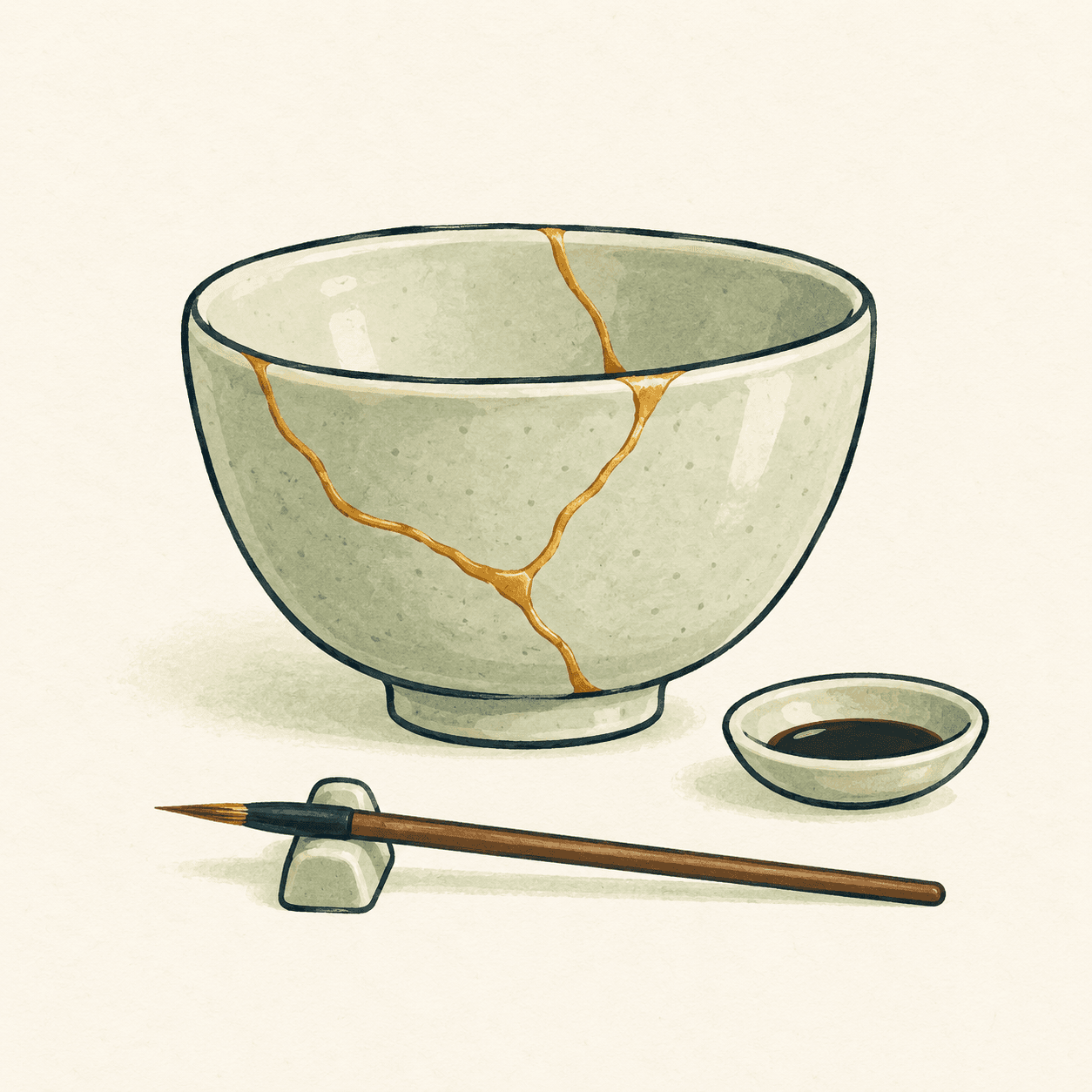
A golden line across a bowl can mark a repair, rather than a pattern added when the object was new. Kintsugi is a Japanese practice of repairing ceramics with lacquer and metal powders. Japan House London describes work that makes the rejoined break visible. The discovery is concrete: a join can continue doing a job while becoming part of the object’s appearance, rather than simply disappearing into the background. [1]
In the traditional technique described by Japan House, urushi lacquer contributes to the repair and gold powder to the finish. We should not picture molten gold being poured between two broken pieces. The bright line belongs to skilled work with materials and surfaces. The name is roughly translated as joining with gold; this helps us remember the action, but does not replace the craft knowledge needed to perform it. [2]
A documented example belongs to the University of Michigan museum: a small footed bowl, inventory number 1954/1.541, has an asymmetrical golden line. The museum dates it between the seventeenth and eighteenth centuries; the title Hagi ware? explicitly preserves uncertainty about its attribution. At the Metropolitan Museum, an eighteenth-century red Raku bowl, inventory number 36.120.525, is recorded with gold lacquer repairs. These are not interchangeable pictures of one vague, general tradition. [3][4]
Different practices still need distinguishing today. In its description of a workshop led by artist Hakose Junichi, Japan House identifies an adapted introductory method using epoxy glue and synthetic powders. It does not present that approach as identical to the entire traditional procedure. This detail matters when we encounter kits or demonstrations: the same word can accompany different materials and timescales, which deserve clear descriptions rather than an appealing but unexplained label. [2]
Try an editorial example, only on paper: draw a bowl and add an irregular line across its surface. Imagine two captions, one calling the line decoration and the other explaining a repair. The drawing stays the same; what changes is our knowledge of its journey. We are neither practising kintsugi nor reconstructing a museum object. We are learning to notice the difference between an appearance and a history supported by evidence. [3]
The idea of repairing something without erasing every trace can inspire personal reflection. Such reflections are editorial interpretations, not a psychological rule or a belief automatically shared by every Japanese person. Our illustration likewise depicts an imaginary bowl. To understand the practice, it helps to begin with specific objects, materials, makers and attributions, giving motivational simplifications a much smaller role than the actual work of bringing pieces back together. [1][3]
Take this with youLook at a repair without immediately giving it a symbolic meaning. Ask what was joined, with which material, and what information about its history is actually documented.
One idea, in simple words
Kintsugi is a Japanese practice for repairing ceramic objects. The traditional technique uses urushi lacquer, a material involved in the repair, and adds gold powder to the finish. Golden lines make the joins between pieces visible. They are not molten gold poured into the cracks. [2]
The University of Michigan museum holds a small bowl with an asymmetrical golden line. This is a documented example, while our picture is imaginary. Here is an exercise from the editors: draw a bowl with a line and write two captions, “decoration” and “repair”. The drawing stays the same, but the explanation changes. Some modern workshops use adapted materials. Knowing the process helps us understand what we are looking at without treating every technique as identical. [3][2]
A little discovery to keep
What did you discover?
Read the sources (4)
- An Introduction to Kintsugi: Workshop Japan House London · accessed 6 Oct 2026
- Repairing with gold: Kintsugi workshop with maki-e artist Hakose Junichi Japan House London · accessed 6 Oct 2026
- Footed Bowl, Hagi ware? · 1954/1.541 University of Michigan Museum of Art · accessed 6 Oct 2026
- Red Raku Tea Bowl (Chawan) · 36.120.525 The Metropolitan Museum of Art · accessed 6 Oct 2026
Original writing and illustration made with AI assistance. Our editorial method
More in Cultures & peoples