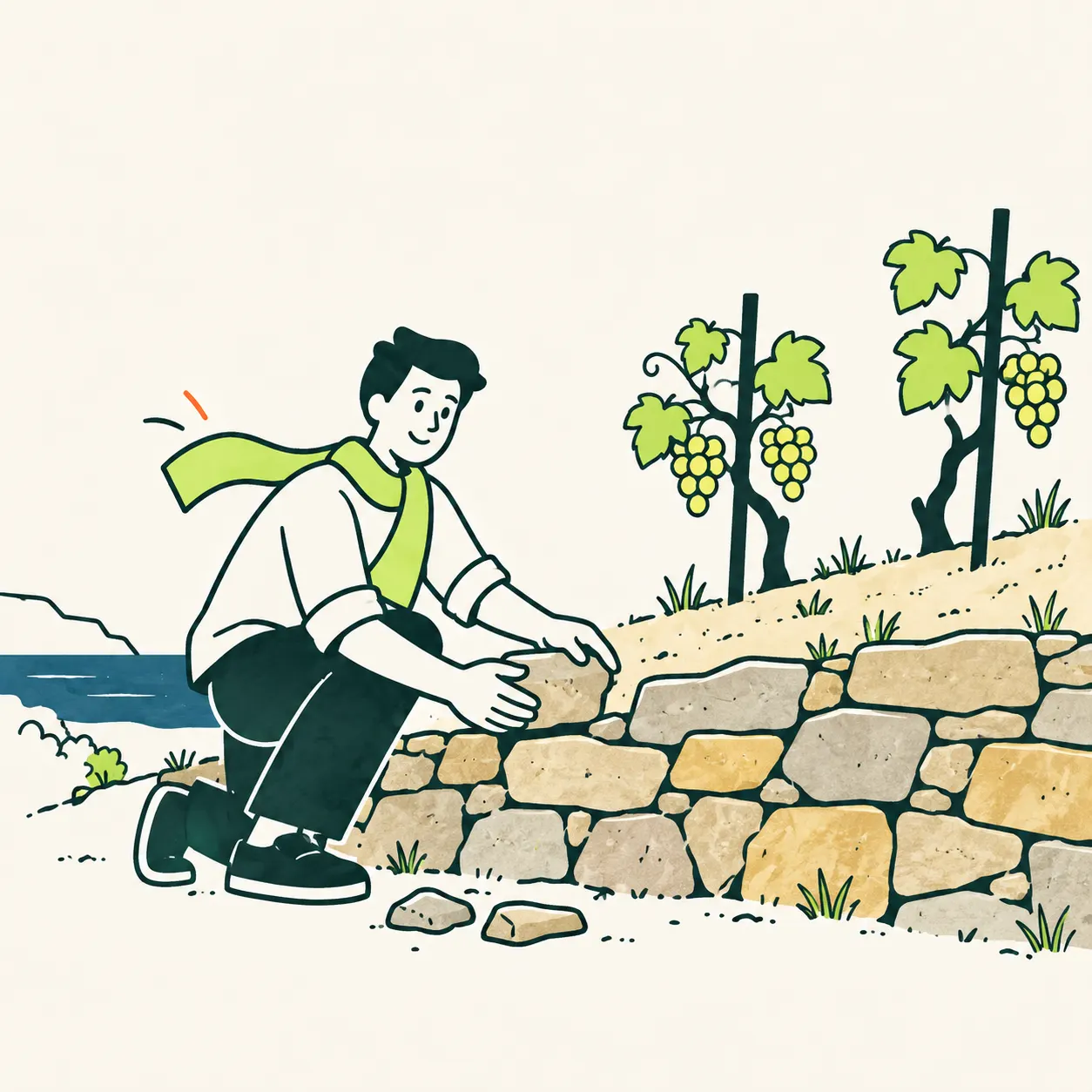
A wall of stones can look like a backdrop to a landscape. On the terraces of the Cinque Terre, it helps make small cultivable spaces on a slope. The National Park describes the work that transformed steep hillsides into strips supported by walls. Our editorial question begins here: when we admire a panoramic photograph, do we also recognise the work needed to maintain what it shows? The wall is more than a dark edge between two bands of green. [1]
The Park’s manual distinguishes dry stone walls from structures joined with mortar. Dry stone means that the stones are arranged without that binding material. It does not mean without planning, skill or relationships between parts. This is the central discovery: the absence of mortar is not the absence of construction. The visible support belongs to a system involving the ground, the arrangement of stones and elements that a photograph taken directly from the front cannot show us. [2]
The guidance also describes filling and drainage material behind the facing, the wall’s visible surface. We should therefore avoid reducing the method to a puzzle of shapes on the outside. We offer no structural recipe: the manual concerns particular interventions and local conditions. As an editorial exercise, draw two lines on paper, one for the hillside’s profile and one for the cultivated edge, and leave a question about what remains hidden between the visible features of the scene. [2]
The Park connects these terraces with crops such as vines and olives, while noting the difficulties of maintenance and mechanisation. These are specific conditions, not proof that every old wall is automatically better than any alternative. In our reading, landscape also contains access, time and repeated work. We can appreciate a view without erasing those who care for it, or turning effort into a postcard where everything seems to function by itself, with no attention needed ever again. [1]
Passing on skills remains an active concern elsewhere too: the Dry Stone Walling Association presents practical training courses. This example does not make every region’s techniques identical; it shows that manual knowledge can be taught and assessed through work. For an editorial exercise, ask which gestures you could describe and which you could only copy from a distance. Knowing the name of a technique is a beginning, not a qualification to alter or repair a structure that supports soil. [3]
The Cinque Terre manual also draws on surveys and knowledge gathered in the area: observing and listening form part of how the craft is documented. On a future walk, look from an accessible route at the variety of stones and the relationship between wall and ground. The invitation is to read, not dismantle. An apparently anonymous stone can prompt questions about who selected it, how it arrived there and what maintenance allows the whole structure to continue doing its job. [2]
Take this with youObserve the visible wall as only one part of a terrace. Recognising dry stone work includes drainage, maintenance and skills; reading a landscape should not be confused with an operating manual.
One idea, in simple words
Some slopes in the Cinque Terre are arranged as terraces: strips of land supported by walls, where crops can grow. Dry stone walls are built by placing stones without mortar, the material that would bind them together. This does not mean that the stones are arranged randomly. A wall belongs to a system that includes the ground and less visible parts. Here is an editorial example: on a walk along an accessible route, look at the edge of a cultivated strip. Describe what you can see and note what you do not know. There is no need to move stones. Learning the technique’s name helps recognise the work, but is not enough to build or repair a wall. [2]
A little discovery to keep
What did you discover?
Read the sources (3)
- I terrazzamenti delle Cinque Terre Parco Nazionale delle Cinque Terre · accessed 20 Oct 2026
- Manuale per la costruzione dei muri a secco: linee guida per la manutenzione dei terrazzamenti delle Cinque Terre Parco Nazionale delle Cinque Terre / Università di Genova, progetto LIFE PROSIT · accessed 20 Oct 2026
- Training and education Dry Stone Walling Association · accessed 20 Oct 2026
Original writing and illustration made with AI assistance. Our editorial method
More in Cultures & peoples