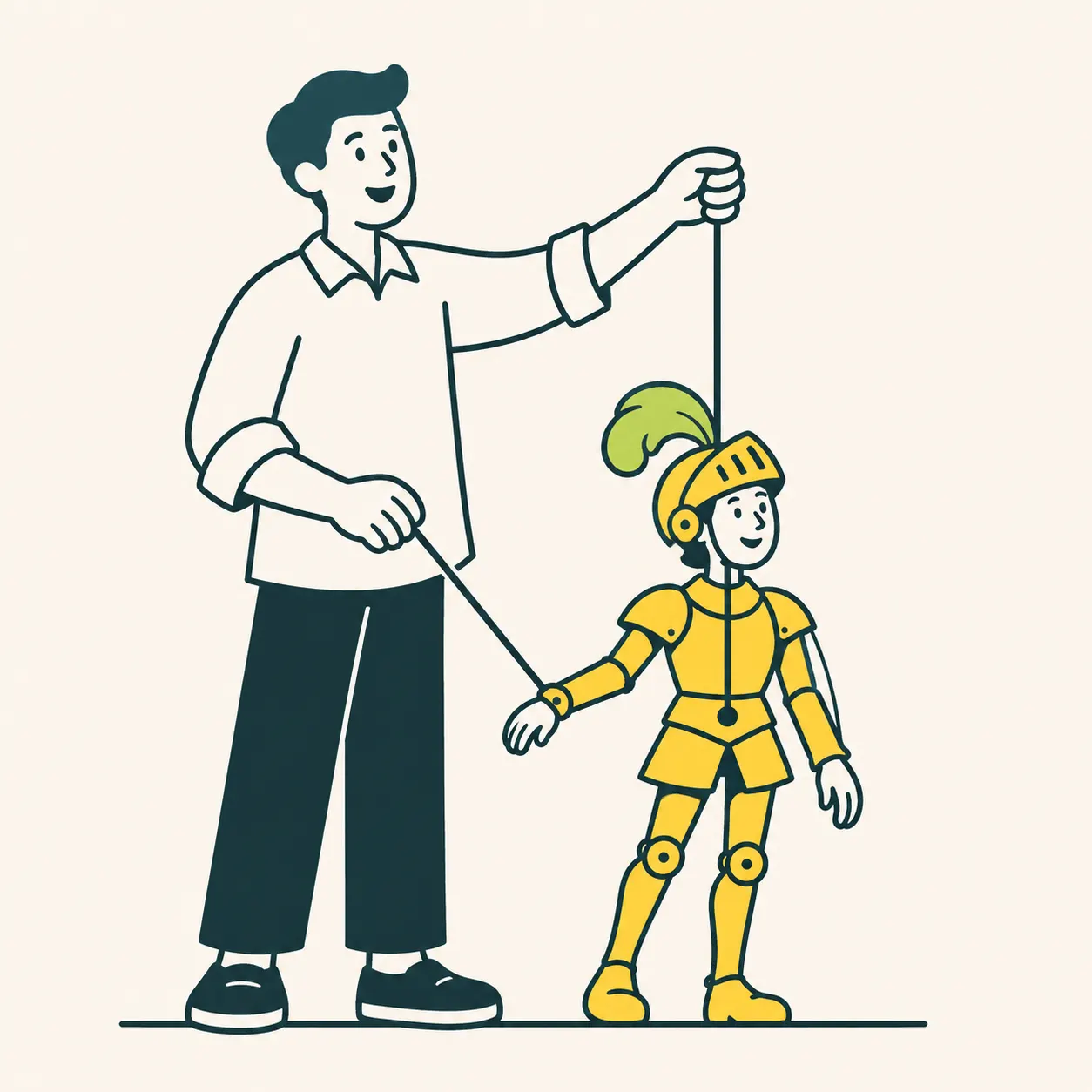
A little knight enters the stage and seems to have an intention. That movement comes from more than the character in the story: it depends on the performer and on how the puppet is built. Sicily’s Opera dei pupi makes this alliance between craft and theatre visible. The regional tourism authority describes the puparo as a performer who supplies voice and pace while following a narrative outline. A well-made object does not perform alone; a voice meets materials, joints and actual possibilities for movement. [1]
The Antonio Pasqualino Museum makes a clear distinction between two traditions. Palermo puppets have jointed knees, whereas Catania puppets have rigid ones. One rod passes through the head and connects to the torso, another moves the right arm, and a string can control the left. Dimensions and the operator’s position also differ. It is therefore inaccurate to imagine all pupi as identical marionettes suspended solely from strings. Technical differences belong to the tradition rather than representing faults measured against one supposedly correct model. [2]
The repertoire includes chivalric stories, plots and characters drawn from literature. The museum places the emergence of the particular combination of repertoire, metal armour and mechanisms identifying the Opera dei pupi in the early nineteenth century. It does not claim that every form of puppet theatre was invented then. This distinction avoids a familiar shortcut: a recognisable local form can have a specific history without erasing other traditions or becoming the universal origin of all puppetry. We are examining one practice with differences within it. [2][1]
As an editorial exercise, imagine watching only a knee or an arm for a moment during a performance. What makes an entrance, a hesitation or a change of direction convincing? You need not know the whole plot to notice a movement choice. The exercise does not reduce theatre to machinery. Instead, it shows how a craft decision can offer possibilities to the performer or place limits on them. From this viewpoint, a technical detail becomes an entrance into the story rather than something hidden behind its magic. [2][1]
Preserving a puppet and sustaining a living practice are connected but different tasks. The Pasqualino Museum describes both care for its collections and work in performance, production and education. Looking at an object in a display case lets us examine its construction; seeing it animated adds time, voice and a relationship with an audience. Respect does not require pretending a tradition is motionless. We can begin with a concrete question: what knowledge enables this small body to make that particular gesture at that moment in the story? [2]
Take this with youWatch a joint and listen to the voice. In the Opera dei pupi, construction belongs to the storytelling: it makes particular gestures possible.
One idea, in simple words
The Opera dei pupi is a traditional form of Sicilian theatre. A puppeteer called a puparo tells the story, voices characters and makes them move. The puppets are not all identical. The Antonio Pasqualino Museum explains that Palermo puppets have jointed knees, while Catania puppets have rigid knees. A rod supports the body through the head, and other controls move the arms. Imagine watching just a knee during a scene: you can notice how construction changes movement. This is an exercise suggested by the editors. Stories include chivalric adventures, but this tradition does not represent every kind of puppet theatre in the world. Preserving objects and continuing to stage performances are two connected but different activities. [2][1]
A little discovery to keep
What did you discover?
Read the sources (2)
- The Opera dei Pupi Regione Siciliana, Visit Sicily · accessed 9 Nov 2026
- The collections: Puppets in Catania, Naples, Palermo, Brussels and Liège Museo internazionale delle marionette Antonio Pasqualino · accessed 9 Nov 2026
Original writing and illustration made with AI assistance. Our editorial method
More in Cultures & peoples