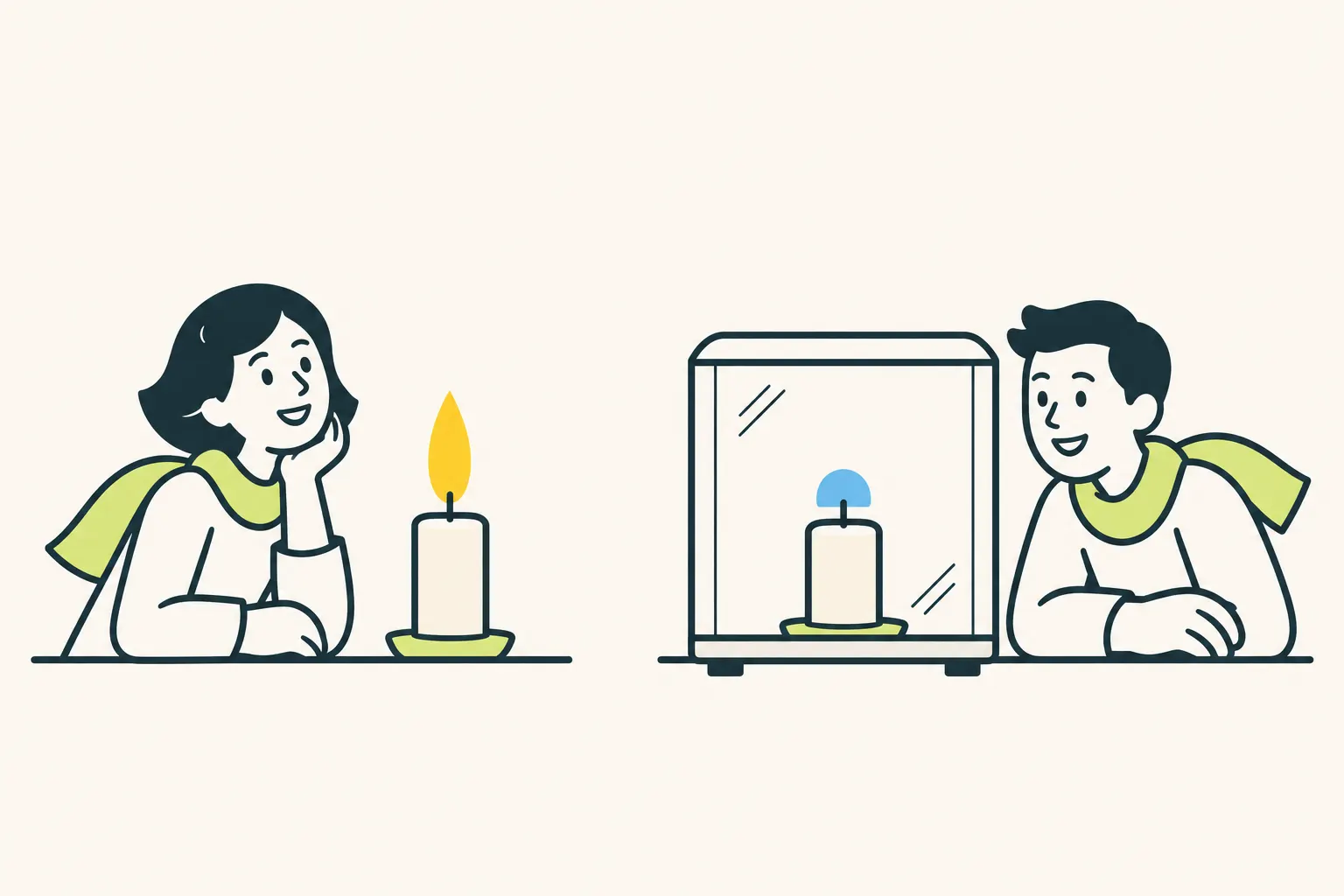
Why do we almost always draw a candle flame as an elongated teardrop? The detail is familiar: a base close to the wick and a tip pointing upwards. Yet that outline is not a compulsory property of fire. In NASA’s comparison, an Earth candle has the usual shape, whereas a microgravity flame looks rounded and blue. Changing the setting reveals an ingredient that is normally hidden from our attention: the movement of the surrounding air. [1]
On Earth, heated air is less dense than its surroundings and rises; cooler air moves in to replace it. NASA identifies that circulation as the reason for the candle’s typical shape. The process is called buoyant convection. Heat is not deciding that it wants to reach the ceiling: gas is moving in the presence of gravity. The tip makes part of this situation visible, something the outline of the wax alone cannot explain. [2]
What changes in microgravity? In their report on USML-1 experiments, published in 1994, researchers describe candles in a quiet environment where diffusion dominated the transport of heat and matter. Following an initial phase, the observed flames became blue and hemispherical. “Hemispherical” is more precise than imagining a perfect ball around the entire candle. These are experimental findings under specified conditions, rather than a rule that every fire in space must look exactly the same. [3]
The unexpected connection therefore runs from a small table object to safety inside spacecraft. NASA studies combustion in experimental facilities that contain flames, seeking to understand ignition and fire spread. Microgravity does not mean a vacuum, and it does not remove the need for the substances involved in combustion. Imposed air flows also matter: comparing quiet candles does not automatically describe a ventilated cabin, every burning material or every possible fire in space. [2][3]
Return to the original drawing. We can compare NASA’s images without lighting anything: where is the luminous region, how elongated is it, and what differences does the caption describe? This is an editorial invitation to observe, rather than a home experiment to reproduce. The Earth candle’s yellow light involves glowing soot particles; the illustrated comparison uses different conditions. Colour alone is not a universal thermometer, and a blue flame is certainly not harmless simply because it is blue. [1][2]
Take this with youNext time you encounter a flame symbol, ask which conditions the drawing takes for granted. A familiar shape can tell us about the environment around an object as well as the object itself: here, air and gravity enter the picture.
One idea, in simple words
A candle flame on Earth often has a tip pointing upwards. Nearby air heats up, becomes less dense and rises. Cooler air moves in to replace it. This movement is called convection and helps shape the flame. In the microgravity experiments described by NASA, that gravity-driven movement is greatly reduced. In a quiet environment, the observed flames could become rounded and blue. This does not mean that every fire in space is identical, or that a candle can burn in a vacuum. Researchers use equipment that contains fire so they can study it safely. We can compare NASA photographs without lighting candles: look at the shape and colour and read which conditions differed. Blue colour does not make a flame safe. [1][2][3]
A little discovery to keep
What did you discover?
Read the sources (3)
- Candle Flame — 1g vs Microgravity NASA · accessed 5 Nov 2026
- Why NASA is studying flames in space NASA Science · accessed 5 Nov 2026
- Candle Flames in Microgravity: USML-1 Results — 1 Year Later H. D. Ross, D. L. Dietrich, J. S. Tien · NASA NTRS · accessed 5 Nov 2026
Original writing and illustration made with AI assistance. Our editorial method
More in Curiosities