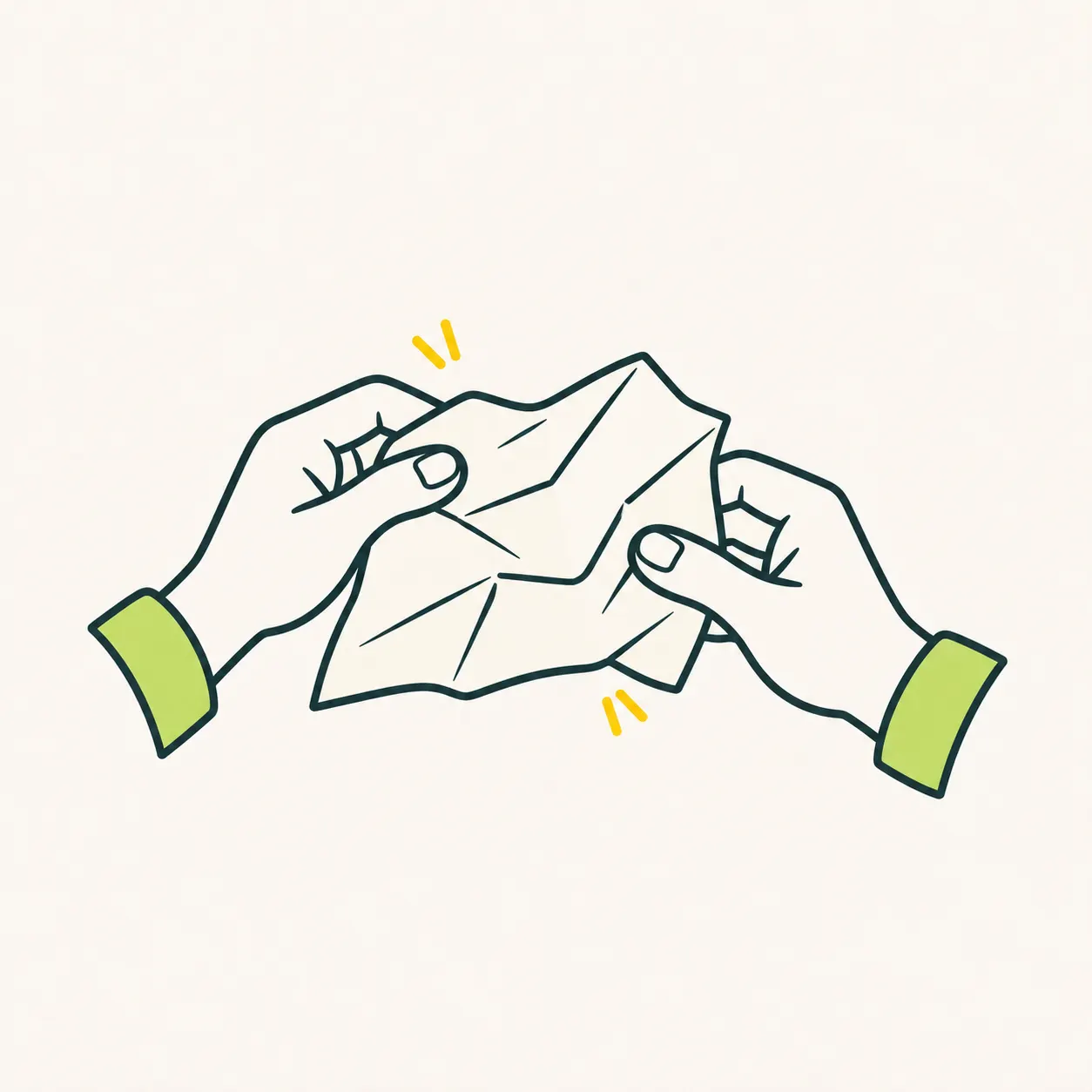
In a quiet room, a sheet heading for the recycling bin suddenly seems to have something to announce. You squeeze gently and it answers with a series of pops. Where do they come from if you are not tearing it? Begin by changing the movement: partly reopen a crumpled sheet and gently move its edges. Cornell’s teaching activity invites us to find a patch that snaps inward and outward. A small part can draw our attention through sound. [2]
The central explanation is an abrupt change of shape: some facets bounded by creases snap and produce sound pulses. Houle and Sethna described this in a 1996 study. They did not identify these pops with the direct formation of new creases. It is therefore useful to distinguish the sound we are looking for from rustling or an actual tear. [1]
The unexpected connection concerns movement and response. Your hands can advance gently while one part of the sheet suddenly changes configuration. Researchers study jump-like responses in very different materials, including magnetic systems. This does not mean that a paper ball is a miniature earthquake, or that their mechanisms are identical. A resemblance suggests questions to investigate; it does not provide a universal explanation by itself. The comparison needs to remain a starting point, rather than a shortcut to certainty. [3]
To look more closely, try this observational variation, not a controlled experiment: rest your elbows on a table, hold a used sheet without completely closing it, and choose one fold to follow with your eyes. Move an edge a little, then stop. Did you see a snap at the same moment as you heard a pop? If you cannot connect them, note that too. The interesting result is not succeeding at all costs. It is turning “it makes a noise” into a more precise question about where and when something happens. [2]
A laboratory must go beyond that impression. In the 1996 work, the researchers recorded sound and separated pulses for analysis; they also reported methodological limitations. Our exercise measures no energies and proves no statistical law. We therefore cannot assign a number of creases to each pop or insist that two sheets must sound identical. Conditions we have not controlled are part of the difference between an observation at home and a research result. Being explicit about that difference preserves the usefulness of both. [1]
Finally, choose just one thing to tell the person beside you: not “I understand everything about paper”, but “I followed this patch and noticed this transition”. This is our editorial invitation to use eyes, hands and ears together, without treating one sensation as proof of everything else. Next time a sheet breaks the silence, allow it a few seconds before recycling it. Its apparent continuity contains movements that do not all proceed at the same pace. A familiar gesture can become a focused act of observation. [2]
Take this with youPartly reopen a used sheet and follow a single snap: separating slow movement from sudden response is already a discovery.
One idea, in simple words
Crumpled paper can make small pops without being torn. Some areas between its creases, called facets, suddenly change from one shape to another. That movement produces sound pulses. Your hands can move slowly while a small part of the sheet snaps quickly. You can look at a partly reopened used sheet and try to follow one area as it changes position. This is an observation exercise, not a laboratory measurement. In 1996, researchers Houle and Sethna recorded and analysed these sounds. The pops should not be confused with every rustle or with paper tearing. Watching one patch while listening at the same time helps you ask a more precise question about what is happening. [1]
A little discovery to keep
What did you discover?
Read the sources (3)
- Acoustic emission from crumpling paper Paul A. Houle e James P. Sethna, Physical Review E 54, 278–283 · accessed 14 Nov 2026
- Paper Crackles: Crackling noise experiment Cornell University, SimScience · accessed 14 Nov 2026
- From Rice Krispies to earthquakes, physicists unravel the mechanics of crackling Cornell Chronicle · accessed 14 Nov 2026
Original writing and illustration made with AI assistance. Our editorial method
More in Curiosities