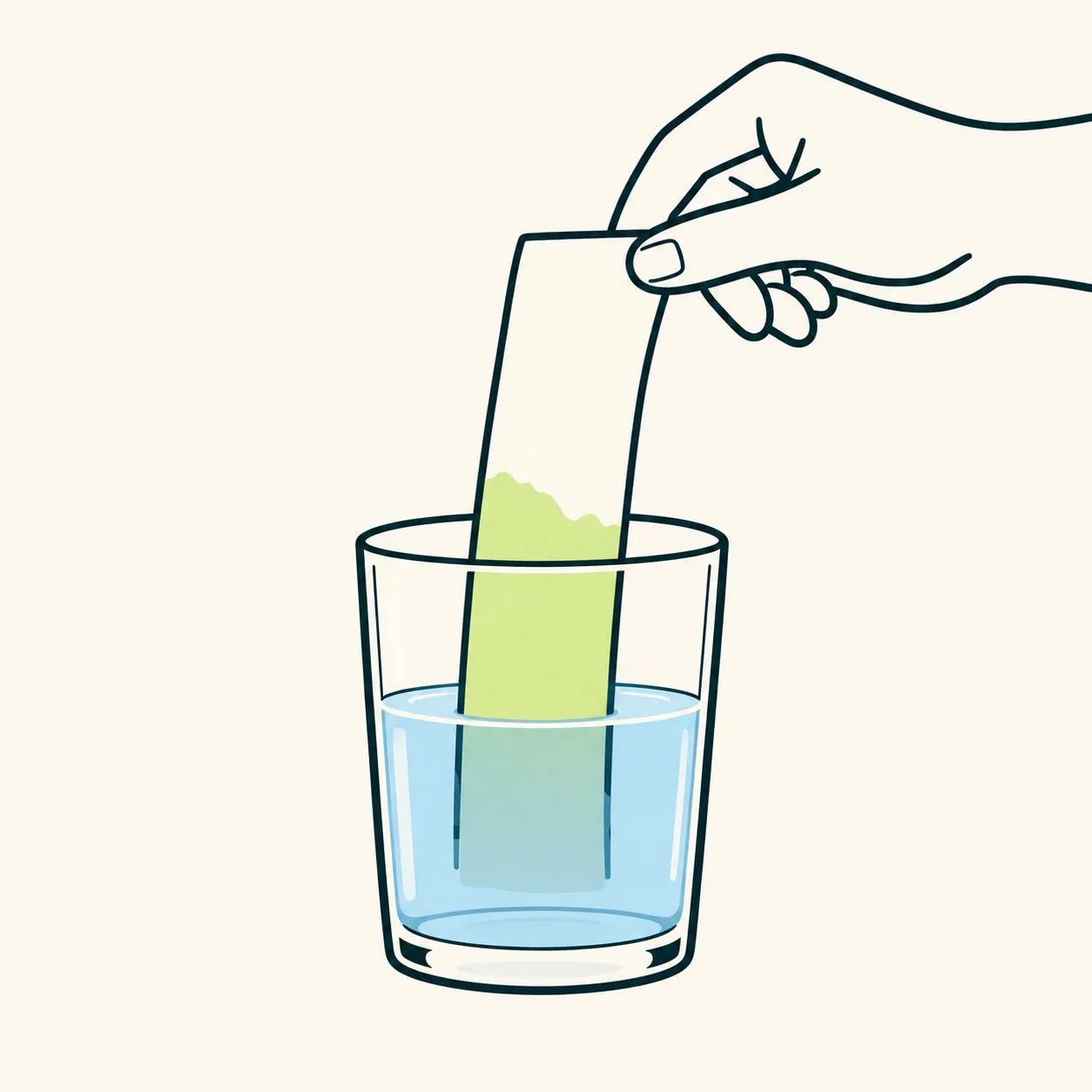
You place the edge of a paper towel against a small puddle and the wet patch spreads. Yet if you hold a strip vertically with its tip in a glass, the wet area can rise above the water level. What pushes it upwards? There is no need to squeeze the paper or tilt the container. This everyday action introduces capillary action: movement through the small spaces in a porous material. [1]
Paper is not a solid wall. It offers a network of fibres and gaps. Water interacts with the surfaces it wets through adhesion, while cohesion holds water molecules together. Surface tension also plays a role in these spaces. The visible result is liquid advancing through the paper. Water has not made a decision, and no hidden pump is at work: these are physical interactions between a liquid, surfaces and air. [1][2]
The surprise is that climbing does not mean gravity has been abolished. Gravity itself helps limit the rise. The USGS compares narrow tubes of different diameters: under the illustrated conditions, narrower tubes show a higher rise. A sheet of paper, however, is not one regular tube. Its fibres create different pathways, so the width of a strip alone cannot tell us an exact height or a universal speed for the moving water. [1]
Now imagine, as an editorial example, two strips of different papers dipped into water by the same small amount. Watching where the wet front reaches is more useful than immediately declaring a winner. Material, structure and conditions need careful comparison. Educational activities from Duke University specifically direct attention to the gaps between fibres. A simple observation can suggest a question; by itself, it cannot certify the quality of every product. [2]
The unexpected connection leads to plants: adhesion, cohesion and small passages matter there too. But a napkin is not a miniature tree. The USGS explains that capillary rise alone can cover only a limited distance; understanding water transport in a plant requires a broader picture. The similarity helps identify some of the forces involved. It does not allow us to explain an entire tree canopy with a glass and a piece of paper. [1]
Next time you dry a table, pause before wiping. Watch where the wet area begins and how its boundary changes; there is no need to add substances or turn the kitchen into a laboratory. The paper reveals something we normally use without noticing. Our illustration highlights the wet section with a conventional colour: it is an editorial representation of the phenomenon, rather than an experimental measurement of how high the water rises. [1][2]
Take this with youWatch the tip of paper dipped in water: compare its wet boundary with the level in the glass, without tilting the container.
One idea, in simple words
A strip of absorbent paper can become wet above the level of the water holding its tip. This happens through capillary action: water moves through small spaces in a material. Paper consists of fibres, with many passages between them. Adhesion is attraction between water and the surfaces it wets. Cohesion is attraction between water molecules. These interactions, together with surface tension, help the liquid advance. Gravity does not disappear: it limits the rise. You can watch the wet boundary while holding a strip still with its tip in a glass. You do not need to squeeze it. The connection with plants is interesting, but capillary action alone does not explain the whole journey of water to the leaves of a tall tree. [1][2]
A little discovery to keep
What did you discover?
Read the sources (2)
- Capillary Action and Water U.S. Geological Survey · Water Science School · accessed 24 Oct 2026
- Capillary Action Activities Worksheet Duke University · TeachEngineering · accessed 24 Oct 2026
Original writing and illustration made with AI assistance. Our editorial method
More in Curiosities