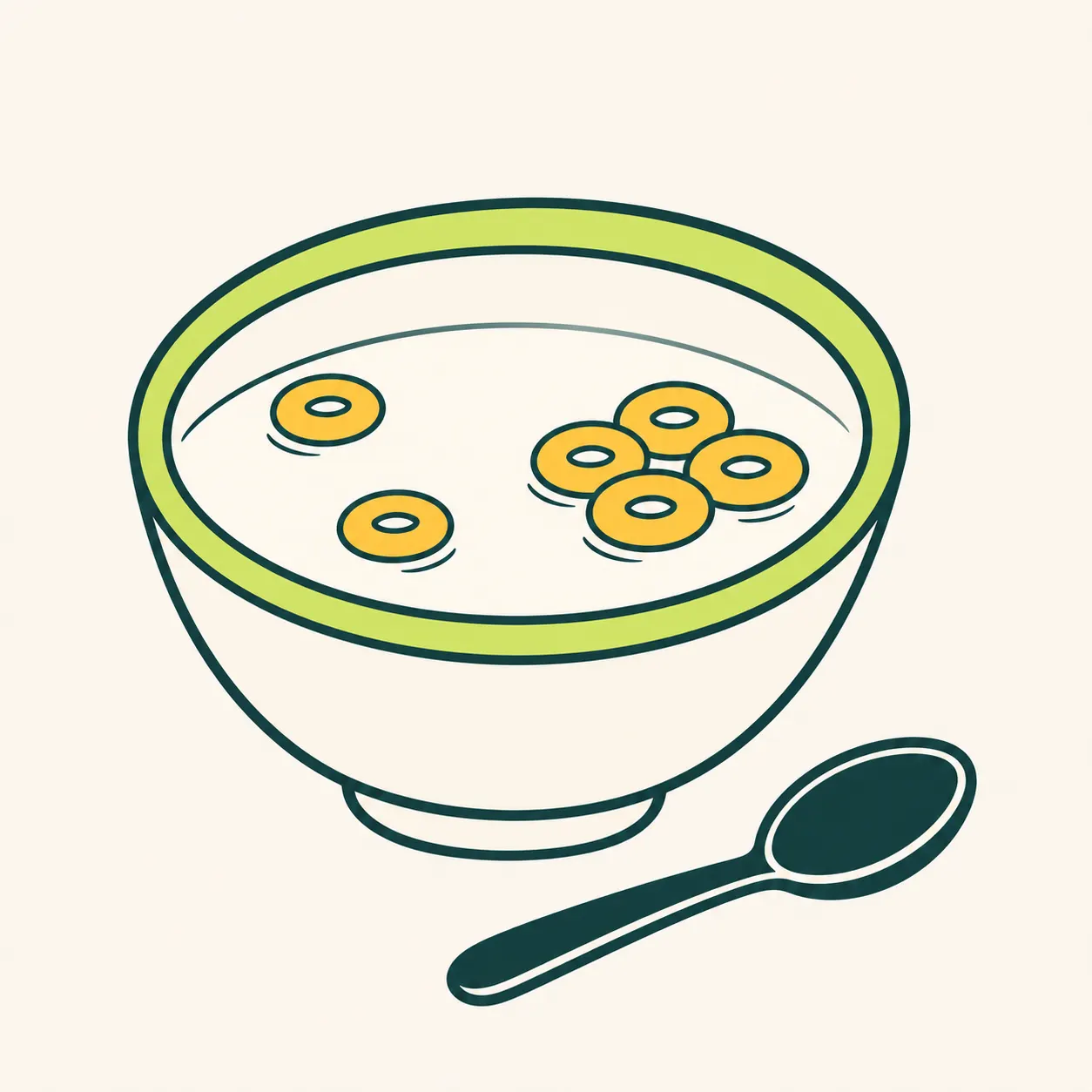
Why do the last cereal pieces in a bowl seem to seek each other out? With only a few pieces left on the milk, you may see them gather together or collect beside the edge. Physics calls this familiar detail the “Cheerios effect”, after a commercial cereal. That particular brand is not required. The interesting question starts before giving breakfast intentions: what part of the system changes when an object floats? [1]
Look at the liquid’s surface. Around floating objects it need not remain flat: it can curve. Gravity, buoyancy and surface tension contribute to the balance. Surface tension is the property by which the boundary between liquid and air tends to resist an increase in its area. Nearby objects respond to these deformations, allowing sideways movement without a thread, a magnet, or somebody pushing the spoon. The surrounding liquid is part of the explanation. [1]
The unexpected connection is with bubbles gathering on water. They are not cereal and do not need to “like” each other: they too interact through the interface. In their 2005 paper, however, Dominic Vella and L. Mahadevan show an essential limitation: different conditions can produce repulsion. We cannot say that everything floating attracts everything else. The object’s vertical support and how it changes the surrounding surface both matter to the outcome. [1]
A bowl does not replace a laboratory. In 2019, Brown University researchers described measurements involving floating disks, using a controlled magnetic force as a tool to measure capillary attraction. This does not make cereal pieces magnets. Closely spaced disks could also tilt, a movement important for describing forces at short distances. Equipment designed to isolate particular effects allows researchers to ask more precise questions than simply watching milk in a breakfast bowl. [2]
Try this editorial observation: after you stop stirring, choose two pieces and watch how their separation changes. Notice the bowl’s edge and the other pieces too. Do not immediately write down “they attract” as the only conclusion: movement viewed from above does not reveal every force involved. Comparing an observation with a physical model is useful precisely when we preserve the distinction between what we see and the explanation we test. [1][2]
The discovery is not a universal law about company, or a scientific metaphor for friendship. It is more concrete: one object can influence another by changing the medium they share. At your next breakfast, look for the surface rather than only the pieces. Milk is not a rigid floor beneath them; its changing shape is part of the problem. A kitchen question becomes interesting when we stop assuming that its answer is obvious. [1]
Take this with youWatch the space between objects: sometimes their relationship passes through a surface that appeared to be merely background.
One idea, in simple words
Have you noticed the last cereal pieces moving together in a bowl? Physicists call this the Cheerios effect. It does not require a particular brand. The pieces float on a surface that can curve around them. Gravity, buoyancy and surface tension contribute to what happens. Buoyancy is the upward support from the liquid. Surface tension helps the liquid resist changes to its surface. One object can therefore influence another through the liquid. Some bubbles gather in groups too. But not all floating objects attract each other: under some conditions they move apart. Scientists study these movements with controlled experiments. At breakfast, you can watch two pieces after you stop stirring. They are neither friends seeking company nor magnets: you are observing a physical phenomenon. [1][2]
A little discovery to keep
What did you discover?
Read the sources (2)
- The “Cheerios effect”, American Journal of Physics 73, 817–825 Dominic Vella and L. Mahadevan · AAPT / University of Oxford · accessed 11 Nov 2026
- Researchers directly measure Cheerios effect forces Brown University · accessed 11 Nov 2026
Original writing and illustration made with AI assistance. Our editorial method
More in Curiosities