Why does a rubber band pull back when we stop stretching it? The question seems to belong in a drawer marked obvious, beside the paper clips. Yet rubber also contains a small story about heat. A University of Colorado demonstration describes slight warming during rapid stretching. If a stretched band is allowed to return to room temperature and then rapidly relaxed, it can instead cool. Shape and temperature are not separate stories. [1]
The key detail lies in the long chains making up the material. In relaxed rubber, they can adopt many coiled arrangements. Pulling restricts those possibilities and tends to orient the chains: the stretched state has lower entropy. Here entropy is a property related to the available microscopic configurations, not the untidiness of a drawer. When tension decreases, the return towards more numerous arrangements contributes to the elastic force. Rubber makes no decisions and does not remember a shape by choice. [1][2]
Consider an editorial comparison, not a complete model: a thread lying on a table can form many curves, whereas holding its ends far apart restricts its possible shapes. Rubber contains very many connected chains, not one loose thread. The example helps distinguish overall length from internal arrangement. Saying that a band stretches does not imply that every bond in it behaves like a tiny metal spring identical to all the others. [1]
The connection has another side in university demonstrations: a strip of rubber already under tension can contract when heated. At Simon Fraser University, this behaviour lifts one end of a rod. This is teaching apparatus, not an experiment to improvise with a heat source. The result is surprising because we often expect warming simply to mean expansion. That expectation alone does not describe every material under every set of conditions. [3][2]
The limits matter: rubber composition, the amount and speed of deformation, temperature and heat exchange affect what is observed. A slight change may be difficult to feel; failing to notice it does not automatically refute the explanation. We do not suggest bringing stretched bands close to the face or heating them at home. The sources describe guided demonstrations; our discovery concerns the connection between a visible gesture and an invisible structure. [1][3]
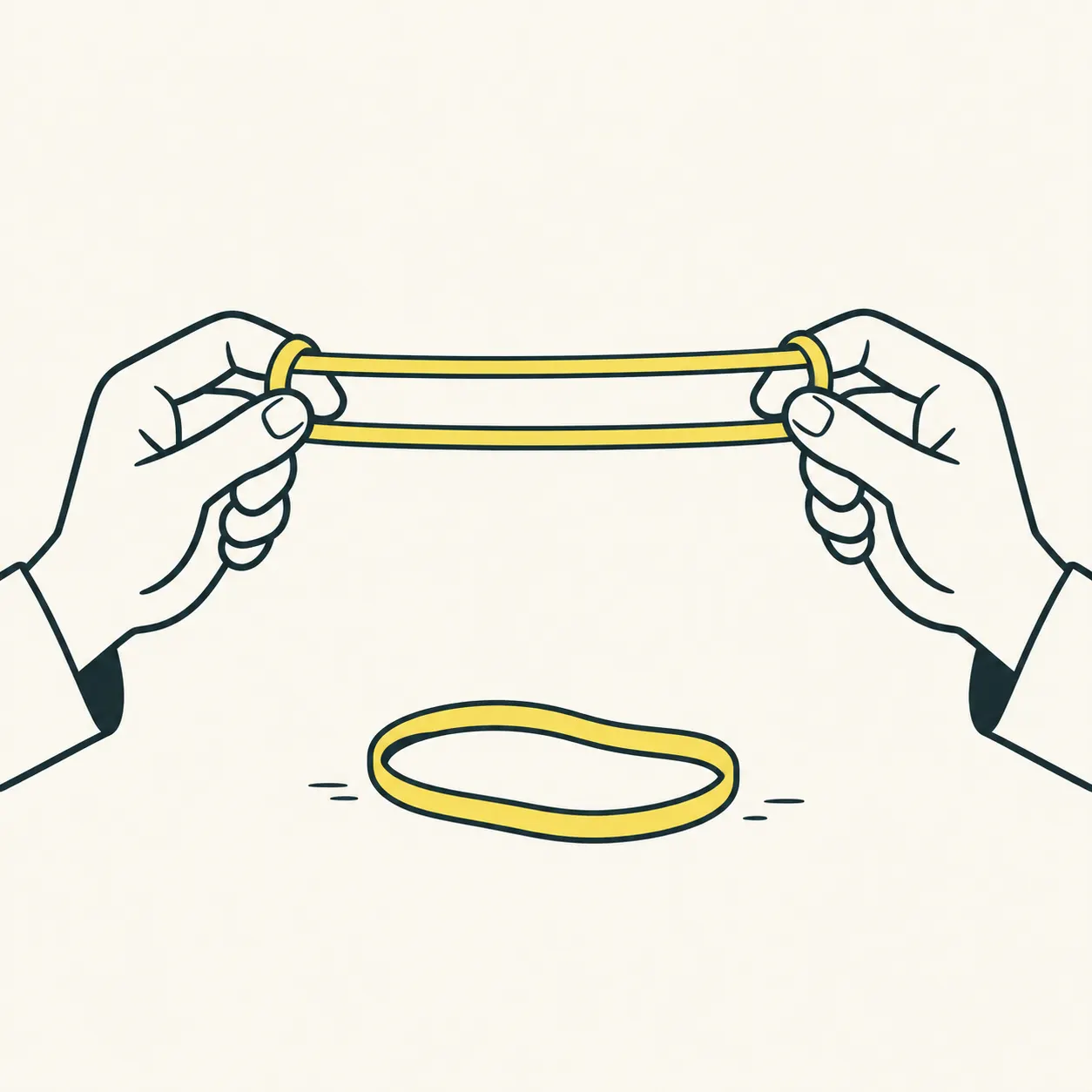
For now, look at an intact band resting on a surface, then gently stretched between your hands away from your face. Observe its shape without pulling it to its limit or letting it snap. What remains unseen is interesting too: the material can rearrange internally, and heat enters the story. The drawer does not contain a miniature power station. It does contain a good reason to stop calling every small object trivial. [1]
Take this with youCompare the relaxed and gently stretched shapes: which change can you observe directly, and which needs a measurement or an explanation?
One idea, in simple words
A rubber band contains long chains of molecules. A molecule is a group of atoms joined together. When rubber is relaxed, its chains can adopt many coiled arrangements. Stretching reduces these possibilities. Returning towards more numerous arrangements helps the band shorten when tension decreases. There is also a connection with heat: in university demonstrations, rapid stretching can warm rubber slightly. Entropy is the name of a property related to the possible microscopic arrangements. It does not simply mean mess. Imagine a thread making many curves on a table: this is only a comparison, not a copy of rubber. To observe a band, you do not need to heat it, bring it near your face or let it snap. [1][2][3]
A little discovery to keep
What did you discover?
Read the sources (3)
- T590: Entropy – Stretching Rubber Bands University of Colorado Boulder · accessed 4 Nov 2026
- Entropy and Rubber Bands University of Illinois Urbana-Champaign · accessed 4 Nov 2026
- 4A30.80 Heat Rubber Bands Simon Fraser University · Department of Physics · accessed 4 Nov 2026
Original writing and illustration made with AI assistance. Our editorial method
More in Curiosities