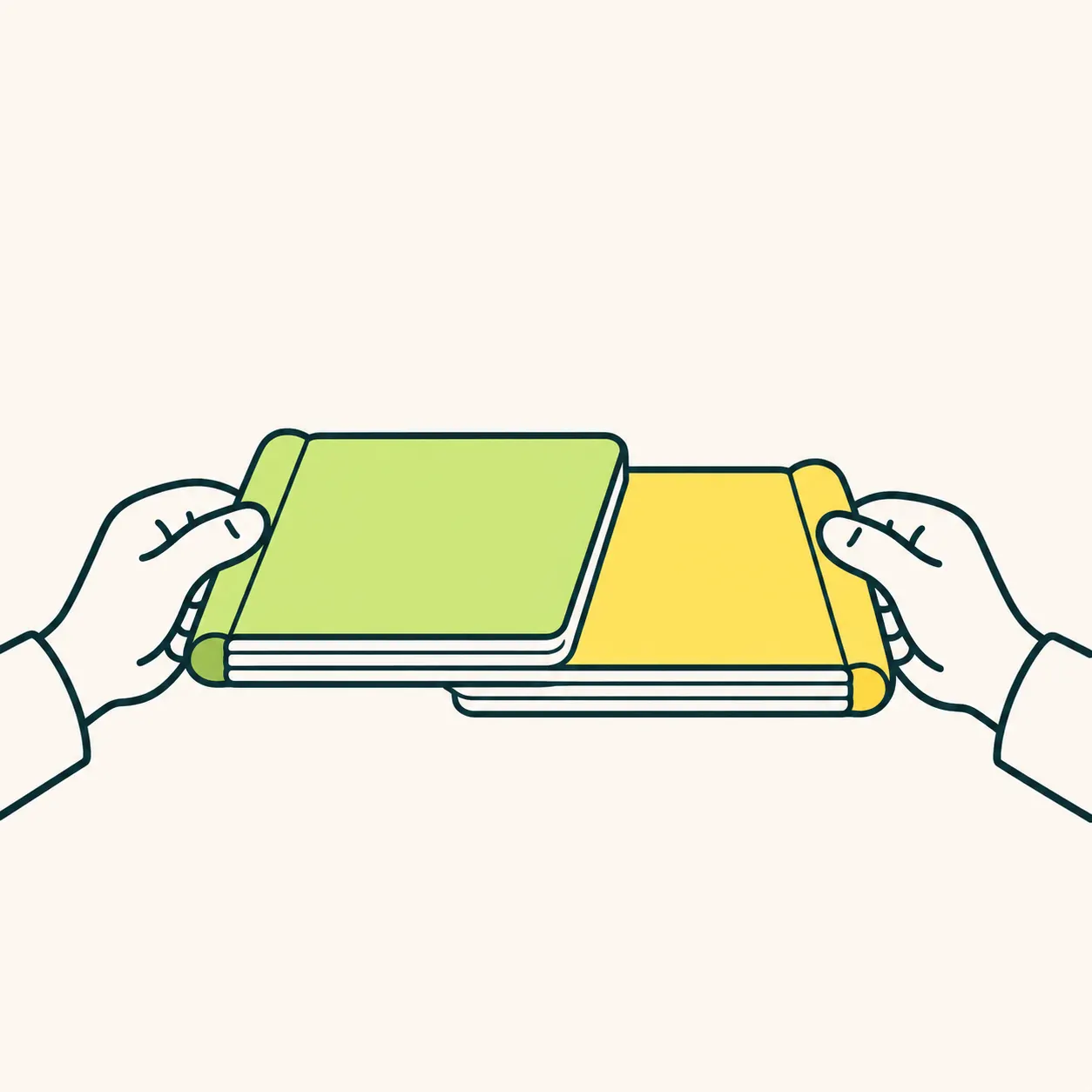
Why can two notebooks with alternating pages become so difficult to pull apart? One sheet slides fairly easily over another; a differently arranged stack can resist surprisingly strongly. The classic demonstration uses telephone directories, but the principle has been studied with controlled booklets. There is no secret glue. The detail worth noticing is the path each page follows from its spine into the overlapping region. [1]
The sheets do not all enter the shared stack perfectly parallel: they make small angles. When the spines are pulled, some of the tension becomes pressure between the pages. That pressure increases the friction resisting their motion. The very action intended to open the system helps tighten it. Paper is not deciding to be stubborn; the result comes from how its contacts are arranged. [1]
The study by Alarcón and colleagues, available in its 2015 version, compares measurements with a geometrical model. The number and thickness of sheets, together with their distance from the contact zone, change the resistance. The model does not simply say that more paper weighs more. It explains amplification: small effects between surfaces grow important through many linked contacts. Arrangement matters alongside the material we are looking at. [1]
A later study by Taub and colleagues, read in its 2020 version, investigates the initial force on the outside pages. The authors identify paper-to-paper adhesion as a plausible source of the amplified force, distinguishing it from weight alone and simple bending. Adhesion here does not mean that somebody glued the notebooks together. It is an interaction between surfaces, whose role is examined through experiments and quantitative comparisons. [2]
The unexpected connection also concerns our behaviour: faced with a resisting object, “pull harder” feels like an obvious suggestion. This model shows why that response may not help. That is our editorial observation about a gesture, not evidence that the same mechanism explains an argument or a difficult decision. A metaphor can be entertaining, but human relationships are not paper stacks with a coefficient of friction. [1][2]
To observe without a contest of strength, look at two small booklets and imagine the alternating paths of their pages; do not use precious books or yank them. Our illustration is conceptual, rather than a technical cross-section of the setup. Next time something sticks, first describe where it touches and in which direction you are moving it. Changing the question may teach more than changing the force. [1]
Take this with youLook for points of contact and their directions: pulling an assembly of pages can increase the very pressure that makes sliding difficult.
One idea, in simple words
Two notebooks can resist strongly if their pages are alternated one by one. No glue needs to be added. The sheets form small angles between their spines and the overlapping section. When we pull, these angles turn some of the pull into pressure between pages. The pressure increases friction, which means resistance to sliding. Our action also helps squeeze the stack. Scientists have measured this effect with booklets prepared in a laboratory. The result depends on the number, thickness and arrangement of the sheets. To understand the idea, imagine and draw the paths of the pages without pulling books or using great force. A drawing helps explain the idea, but it is not a scientific measurement. [1][2]
A little discovery to keep
What did you discover?
Read the sources (2)
- Self-amplification of solid friction in interleaved assemblies, v2 Alarcón et al., arXiv · accessed 10 Nov 2026
- Nonlinear amplification of adhesion forces in interleaved books Taub et al., arXiv · accessed 10 Nov 2026
Original writing and illustration made with AI assistance. Our editorial method
More in Curiosities