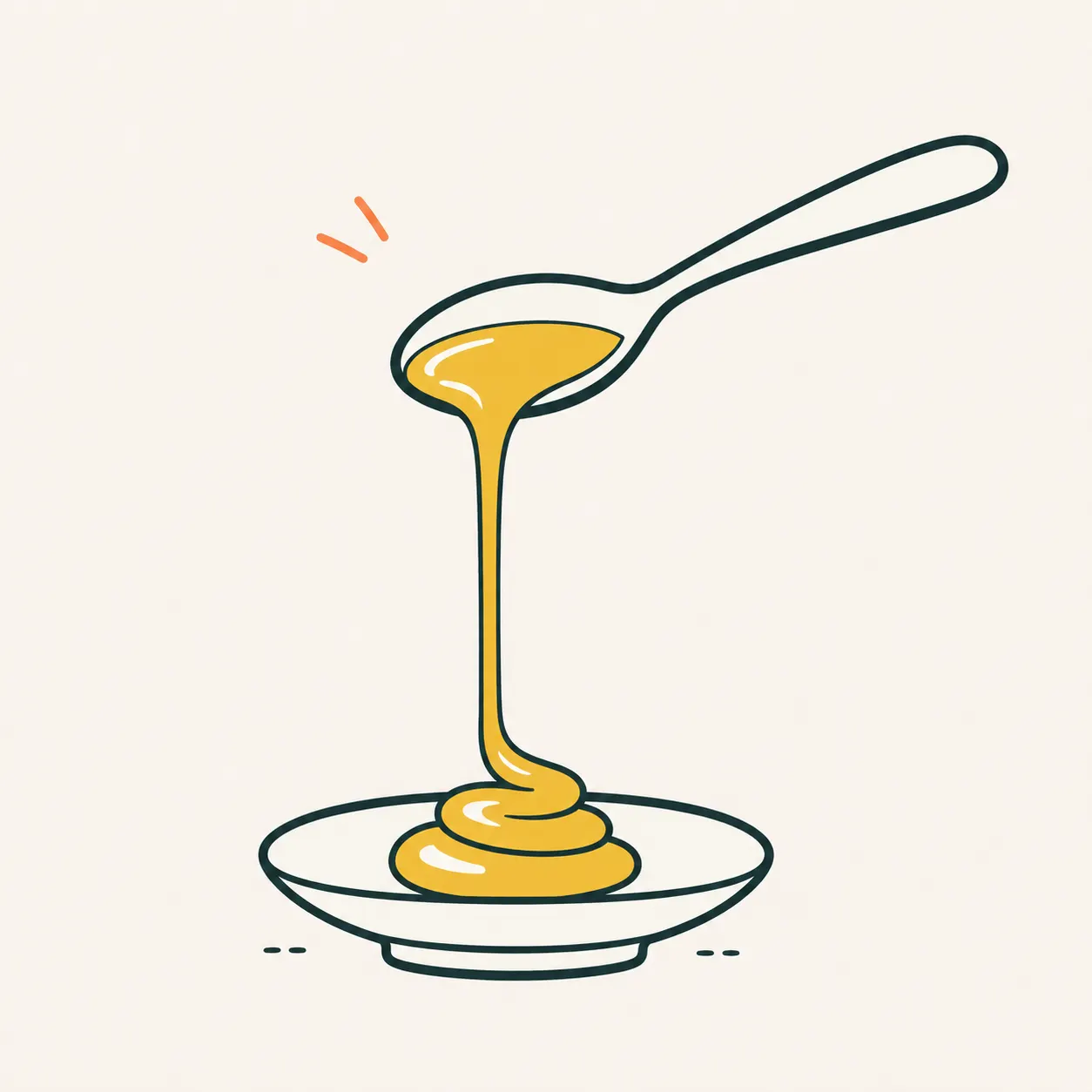
Lift a spoon and let a thread of honey fall onto a small plate. Your hand can remain still, yet near the landing point the thread sometimes begins to turn, laying little coils over one another. Who is moving the pencil? The question starts with an ordinary gesture: we poured something, but it looks as though somebody added a circular movement. This does not happen with every honey at every height, which makes the contact point worth watching. [1][2]
The phenomenon is called liquid rope coiling. When a viscous flow meets a surface or accumulated honey, it slows while more liquid continues to arrive from above. Under suitable conditions, the lower section bends and rotates. Comparing it with a rope piling up is helpful, but remains an analogy: here the material continues to flow and spread. There is no solid rope hidden inside the spoon, and the liquid's changing shape needs its own physical explanation. [1]
Viscosity describes a liquid's resistance to deformation and flow; it is not simply its weight. Fall height, the amount flowing and the liquid's properties contribute to the pattern. A review of kitchen flows discusses these factors and distinguishes stationary, moving and rotating surfaces. We should not treat its examples as a universal recipe: temperature and composition can substantially alter behaviour. Two jars need not make identical spirals for us to be observing the same kind of phenomenon. [2]
An experimental study published in Fluids in 2018 used controlled delivery, high-speed recordings and digital image analysis to measure the dimensions and frequency of coiling. That detail shifts the perspective: what we call “honey making a curl” at the table can become a sequence of measurements. The work distinguishes physical conditions and transitions. It does not establish that every household pour belongs to a regime that we can identify accurately simply by looking at it. [1]
The unexpected connection is between an orderly shape and an instability. In everyday speech, “unstable” can suggest something confused or about to fail. Here it describes how one way of flowing can give way to another with a visible geometry. This is a physical explanation, not a moral lesson about disorder. Our editorial observation is more modest: the label we attach to a movement can sometimes stop us from noticing its individual details. [1][2]
Next time you normally use a little honey, watch the final stretch before the small pile spreads. Keep the plate still and notice whether the thread arrives straight, bends or coils; there is no need to heat anything or use extra honey. If no coils appear, note that too. The pleasure of the question lies in recognising a difference previously overlooked, rather than forcing a jar to perform a circus trick on demand. [2]
Take this with youA still hand can make a moving pattern. Watch where the thread slows: sometimes a shape emerges from the meeting of what arrives with what is already there.
One idea, in simple words
A thread of honey can make little spirals while falling from a stationary spoon. When it reaches the plate or honey already there, it slows down. More honey keeps arriving from above. Under certain conditions, the thread bends and begins to coil. Researchers call this liquid rope coiling. Viscosity is a liquid's resistance to changing shape and flowing. It helps explain the behaviour, together with the height and the amount arriving. Not every honey makes the same pattern. A study published in 2018 measured these movements using high-speed recordings. You can watch the landing point when you normally use honey, without heating it or wasting extra amounts. The spiral does not require your hand to turn. [1][2]
A little discovery to keep
What did you discover?
Read the sources (2)
- Experimental Measurement of Steady and Transient Liquid Coiling with High-Speed Video and Digital Image Processing Frank Austin Mier et al. / Fluids · accessed 12 Nov 2026
- Coiling instability in the kitchen — arXiv:2501.08307v1 Andrzej Herczyński e Maciej Lisicki / arXiv · accessed 12 Nov 2026
Original writing and illustration made with AI assistance. Our editorial method
More in Curiosities