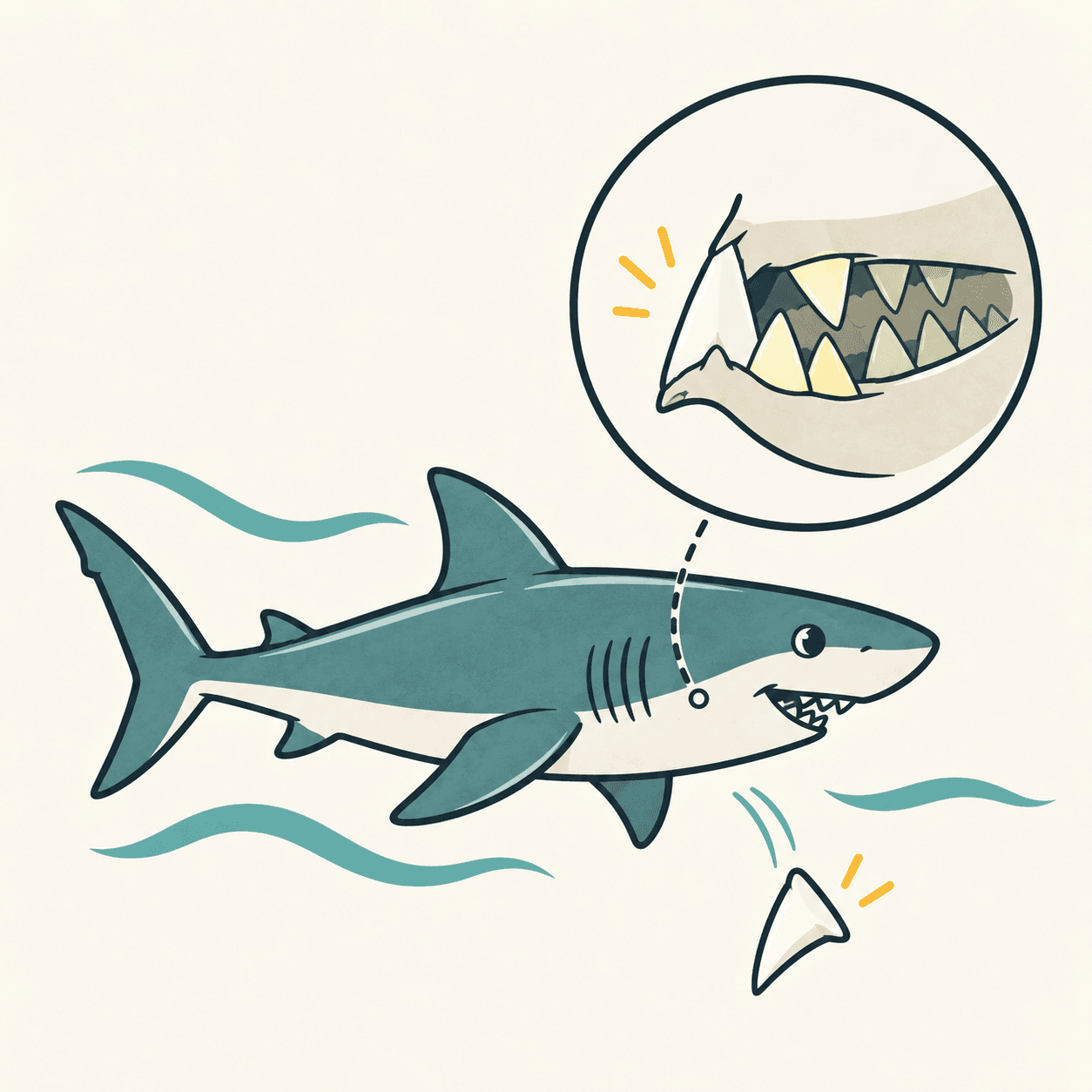
For a shark, losing a tooth does not necessarily end the work of that position in its mouth. The jaws carry several rows of teeth, with replacement continuing throughout life. The Smithsonian describes thousands of teeth being shed and replaced by a single animal. The exact total is not one rule applying equally to every species: the central discovery is renewal, rather than a competition for the most astonishing number. [1]
Imagining one white row, like a human smile, therefore hides part of the system. The teeth we see in use belong to a dentition that keeps renewing itself. In our illustration, the mouth and enlarged detail are editorial diagrams, without a tooth count representing a particular species. Their purpose is to show that looking only at the jaw's edge does not reveal the entire arrangement of the teeth. [1]
Nor do all teeth have the same shape. The Smithsonian distinguishes pointed forms useful for grasping fish from teeth better suited to cutting or crushing. The Florida Museum notes that position in the jaw and stage of life can contribute to differences. An isolated tooth is therefore not an infallible miniature name tag: identifying its species can be difficult even for people who study these remains. [1][2]
Try a model invented by the editors, using paper alone. Place some small triangles in a visible row and others behind them. When you remove a front triangle, move another from the reserve. This activity represents the idea of replacement; it does not reproduce tissue growth, the speed of the process or actual anatomy. It is useful precisely when we explain what it leaves out, instead of treating it as a working jaw. [1]
Shed teeth can tell a much longer story. According to the Florida Museum, rapid burial in sediment helps protect them and, under suitable conditions, can begin their preservation as fossils. Fossils are not a complete inventory of all animals that once lived, however. The museum's introduction explains that the required conditions are uncommon and much organic material disappears instead of becoming part of the fossil record. [2][3]
This suggests an editorial caution when we look at a display full of teeth: many specimens do not automatically mean the same number of sharks. One animal can shed many teeth. Interpreting a find also requires its location, the sediments and comparison with other remains. This reading is not a collecting guide. We can begin with a museum collection and the question that makes a detail interesting, rather than concentrating only on its sharp point. [2]
Take this with youWhen viewing a fossil tooth, separate three things: what you can see, what the museum label documents, and what remains to be understood.
One idea, in simple words
Sharks have several rows of teeth and keep replacing them throughout their lives. When a tooth is lost, other teeth belong to the replacement system. One shark can shed thousands, but we should not imagine the same number for every species. The shape of their teeth can differ too. [1]
Imagine this editorial example: arrange paper triangles in a row, with more triangles behind them. Remove one from the front and move another forward. You have made a model of the idea of replacement, not a real mouth. Some shed teeth survive as fossils: ancient remains preserved in sediments or rocks. Many teeth in a collection therefore do not necessarily mean many different sharks: a single animal can have lost plenty of teeth. [2][3]
A little discovery to keep
What did you discover?
Read the sources (3)
- Sharks · Anatomy, diversity and evolution Smithsonian Ocean · accessed 6 Oct 2026
- Fossil Shark Teeth · morphology and common questions Florida Museum of Natural History · accessed 6 Oct 2026
- Fossil Shark Basics Florida Museum of Natural History · accessed 6 Oct 2026
Original writing and illustration made with AI assistance. Our editorial method
More in Curiosities