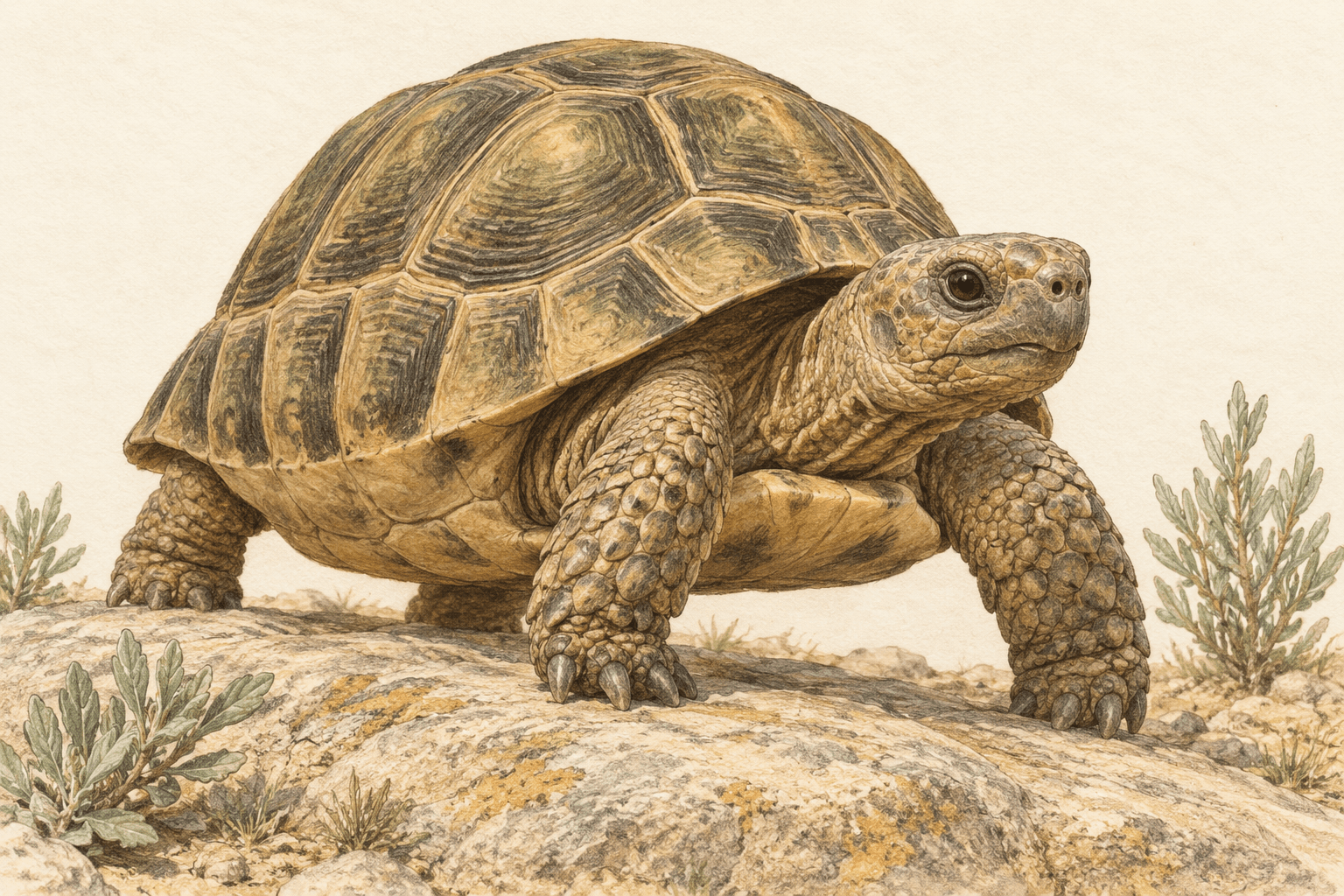
In cartoons, a turtle can take off its shell and stand there, surprised and homeless. Anatomy does not allow that move. San Diego Zoo explains that the shell is permanently attached to the spine and rib cage. Its upper part is called the carapace and its lower part the plastron. It is not a container worn by an otherwise complete animal: it belongs to the construction of the body itself. [1]
The evolutionary history makes that structure more interesting. In 2018, the Field Museum presented Eorhynchochelys sinensis, a fossil reptile about 228 million years old with a beak and expanded ribs, but without the shell seen in today’s turtles. The museum used it to explain mosaic evolution: different traits need not appear together or follow a single orderly staircase. This is historical research, not a discovery announced today. [2]
Living species also resist a single picture. NOAA describes the leatherback’s tough skin over small, interlocking dermal bones, with seven ridges running along its back. It lacks the scales and hard shell typical of other sea turtles. That difference does not make the shell a removable accessory: it shows how the same broad anatomical history can include very different constructions, surfaces and shapes in living animals. [3]
Try an editorial example with two drawings, without handling an animal. In the first, put a shell beside a turtle; in the second, show ribs and back connected to the upper shell. The first communicates the idea of clothing. The second tries to communicate an anatomical relationship. Neither replaces a scientific diagram, but comparing them helps locate the exact point where a familiar metaphor stops explaining what is really there. [1]
We can then add a question to the page: are we looking at the outside, the inside or the history of the structure? A photograph of the back, a skeletal model and a fossil answer different questions. Our editorial view is that curiosity works best when we separate those questions and then connect them. We need not correct every cartoon, only recognise when we are enjoying a joke and when we want to understand a living body. [2]
Take this with youTry replacing “the turtle’s house” with “part of its body”. The second expression is less like a fairy tale, but opens a much more surprising anatomical story.
One idea, in simple words
A turtle’s shell is not a backpack. It is connected to the spine and ribs, so it belongs to the body. A turtle cannot leave it and look for another one. The upper part is called the carapace; the lower part is the plastron. These names describe different parts of the same structure. Cartoons may show something else, but that is make-believe. [1]
Here is an editorial example: compare a drawing of a hanging coat with a turtle anatomy diagram. One shows a separate object; the other shows connected body parts. Not all turtles have the same covering: the leatherback has tough skin. Understanding an animal means noticing both what it shares with others and what makes its structure different. [3]
A little discovery to keep
What did you discover?
Read the sources (3)
- Turtle and Tortoise San Diego Zoo Wildlife Alliance · accessed 7 Oct 2026
- 228-million-year-old fossil turtle didn’t have a shell yet, but had the first toothless turtle beak Field Museum · accessed 7 Oct 2026
- Leatherback Turtle · Appearance NOAA Fisheries · accessed 7 Oct 2026
Original writing and illustration made with AI assistance. Our editorial method
More in Curiosities