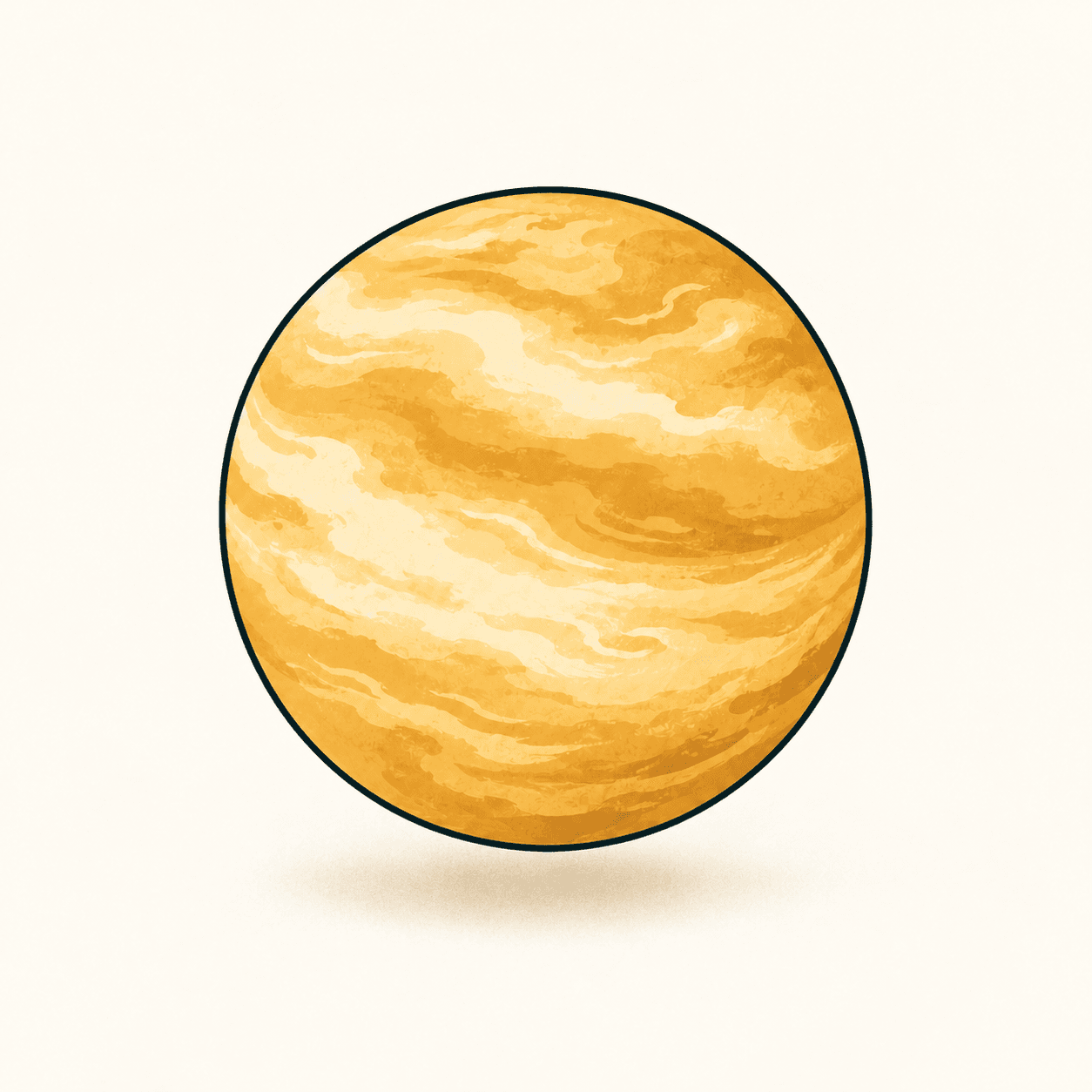
Venus rotates once on its axis in about 243 Earth days, but completes an orbit around the Sun in approximately 225. The comparison works when we define our measurements: rotation relative to the stars and revolution around the Sun. NASA’s fact sheet lists them separately. A planet can therefore complete its orbital journey before finishing a turn on its own axis: these are two different kinds of motion. [1][2]
This produces the surprising statement that a day on Venus lasts longer than a year. It needs a qualification: those 243 days describe the rotation period, known as a sidereal day. The interval between successive sunrises is different, approximately 117 Earth days. NASA’s 2013 planetary information sheet gives both. Automatically replacing rotation with sunrise would erase the most interesting distinction and turn an accurate comparison into an incorrect explanation. [2]
The reason is that the planet moves along its orbit while rotating. Venus also rotates in a retrograde direction compared with Earth: in the usual model, the Sun would rise in the west and set in the east. To find the Sun in the same direction again, we cannot simply ask when the planet completes a turn relative to the stars. We have to consider both movements and their directions together. [2]
An editorial example helps separate the questions. Put a cup in the middle of a table as the Sun and move a small marked object around it. You can check when the mark faces the same wall again and when it faces the cup again. This model does not reproduce Venus’s dimensions, distances or speeds. It simply shows that a distant reference and the centre of an orbit pose different questions. [1]
Even the 243-day value is not an unchanging clock carved in stone. A study by Margot and colleagues, using radar observations from 2006–2020, measured variations in rotation period and an average of about 243.0226 Earth days. This does not invalidate the rounded comparison: it clarifies its precision. The simpler number remains useful for understanding; the more detailed value belongs with the measurements, time interval and uncertainties that accompany it. [3]
To read an astronomical table carefully, put a name beside each number: rotation, orbit, solar day. The educational StarChild table already separates the first two. In our editorial illustration, the globe is a visual interpretation rather than a quantitative model of the movements. Before asking whether a duration is long or short, it is worth asking which movement defines it and which reference is being used to measure its completion. [4]
Take this with youA curiosity becomes more interesting when its definition survives: on Venus, rotation lasts longer than the year, while the interval between sunrises is about 117 Earth days.
One idea, in simple words
Venus moves in two ways. It spins on its axis and travels around the Sun. One rotation takes about 243 Earth days. A complete journey around the Sun, or one year, takes about 225. These are different movements, so they can take different amounts of time. Venus’s rotation takes longer than its year does. [1][2]
However, one detail matters. The time between successive sunrises is not the same as a turn relative to the stars: it takes about 117 Earth days. While rotating, Venus also travels along its orbit and spins in the opposite direction to Earth. We therefore need to explain what day means. Imagine asking when you face the same wall again and when you face the centre of your route again. These references differ. [1][2]
A little discovery to keep
What did you discover?
Read the sources (4)
- Venus Fact Sheet · orbital parameters NASA Goddard Space Flight Center · accessed 9 Oct 2026
- Venus · planetary lithograph, revised July 2013 NASA · accessed 9 Oct 2026
- Spin state and moment of inertia of Venus · full manuscript Jean-Luc Margot and colleagues · arXiv / Nature Astronomy · accessed 9 Oct 2026
- Facts about Venus NASA Goddard · StarChild · accessed 9 Oct 2026
Original writing and illustration made with AI assistance. Our editorial method
More in Curiosities