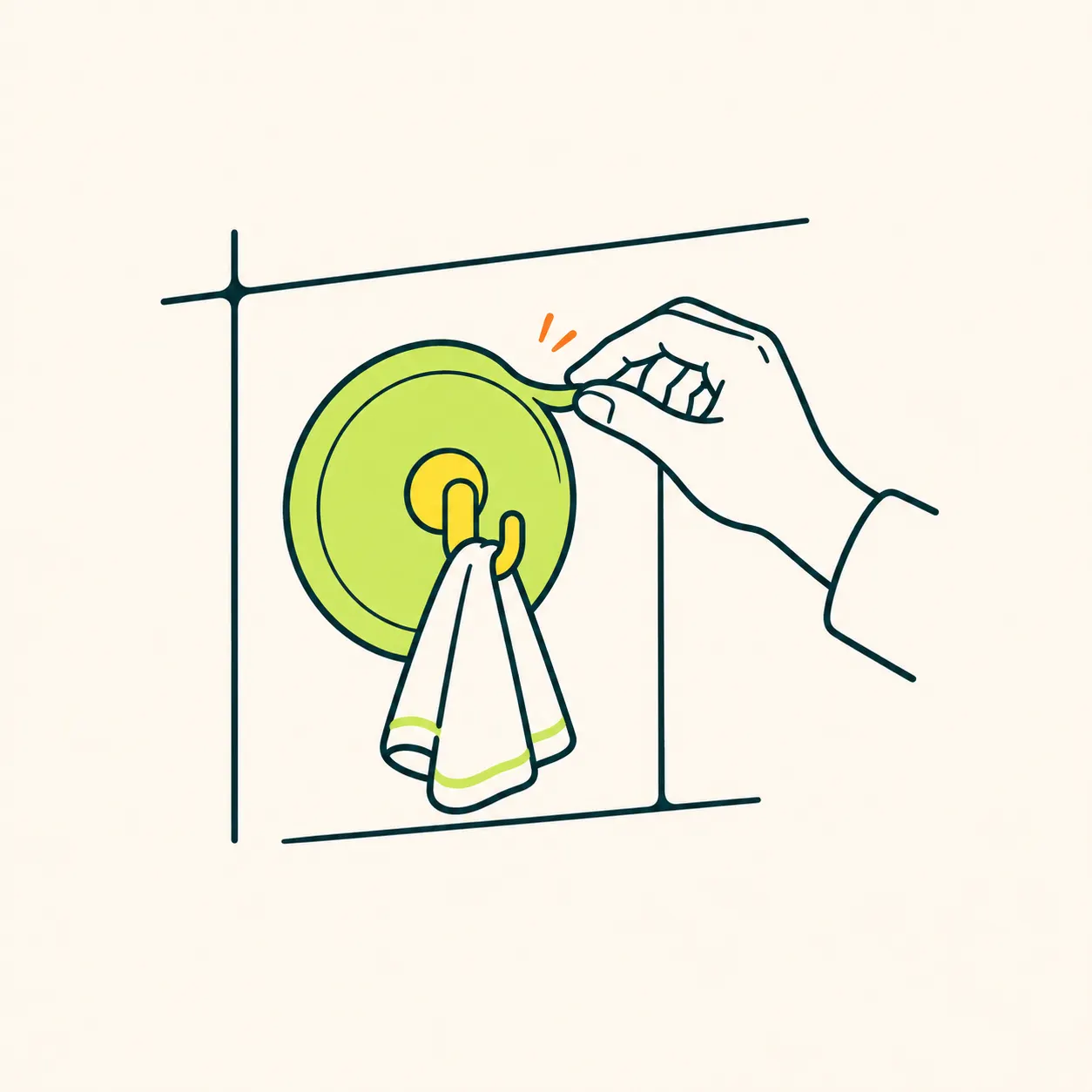
The hook resists when we pull it, then releases as soon as we lift one edge of its suction cup. What changed with such a small movement? Purdue University’s teaching demonstration begins with this contrast between pulling centrally and opening the rim. The everyday question is not about invisible glue. It asks us to notice the space enclosed between a smooth surface and a flexible cup, and particularly how that space stays sealed. [1]
Pressing the cup pushes some air out. If its rim maintains a seal, pressure beneath it can remain lower than outside: the surrounding air presses it against the surface. Lifting an edge lets air back in and reduces that difference. UCAR demonstrates this principle with two cups pressed together. A perfect vacuum is unnecessary, and this does not mean that air presses only from above: pressure acts in every direction around the object. [1][2]
An unexpected connection takes us to a fish: the Northern clingfish, Gobiesox maeandricus. Its belly disc can attach to wet, rough and slippery surfaces. The University of Washington describes a flexible rim bearing microscopic structures that increase friction and help it contact uneven surfaces. The problem posed by our bathroom hook reappears in a different environment: how can an effective contact be maintained when the surface is not a perfectly smooth tile? [3]
In 2019 Petra Ditsche and Adam Summers presented prototypes inspired by this disc, combining a more rigid support, soft components and features of the margin. They tested different surfaces by pulling until attachment failed. This is dated experimental research, not an announcement of a new product available today. It does not show that every adhering animal uses the same system, or that copying a shape reproduces its performance: materials, friction and deformation matter here. [3]
Return to the bathroom with our own observation exercise: without hanging any weights, examine the rim of a small suction cup on a smooth, sturdy surface. Compare a central pull with gently lifting one edge. You are not measuring its load capacity and need not reproduce laboratory loads. You are changing one precise condition, the seal. It offers a small lesson in attention: we often stare at an object’s centre while a detail governing its behaviour lies around its edge. [1][2]
Take this with youNext time a suction cup releases, look first at the rim and the surface. Separate observation from explanation: detachment is visible; pressure and sealing are parts of the model we use to interpret it.
One idea, in simple words
A suction cup is a small flexible cup. Pressing it against a smooth surface pushes some air out. If the rim stays sealed, pressure underneath can be lower than outside. The surrounding air then helps hold it against the surface. Lifting an edge lets air return and reduces that difference. This is not glue. A fish called the Northern clingfish has a belly disc that also attaches to wet, rough surfaces. Tiny structures around its rim help contact and friction. In 2019 researchers made prototypes inspired by this system. That does not make our bathroom hook identical to a fish. We can examine a small cup without hanging weights: pay attention to its edge as well as its centre. [1][2][3]
A little discovery to keep
What did you discover?
Read the sources (3)
- 2A-01 Suction Cups Purdue University, Department of Physics and Astronomy · accessed 6 Nov 2026
- Plunger Pull UCAR Center for Science Education · accessed 6 Nov 2026
- Inspired by Northern clingfish, researchers make a better suction cup University of Washington · accessed 6 Nov 2026
Original writing and illustration made with AI assistance. Our editorial method
More in Curiosities