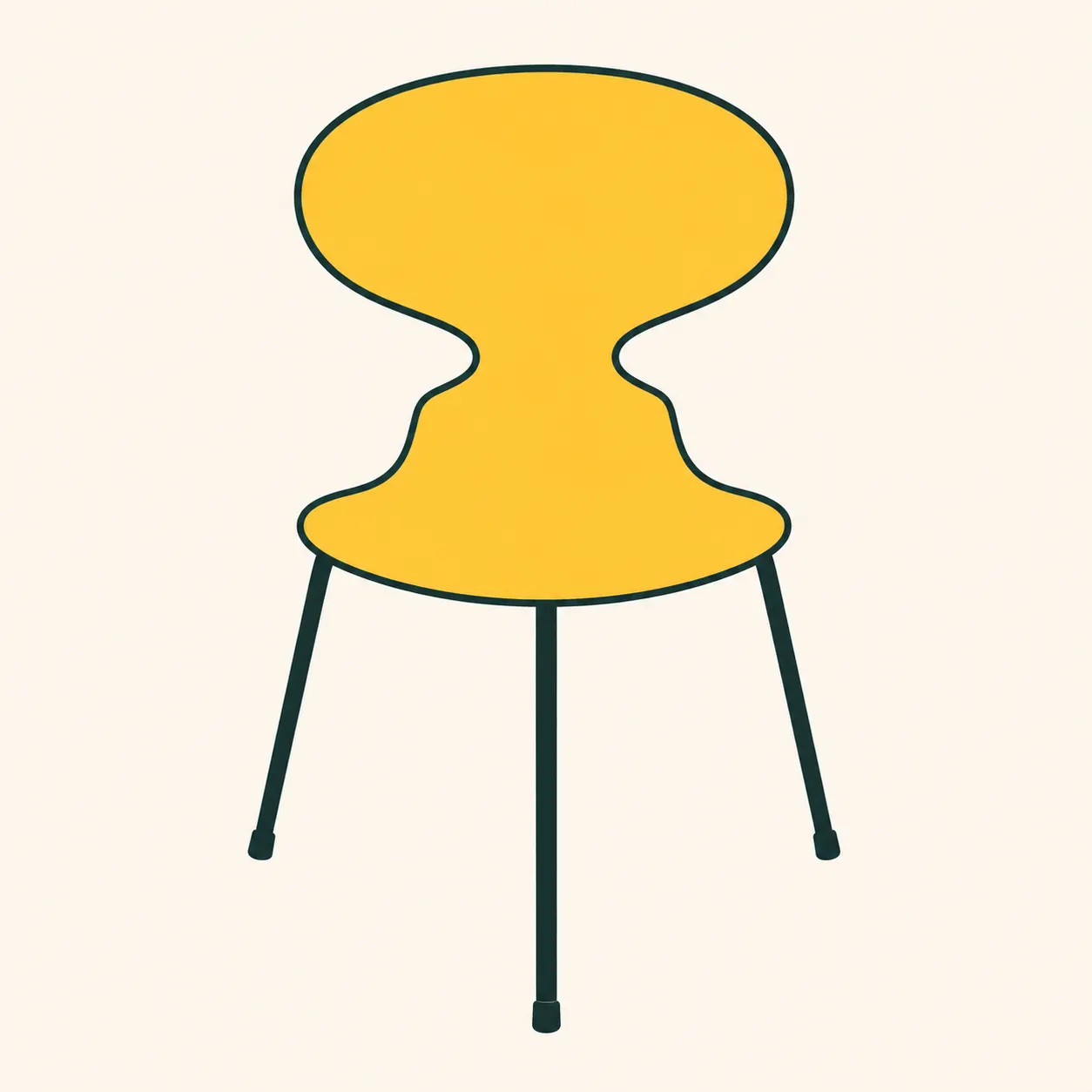
A chair can have a narrow waist without trying to imitate a body. Arne Jacobsen’s Ant, introduced in 1952, is recognisable partly because of the slender connection between its back and seat. Its name invites comparison with an insect, but stopping there misses the design detail. The official archive links this profile to bending plywood: the narrowest area coincides with the place where the curvature posed a particular challenge. The outline has a job to do as well as a name to suggest. [1]
Seat and back are formed from a single moulded plywood shell. Its double curvature contributes strength, while the metal structure supports the whole. The Powerhouse museum holds a three-legged example manufactured in 1987 to a design from 1952: the date of an idea and the production date are different things. A photograph alone cannot tell us when the particular object was manufactured, even when its design has become familiar. Looking closely includes checking the label as well as the shape. [3][2]
The Ant was used in the Novo canteen in Frederiksberg. The task involved more than the appearance of one chair: weight, space and stacking several examples mattered too. The archive records Jacobsen using clay to develop the three-dimensional form. Clay is not the material of the finished chair; it was one of his design tools. That distinction helps reveal the work behind an object which, once successful, can seem almost inevitable, as though nobody ever had to work out its difficult parts. [1][2]
Now imagine, as an editorial exercise, a room being cleared after a meeting. A chair that is attractive but awkward to move poses a different problem from one that stacks quickly. We are not awarding universal comfort scores or claiming three legs are always preferable to four. We are changing the question: what use was intended, which constraints needed resolving, and which compromises remained? A useful comparison begins with circumstances, rather than an urge to announce a winner before considering what the chairs must do. [2][3]
To examine the design, follow the shell’s edge with your eyes without dismantling anything. Where does it widen, narrow or change direction? Then notice how the legs meet the seat. This is a suggestion for visual reading, not a structural test. The small discovery is that a memorable shape can hold a practical negotiation between material, manufacturing and habits. Even a designer Ant, before becoming an icon, needs a convincing way to occupy a room and take part in ordinary life. [1][2]
Take this with youBefore considering the resemblance, examine the construction. The Ant’s narrow waist tells a story about plywood, not merely a well-chosen name.
One idea, in simple words
Arne Jacobsen designed the Ant chair in 1952. The chair has a narrow section between its seat and back. Those two parts form one shell of plywood, a material made from thin layers of wood. Its shape helps the plywood bend and gives the chair strength. One example in the Powerhouse museum has three metal legs. It was manufactured in 1987, although the design is older. These are two different dates. Imagine clearing a canteen: chairs that can be stacked need less storage space. This example helps explain a practical design requirement. We should therefore do more than ask whether a chair resembles an animal. Looking at how its parts are made helps us understand why it has that shape. [1][3][2]
A little discovery to keep
What did you discover?
Read the sources (3)
- The Ant Arne Jacobsen Design · accessed 9 Nov 2026
- The original shell chair Arne Jacobsen Design · accessed 9 Nov 2026
- Ant chair, object 87/810 Powerhouse Collection · accessed 9 Nov 2026
Original writing and illustration made with AI assistance. Our editorial method
More in Design