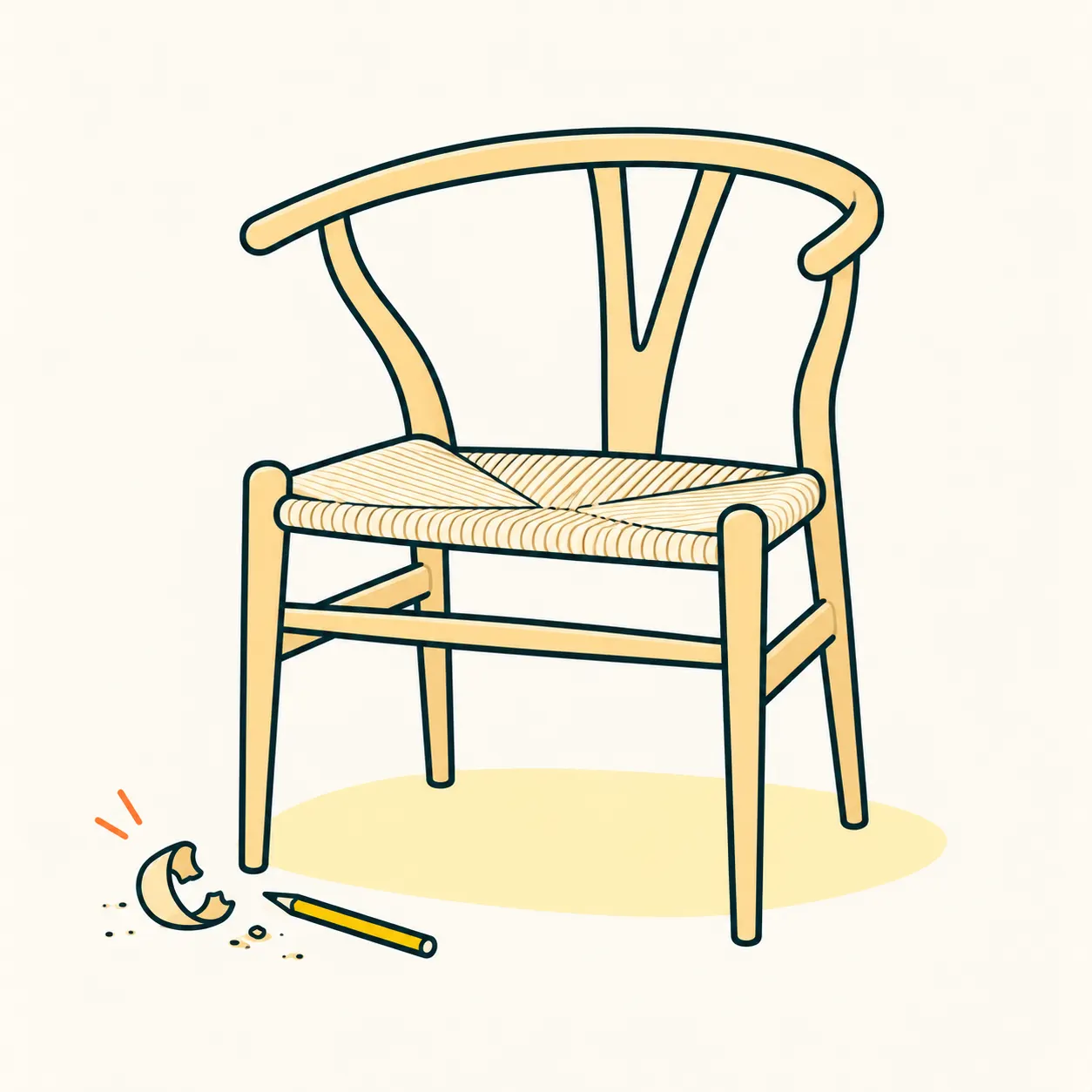
Look at it from behind and a Y immediately stands out. On the CH24, known as the Wishbone Chair, this shape is not a monogram added at the end: it belongs to the backrest. Hans J. Wegner designed it for Carl Hansen & Søn in 1949; the manufacturer dates its introduction to 1950. These are separate moments, design and production. They are easily confused when an object reaches us with a nickname more familiar than its catalogue number. [1]
Wegner combined the backrest and armrests in a single upper piece, bent using steam. The Y supports it and helps provide support for the sitter’s back. The empty spaces beside it make the relationship easy to see: a continuous curve above, a branching element below. You do not need woodworking knowledge to notice where parts meet and where space remains. The detail we recognise as a visual identity also participates in construction. It is more than a signature demanding attention. [1]
Its history did not begin in an empty room. The Vitra Design Museum connects several Wegner chairs with historical Chinese models and describes how his understanding of wood informed his reinterpretations. Designmuseum Danmark presents the Danish chair as an international phenomenon, rooted in other periods and cultures. This offers a more interesting perspective than a vague Scandinavian label: a design can become recognisable without having no ancestors. Influences do not erase the designer’s decisions about what to retain and change. [2][3]
The seat also contains work that the silhouette does not reveal. According to Carl Hansen & Søn, an experienced craftsperson needs roughly an hour to weave it by hand, using approximately 120 metres of paper cord. These are the manufacturer’s figures, not measurements made by our editorial team. They nevertheless help separate an essential appearance from its process: few visible lines do not necessarily mean few actions. Paper made into woven cord should not be pictured as a loose sheet placed across the frame. [1]
Here is an editorial exercise: observe an ordinary chair from the front, then from the back. Which part seems to change its role? A crosspiece may look decorative until we notice its connections. This exercise does not certify strength or comfort, neither of which can be established from a photograph. It separates two questions: what makes this object recognisable, and what holds its parts together? In the Wishbone Chair, the Y helps us ask both questions at the same time. [3][1]
Take this with youFollow a curve with your eyes and find its supports. A simple shape can contain many stages without displaying every one of them.
One idea, in simple words
Hans J. Wegner designed the Wishbone Chair in 1949. Production began in 1950. A Y-shaped part can be seen at the back. It is not a letter added as decoration: it supports the curved piece that joins the backrest and armrests. The seat is woven from paper cord. The manufacturer says a skilled craftsperson takes about an hour to make it. An object with only a few lines can therefore require many actions. Try looking at a chair at home from the front and then from behind. Where do its parts meet? This is an observation exercise, not a test of how much weight the chair can carry. Nothing needs taking apart. [1]
A little discovery to keep
What did you discover?
Read the sources (3)
- CH24 | Wishbone Chair Carl Hansen & Søn · accessed 28 Oct 2026
- Hans J. Wegner: Designing Danish Modern — exhibition 2 March–3 June 2018 Vitra Design Museum · accessed 28 Oct 2026
- The Danish Chair: An International Affair — past exhibition Designmuseum Danmark · accessed 28 Oct 2026
Original writing and illustration made with AI assistance. Our editorial method
More in Design