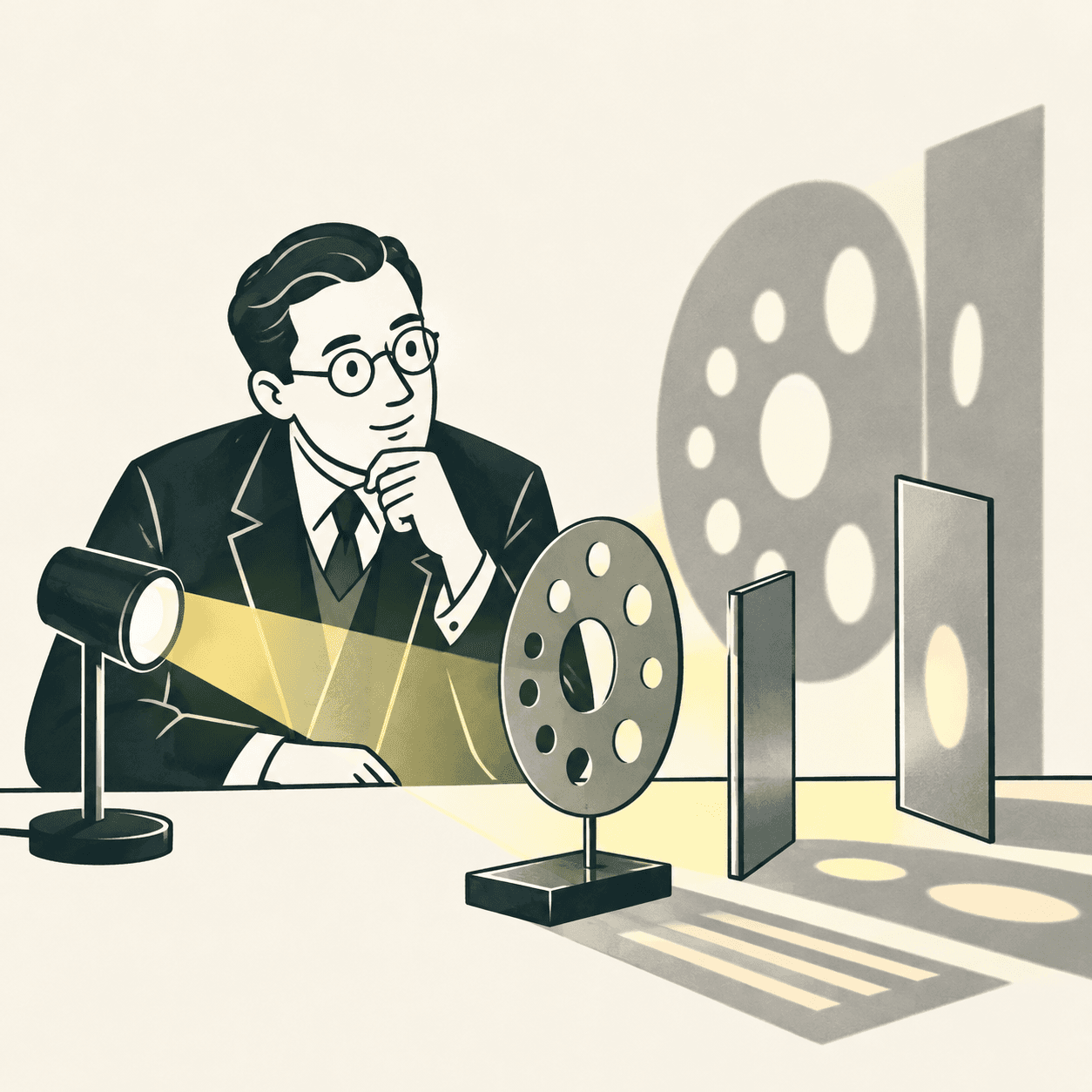
A sculpture can also be a machine that makes images. László Moholy-Nagy’s Light Prop for an Electric Stage, presented in 1930, combines moving parts with light: discs and perforated surfaces change the patterns projected around the object. The interesting question is not simply what shape the machine has, but what happens when it operates. This is a design to observe through time as well as across space. [1]
The artist and designer worked at the Bauhaus from 1923 to 1928, leading its preliminary course and metal workshop. His practice crossed typography, photography, film and exhibition design. Bringing these fields together helps us approach his work without assigning him a single occupation: a page, a room and a screen offered different opportunities to investigate the relationship between materials and the way people perceive them. [2]
A photograph held by the Metropolitan Museum shows two technicians installing the Light Prop. Its catalogue describes collaboration with engineering and metalworking expertise, and the film the artist made in 1930. This detail challenges the picture of a genius doing everything alone. We can admire the idea while recognising that a working device also needs construction, adjustment and people who can translate an intention into actual movement. [3]
In his photograms, Moholy-Nagy explored pictures made without a camera, working directly with objects, light and sensitive paper. The Foundation describes a progression from early experiments towards closer control in the darkroom. Here light does more than reveal something already finished: it helps bring the image into existence. However, not all his works are photograms or machines; each process must be recognised on its own terms. [4]
Space Modulator L3, from 1936, provides a useful example: MoMA identifies its materials as oil on perforated zinc and board, with glass-headed pins. It is not the large motorised device of 1930, although the title suggests a connection. Reading the materials and date prevents us from confusing different works. A familiar title is a clue for further investigation, rather than a sufficient technical description of the object before us. [5]
Try an exercise devised by our editors: watch the shadow of an ordinary colander under a lamp and slowly change the object’s position. Look first at the metal, then at the wall. You are neither reconstructing a Moholy-Nagy artwork nor repeating his photographic technique; you are distinguishing an object from the effect it produces. The comparison makes our opening question tangible: where does a form end if what it does continues elsewhere? [1]
Take this with youTo understand a design, observe its physical body and the experience it makes possible. Then check title, date and materials: precision gives curiosity more to work with.
One idea, in simple words
László Moholy-Nagy was an artist and designer. His Light Prop, made in 1930, uses moving parts and a beam of light. Its surfaces create changing shadows and reflections. To understand it, you need to watch the images around it as well as the metal object. It is called a kinetic sculpture because movement is part of the work. [1]
Imagine an example invented by our editors: shine a lamp through a colander and move it in front of a wall. The shadow changes although the object stays the same. This comparison does not reproduce the original artwork, but helps separate a thing from the effect it produces. A still photograph captures one moment; watching a device operate lets you follow its changes. Light, surface and movement work together. [1]
A little discovery to keep
What did you discover?
Read the sources (5)
- Light Prop shines again Harvard Gazette · accessed 9 Oct 2026
- László Moholy-Nagy · biography Bauhaus Kooperation · accessed 9 Oct 2026
- Light Prop for an Electric Stage (Light-Space Modulator) · photograph, 1930 The Metropolitan Museum of Art · accessed 9 Oct 2026
- Biography · Hattula Moholy-Nagy Moholy-Nagy Foundation · accessed 9 Oct 2026
- Space Modulator L3, 1936 The Museum of Modern Art · accessed 9 Oct 2026
Original writing and illustration made with AI assistance. Our editorial method
More in Design