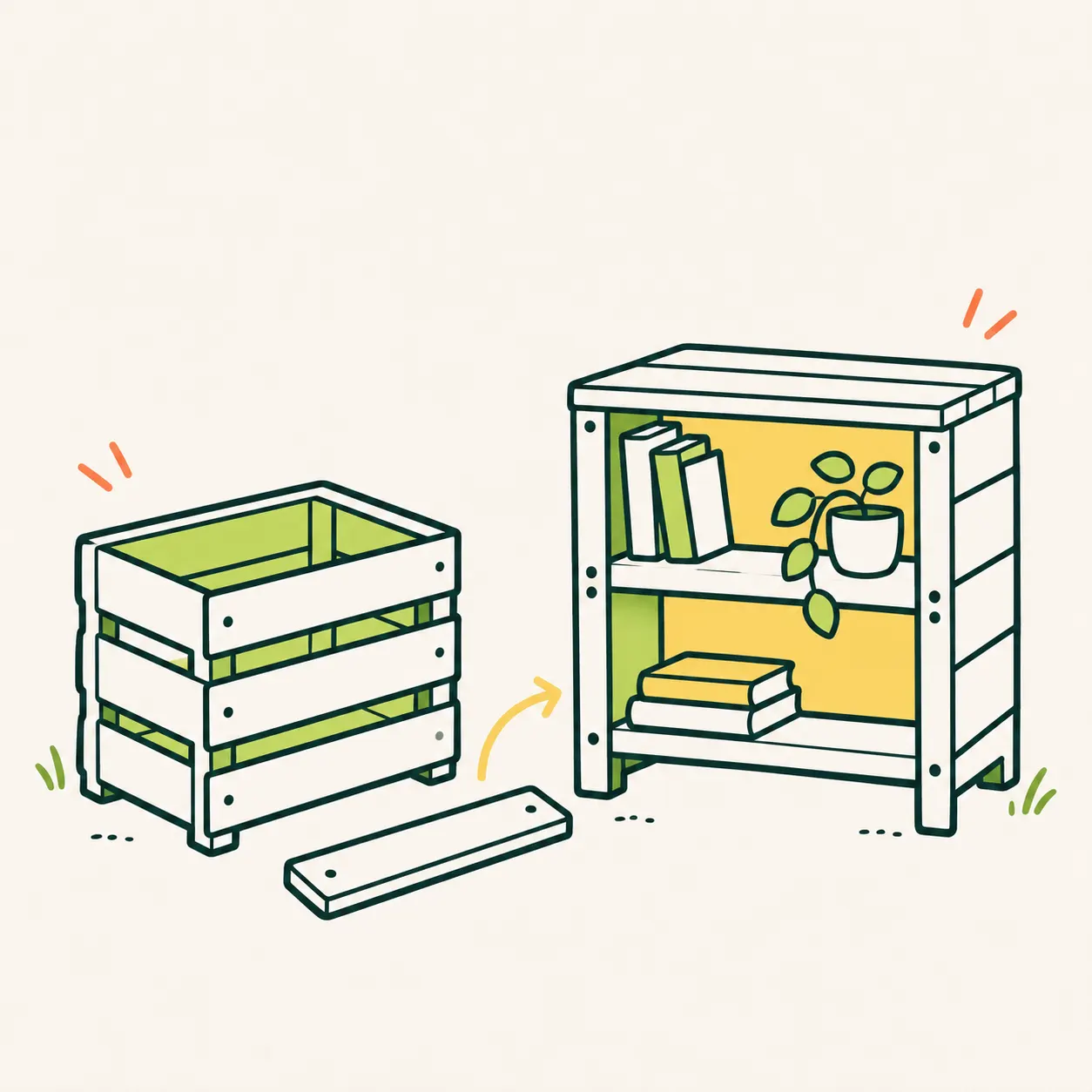
An empty packing crate can seem like the opposite of furniture: the thing left over once we have finally unpacked what we wanted. Louise Brigham changed that starting point. In 1909 she published Box Furniture: How to Make a Hundred Useful Articles for the Home, illustrated by Edward H. Ascherman from her designs. Used wooden boxes supplied the main material. Design helped them change purpose without having to pretend that their timber was precious. [1]
In her preface, Brigham describes two summers on Spitsbergen. Supplies arrived in wooden containers, which accumulated once emptied; other timber was difficult to obtain. This is her account of an experience, not a description of the island today. That constraint made a possibility visible: sides, bottoms and lids already had dimensions, surfaces and connections from which to begin. The discarded object was a particular structure, ready to be examined rather than an abstract raw material. [1]
The book's contents form a small school of transformation. They begin with a box in its simplest form, then introduce additions, partial dismantling, combinations of several containers and finally construction from dismantled material. Different projects use different operations. We can read this sequence as a design question: first recognise what exists, then decide how much intervention is necessary. The number of changes is not, by itself, a measure of how useful those changes will be. [1]
Here is an editorial example. Imagine a clean crate beside an empty corner. On three sheets, draw it whole, turned sideways and separated into boards. Each sketch reveals a different relationship between space, support and footprint. We are neither reproducing a specific Brigham object nor supplying working construction plans. We are using her book to ask which transformation serves a purpose and which is simply a decorative gesture added because there was room for one. [1]
Education was an explicit concern. Brigham suggested supplementing school materials with objects available at home; Rawsthorn also documents her woodworking classes. The ambition extended beyond owning an inexpensive object to participating in its making. Reading the work today, we can appreciate that invitation without automatically adopting every social assumption, finish or construction practice contained in a manual written more than a century ago. Historical interest and present-day endorsement are different kinds of attention. [1][2]
The introduction itself emphasises choosing boxes in good condition and considering the proportions of the parts. It does not certify the safety of a packing crate found today. The lesson we take is about design: understand the material before asking it to begin another life. A crate does not become useful simply because it has a past. It needs a convincing new relationship between form, purpose and the care with which it is transformed. [1]
Take this with youLook at a container intended for reuse and sketch three possibilities before cutting anything. Attention to what already exists can be the first material in a design.
One idea, in simple words
Louise Brigham designed furniture using wooden boxes that had already carried other things. In 1909 she published a book of projects. A box could stay almost whole, lose a few parts or be taken apart completely: its boards became material for something else. The important step was looking at what already existed before deciding how to change it. As an example, imagine drawing the same box open, turned sideways and separated into pieces. You discover different possibilities without adding new material. Brigham also saw this work as a way to learn. Her book is historical: it does not prove that any old crate is suitable for safe furniture today. Observation comes first, followed by design. [1][2]
A little discovery to keep
What did you discover?
Read the sources (2)
- Box Furniture: How to Make a Hundred Useful Articles for the Home — prefazione, indice e capitolo introduttivo Louise Brigham / The Century Co. / Internet Archive · accessed 12 Nov 2026
- Louise Brigham Alice Rawsthorn / Maharam · accessed 12 Nov 2026
Original writing and illustration made with AI assistance. Our editorial method
More in Design