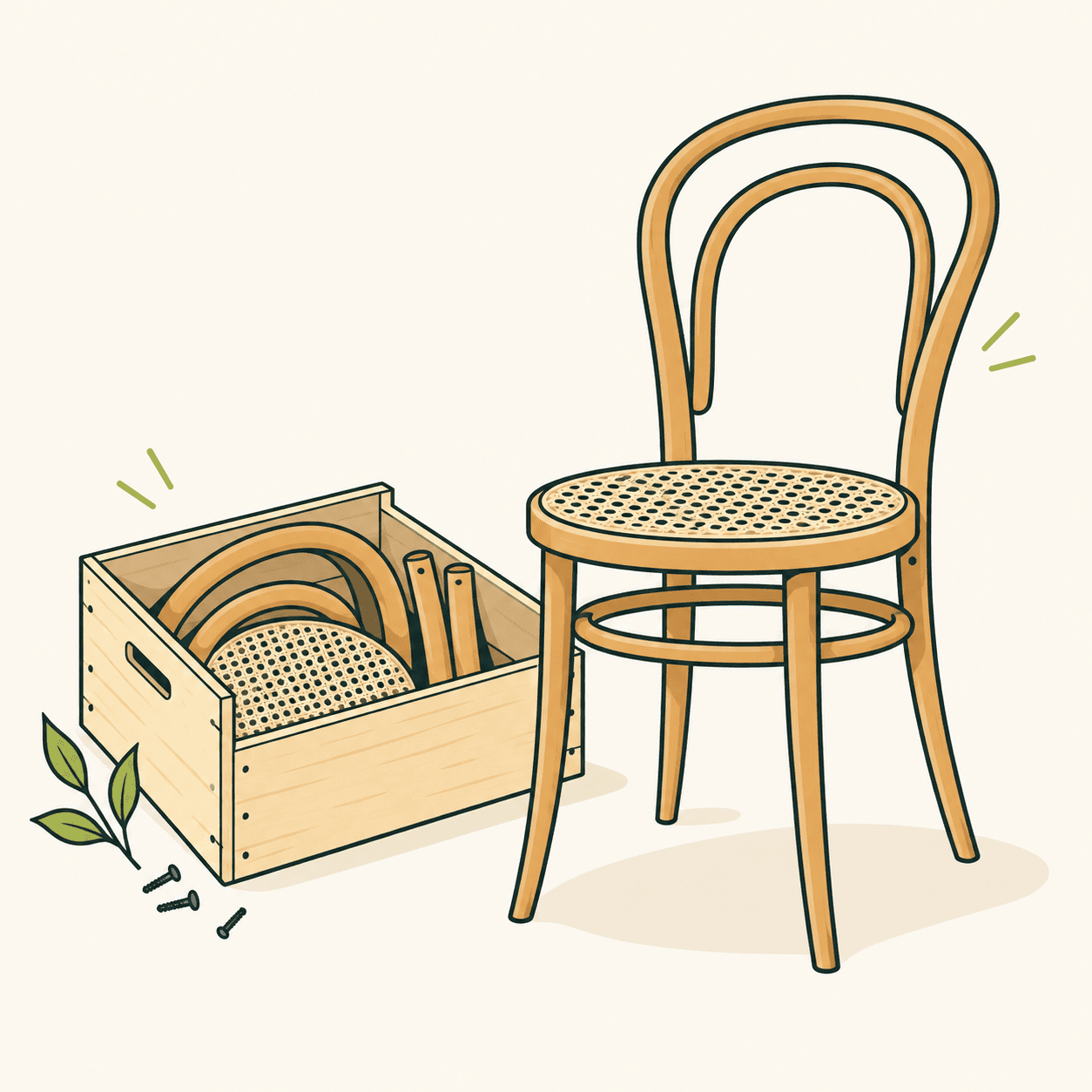
Michael Thonet’s No. 14 chair, designed in 1859, looks like a drawing made from a few curves. Philadelphia Museum of Art also directs our attention to its construction: six pieces of bent beechwood, joined with ten screws and two nuts. The smaller loop inside the back is not simply decorative; it contributes support and stability. The simple outline therefore contains precise structural decisions, rather than a collection of attractive curves chosen only for their appearance. [2]
Wood is not persuaded to bend by force alone. Thonet’s documentation describes steam, heat and moisture working together with a metal band that supports the piece while it is bent around a mould. This is a manufacturing technique, not a household recipe to try with any available plank. The source is the manufacturer: it documents the historical process and its own production practice, while also having an obvious commercial interest in telling the story. [1]
The most interesting discovery comes before use: according to the Philadelphia museum, one crate could hold 36 disassembled chairs. Components could therefore travel for assembly at their destination, rather than only finished objects being shipped. MoMA holds a beechwood and cane example dated 1881. Keep these dates separate: 1859 refers to the design described in Philadelphia; 1881 dates the particular object catalogued in New York, rather than marking a new invention of the same chair. [2][3]
Imagine an editorial example: you are arranging a small party room. First draw the assembled chairs, then their components organised inside boxes. We are not calculating the volume of a real shipment or claiming that every chair can be dismantled. The exercise changes which moment we examine. Alongside the person sitting down, the picture now includes whoever makes, packs and transports the object, and whoever must understand how to assemble it at the other end. [2]
This example also helps separate a principle from a promise. Few components alone do not establish durability, sustainability or comfort in every situation; those claims would require specific evidence. Our editorial lesson from the No. 14 is more concrete: an object’s form can be considered together with its material journey. Looking at a joint or a curve, we can ask which problem it solves, rather than stopping at its resemblance to an icon seen in a photograph. [1][3]
Take this with youTry describing an object at three moments: manufacture, transport and use. This editorial exercise can reveal design decisions that disappear when we consider only the finished silhouette.
One idea, in simple words
Michael Thonet designed the No. 14 chair in 1859. It has a round seat and a curved back. Philadelphia Museum of Art describes six bent beechwood pieces joined with ten screws and two nuts. A nut is a small metal part used to tighten a connection. The design therefore also concerns how its parts fit together. [2]
The chair could travel disassembled: one crate held components for 36 chairs. Here is an editorial example: think about the difference between drawing a finished chair and drawing its pieces inside a box. Its form must help the person sitting, but the design also considers transport and assembly. Our example is not a measurement of a shipment that we carried out ourselves. [2]
A little discovery to keep
What did you discover?
Read the sources (3)
- Bentwood · material and production Thonet · accessed 8 Oct 2026
- Side Chair, Model No. 14 · object 65144 Philadelphia Museum of Art · accessed 8 Oct 2026
- Michael Thonet, Chair No. 14 (1881) The Museum of Modern Art · accessed 8 Oct 2026
Original writing and illustration made with AI assistance. Our editorial method
More in Design