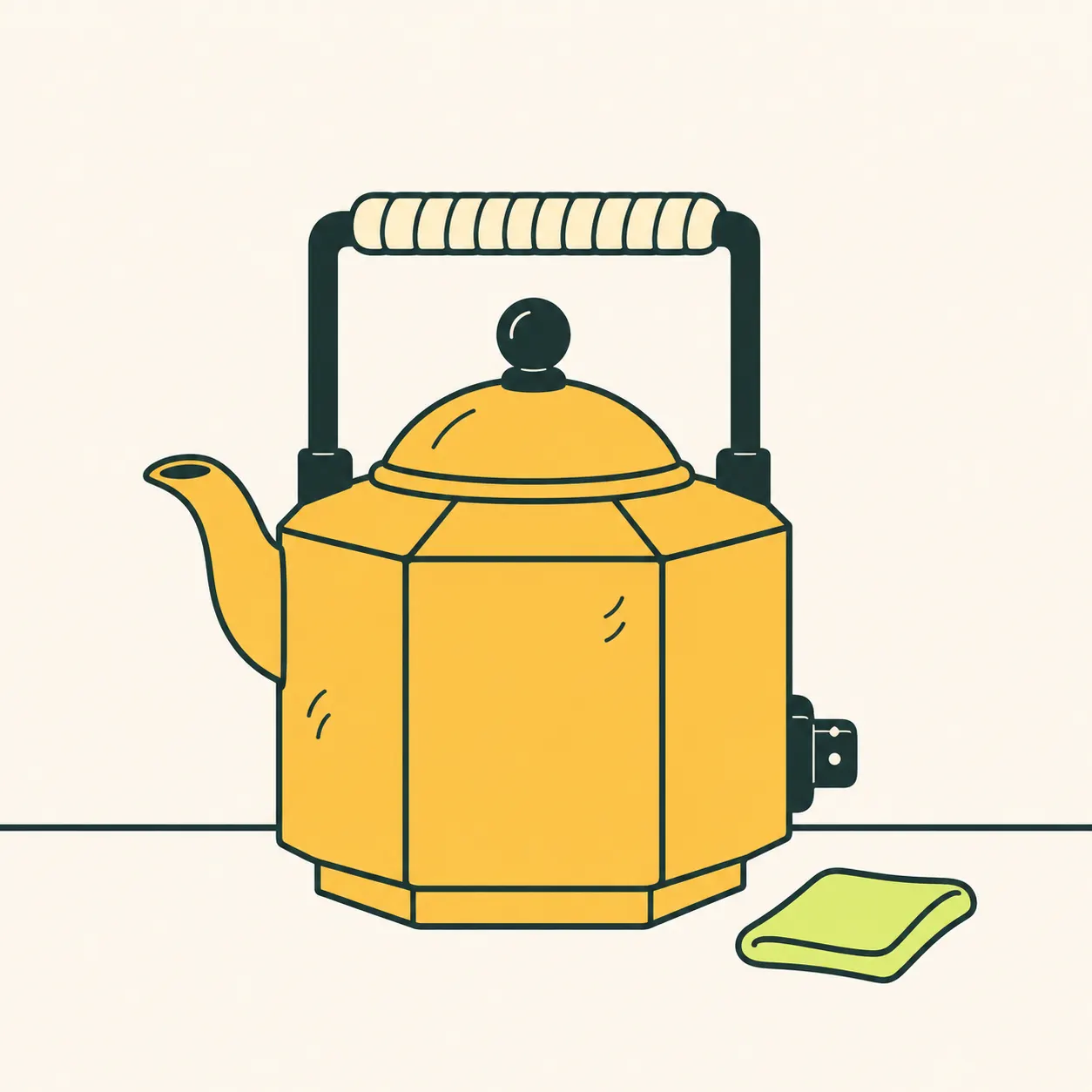
An electric kettle might seem an unlikely place to look for design history. Yet the one Peter Behrens designed for AEG in 1909 puts a precise question on the table: how should a technology appear before it becomes ordinary? The example at Powerhouse has an octagonal brass body and a cane-covered handle. A new source of energy arrives alongside recognisable materials and familiar actions, rather than announcing a complete break with domestic life. [1]
Look at the details without confusing the examples. Powerhouse describes hammered surfaces, a rounded lid, a small black wooden knob and a straight-sided handle. MoMA holds a kettle of the same date made from nickel-plated brass and rattan. These records do not allow us to merge everything into one imaginary object: finish, shape and dimensions belong to a particular piece. Even an industrial family can contain differences that are worth noticing carefully. [1][2]
Powerhouse explains that Behrens joined AEG in 1907 and worked on the appearance of products and their presentation. The kettle makes that attention readable at a domestic scale. Its faceted body organises the view; its handle indicates where a hand might go. These are our observations about form, not an ergonomic assessment. We have not measured temperatures, balance or ease of pouring, and a photograph cannot substitute for those practical checks. [1]
MoMA also points out that early electric appliances did not enter homes simply by being better at every task: price, capacity and speed could compare unfavourably with kettles using other sources of heat. This is useful because it interrupts a tidy story of automatic progress. A novelty must find a place among habits, prices, infrastructure and desires. The museum identifies materials and visual presence as part of the explanation for its acceptance. [2]
Try an editorial exercise: imagine removing the cable and describe only the outline, lid and grip; then restore the cable and add the question of energy. This is no historical experiment, but a way to distinguish change from familiarity. Woven covering beside metal invites us to examine modernity without expecting every surface to resemble a spacecraft. Sometimes the future enters through the kitchen, carrying something that our hands already know how to approach. [1][2]
Take this with youChoose a household appliance and identify one novel detail and one familiar detail. Ask what action each makes understandable: this is an observation exercise, rather than a ranking of the best products.
One idea, in simple words
Peter Behrens designed an electric kettle for AEG in 1909. Powerhouse museum holds an example with an octagonal body: that means it has eight sides. Its handle is covered with woven cane, while its body is metal. The design combines a technology that was then unusual with recognisable materials. Another example, at MoMA, has a different finish. We should not mix up the details of these two objects. MoMA also explains that early electric kettles were not necessarily quicker or better value than other kettles. A new object can appeal for several reasons. For example, we can notice where our hand would go and how its lid opens. Looking at a photograph, however, cannot prove that a utensil is comfortable. [1][2]
A little discovery to keep
What did you discover?
Read the sources (2)
- Electric kettle designed by Peter Behrens, 1909 Powerhouse Collection · accessed 6 Nov 2026
- Peter Behrens. Electric Kettle. 1909 Museum of Modern Art · accessed 6 Nov 2026
Original writing and illustration made with AI assistance. Our editorial method
More in Design