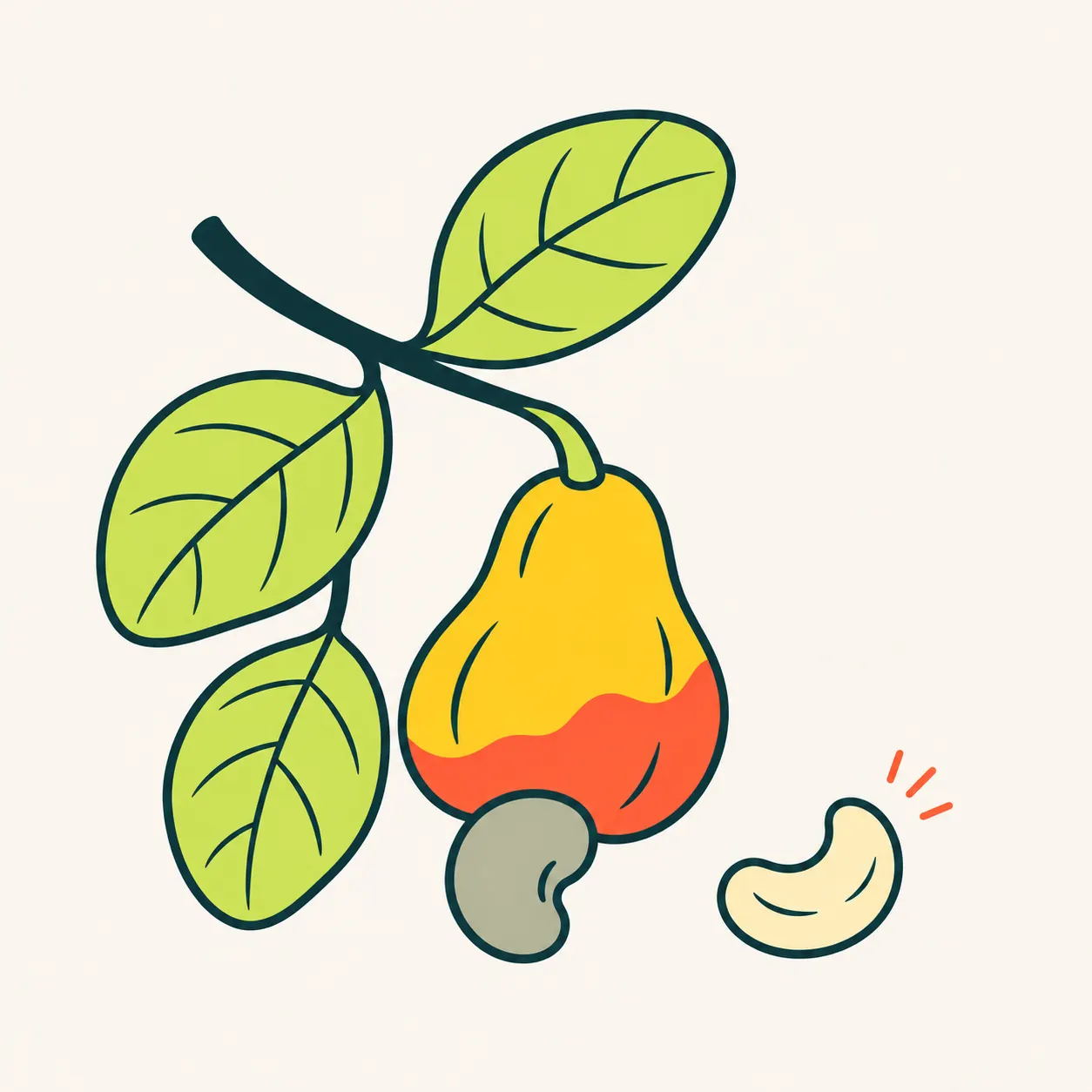
A cashew on a small plate looks like a complete object: pale, curved and compact. On the tree, the scene is different. The University of Florida’s account shows a fleshy yellow or red structure with a smaller kidney-shaped object attached at its end. That smaller object is the true fruit, containing the seed that reaches the market. The seed therefore does not grow naked outside an apple: it is protected inside its own surrounding fruit. [1]
The PROSEA botanical description clarifies the confusion. The so-called cashew apple is a supporting part of the fruit that enlarges and becomes fleshy, rather than an apple in the usual botanical sense. The kidney-shaped fruit remains at the end and encloses the seed. “False fruit” or “accessory fruit” does not mean fake or defective: it distinguishes the tissues’ origin. To understand the whole structure, follow its connections instead of assuming that the most conspicuous part must be the principal one. [2]
Fairchild Tropical Botanic Garden also describes interest in the fleshy part as food, eaten and used for juice in growing regions. Our encounter with an ingredient therefore depends on which part is transported, sold and named. This is an editorial reflection, not a ranking of countries: someone familiar with the juice may recognise a different scene from someone who knows only packets of shelled kernels. Both have encountered one part of the plant’s larger story. [3]
One practical distinction must remain clear. The fruit’s shell contains irritating substances, and the University of Florida advises against shelling and preparing home-grown cashews at home. The food sold commercially has undergone specific processing. A botanical picture is not a preparation procedure, and observing how the parts connect does not require opening an unprocessed fruit. Our subject here is the structure of the plant, rather than an experiment intended to produce a homemade snack. [1][2]
Try a purely visual exercise: compare a picture of the whole fruit with a packaged cashew and look for what has disappeared. The familiar pale colour and curve belong to the kernel; the fleshy structure and shell are absent from the plate. We do not have to replace the language of cooking to recognise that difference. We can still use ordinary culinary categories while also knowing exactly which part we mean when we examine the plant itself. [1][3]
Take this with youNext time you look at an ingredient, ask which part of its plant reached you and which parts are missing. With a cashew, comparing images restores the context without becoming an attempt at home processing.
One idea, in simple words
The cashew in a food packet is a seed. On the tree, called Anacardium occidentale, that seed grows inside a small kidney-shaped fruit. The fruit is attached below a fleshy yellow or red structure called the cashew apple. This apple develops from supporting tissues that swell; it is not the shell containing the seed. A photograph of the complete structure helps explain the difference. The largest, most colourful part does not necessarily have to be the true fruit. The shells of unprocessed cashews contain irritating substances, so they should not be opened or processed at home. Commercial food products have undergone specific processing. Here we are learning to identify the plant’s parts, rather than explaining how to prepare them ourselves. [1][2][3]
A little discovery to keep
What did you discover?
Read the sources (3)
- Cashew Apple Fruit Growing in the Florida Home Landscape — HS1127 University of Florida · IFAS Extension · accessed 5 Nov 2026
- Anacardium occidentale L. C. L. M. van Eijnatten · PROSEA, riproduzione Growables · accessed 5 Nov 2026
- The Cashew and You Richard J. Campbell · Fairchild Tropical Botanic Garden · accessed 5 Nov 2026
Original writing and illustration made with AI assistance. Our editorial method
More in Food