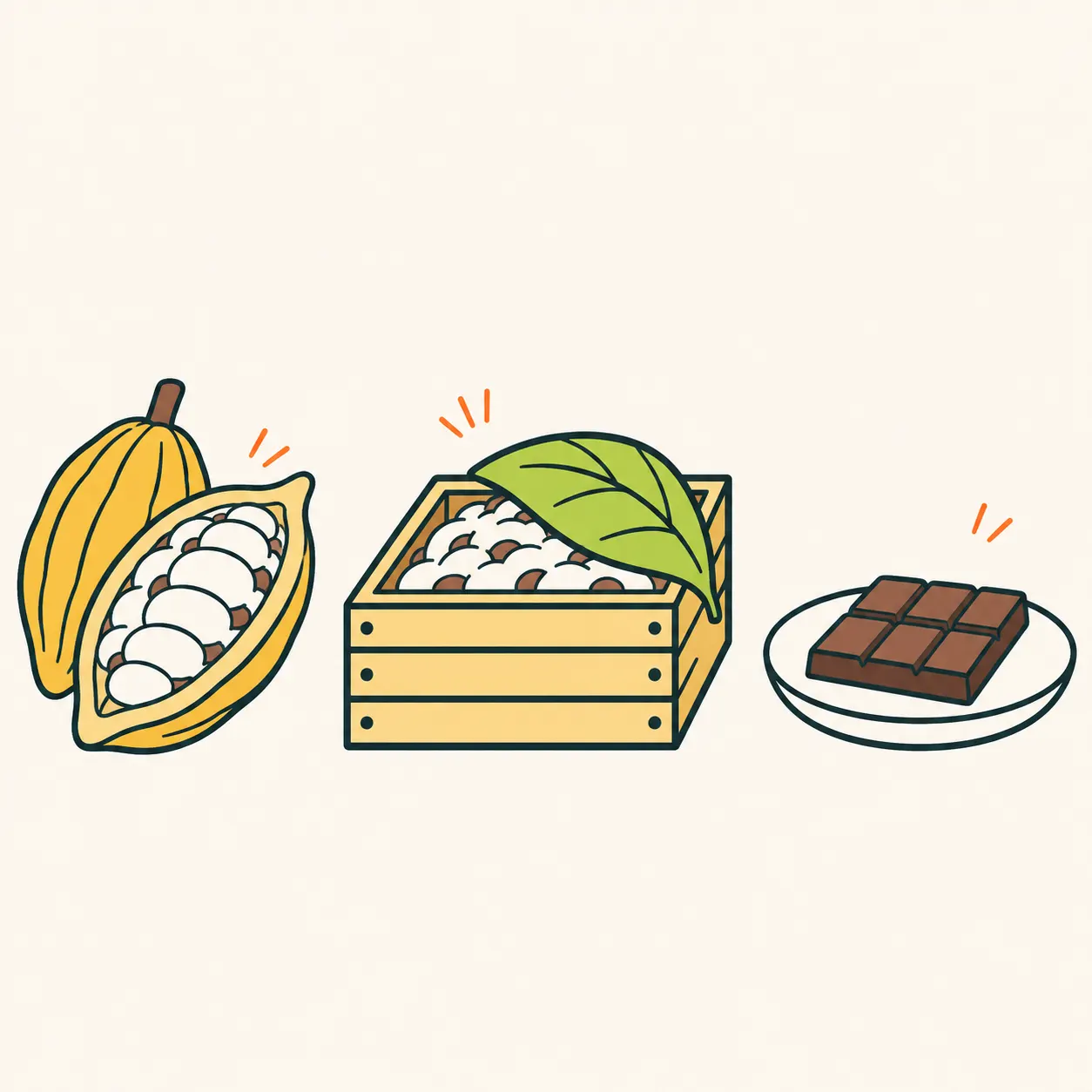
A chocolate bar seems far removed from an opened fruit. Yet a decisive part of its story begins with seeds still surrounded by pulp. The International Cocoa Organization distinguishes two stages that contribute to cocoa’s character: fermentation where it is produced and roasting later in processing. The discovery lies in that earlier beginning. Flavour is not constructed only when a machine gives chocolate its familiar shape. Agricultural work continues after the fruit has been harvested and before the factory enters our mental picture. [1]
Fermentation involves microorganisms that transform the pulp and help create conditions in which the seeds change too. FAO documentation describes systems including heaps and boxes, with management of the material and drainage. This is not simply leaving everything untouched until it becomes a chocolate bar. Cacao passes through distinct stages. Talking about preparation for aroma development helps us avoid confusing changes taking place in the seeds with the final profile of the product we will eventually taste. [2][3]
A 2022 systematic review brought together studies of spontaneous cacao fermentation, comparing microbial communities and ways of observing them. The picture is varied, but the data did not establish a specific association between microorganisms and either location or fermentation method. Some areas are much better represented than others, while identification techniques and incomplete reporting also complicate comparisons. We therefore cannot assign a characteristic invisible team to every origin. Fermentation names biological transformations, not a universal button that guarantees precisely the same flavour every time. [3]
Drying follows, and later roasting contributes to the aromatic profile. Keeping these stages separate is useful even when looking at a wrapper. For an editorial example, imagine three photographs side by side: an opened fruit, beans being processed and a chocolate bar. Between the first and last, more than a change of shape is missing. There is labour, transformation and decision-making. We cannot reconstruct that whole sequence from a flavour note printed on a label, but we can learn to look for information about it. [2][1]
This story does not make chocolate a probiotic food and is not an invitation to improvise fermentation at home. Our interest is recognising a process usually hidden at the point of purchase. Next time you read a cocoa description, distinguish origin, processing and added ingredients: they provide different information, not interchangeable promises of quality. If the people who grow and ferment it are named, follow that clue. Flavour can become a question about people’s work before becoming an elegant word spoken after a tasting. [1][3]
Take this with youFermentation is one stage in cacao’s journey, distinct from drying and roasting. Looking for its story makes the work before the chocolate bar more visible.
One idea, in simple words
Chocolate comes from cacao seeds. Inside the fruit, these seeds are surrounded by pulp. Fermentation is an important stage after harvest. During this process, microorganisms, living things too small to see without instruments, transform the material. These changes help prepare the development of aromas. A finished bar does not immediately appear: other stages follow, including drying and roasting. Drying reduces water, while roasting uses heat in processing. Imagine three pictures: a fruit, processed seeds and chocolate. Between them are people, time and decisions. Fermentations can vary with location and method. This explanation is not a recipe to try at home. It also does not mean that chocolate contains living microorganisms that benefit health. [1][2][3]
A little discovery to keep
What did you discover?
Read the sources (3)
- Processing Cocoa International Cocoa Organization · accessed 8 Nov 2026
- Cocoa processing Food and Agriculture Organization of the United Nations · accessed 8 Nov 2026
- Microbes associated with spontaneous cacao fermentations — A systematic review and meta-analysis Current Research in Food Science / PMC · accessed 8 Nov 2026
Original writing and illustration made with AI assistance. Our editorial method
More in Food