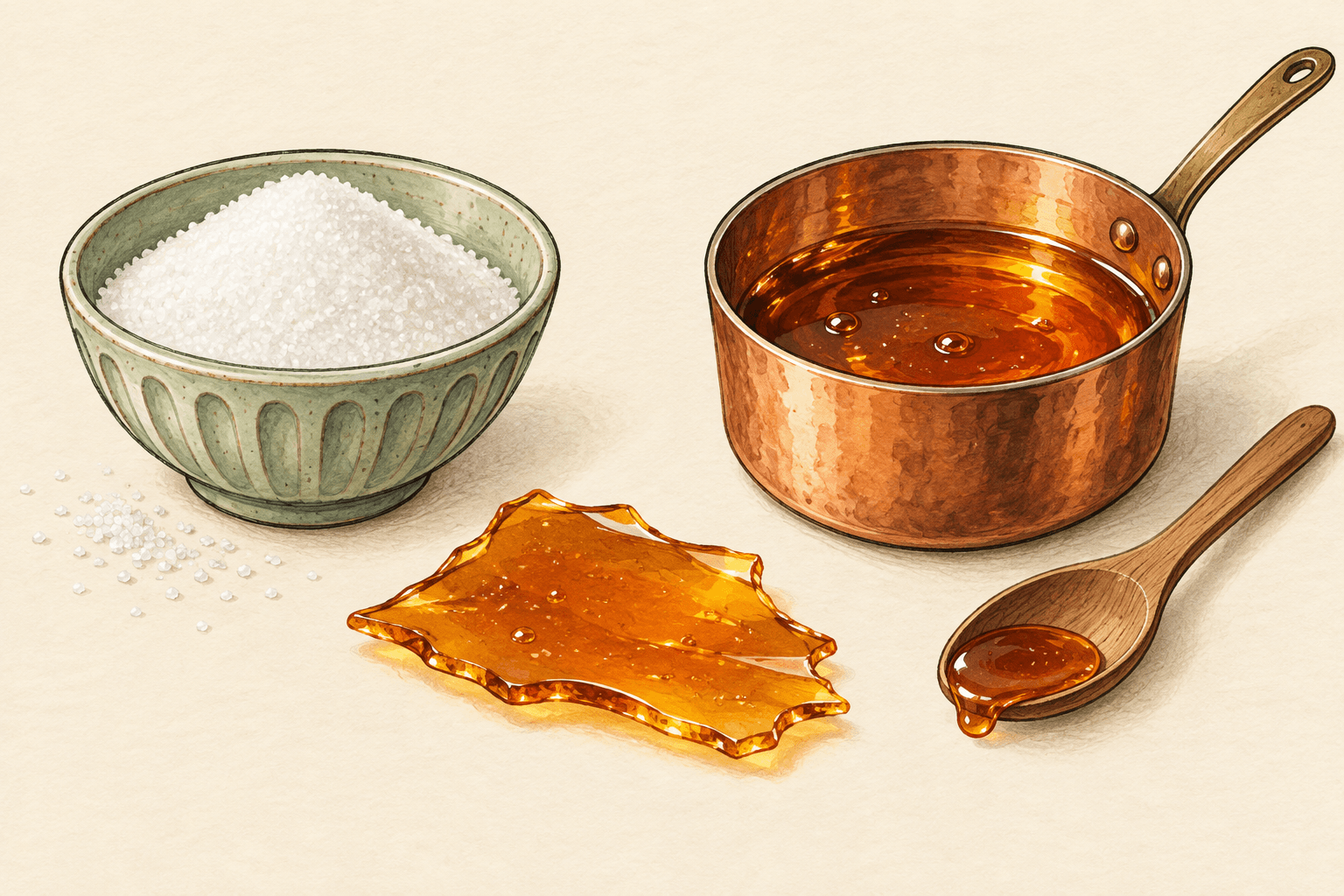
A spoonful of white sugar and an amber decoration may share a history, but they are not the same thing seen through a coloured filter. The Exploratorium describes caramelisation as a change in which heat breaks down sugar compounds and new compounds form. The central point is chemical: we are not simply moving grains around or mixing sugar with something brown to give it a different outward appearance. [1]
To separate the changes, begin with a simpler case. Another Exploratorium explanation describes sugar crystals dissolving when sugar is added to water. Visible grains disappearing does not by itself show that caramel has formed. Sucrose, ordinary table sugar, consists of glucose and fructose joined together. Talking about crystals and talking about changes to molecules means examining two different levels, even when both happen in something as familiar as a kitchen ingredient. [2]
There is another route to brown: the Maillard reaction. Writing in Chemical & Engineering News, chemist Matthew Hartings describes a reaction between a reducing sugar and a nitrogen-containing molecule, such as an amino acid. It is not another name for caramelisation. Looking only at the final colour therefore cannot identify the process: the substances taking part matter too. A familiar culinary name cannot replace a chemical description of what has happened. [3]
An editorial example can clarify the method without switching on a stove. Make three cards: grains in water, sugar heated until it changes, and ingredients containing sugars and proteins. These are not three recipes but three questions. What changes in the arrangement? What changes in the substances? What can react with what? The comparison makes us describe the starting point, rather than guessing everything from the colour in the final picture. [2][3]
The limit of this explanation is deliberate: it supplies no universal temperature, home procedure or nutritional judgment. The Exploratorium itself distinguishes chewy candies containing cream from the process that changes pure sugar. Our concern is to read a transformation without flattening different preparations into one category. The editorial question to take to the table is small but useful: when we say something turned brown, have we described its cause, or only its result? [1]
Take this with youWhen a colour changes, ask which ingredients were there at the start. Observing a result is the first step; distinguishing its causes makes the explanation more interesting.
One idea, in simple words
Sugar can change in different ways. In water, its crystals can dissolve, so we no longer see separate grains. That does not mean caramel has formed. During caramelisation, heat changes the sugar compounds and forms new ones. A chemical transformation changes substances, not just where they are placed. The two changes therefore need different explanations. [1][2]
A brown food does not tell us everything that happened. The Maillard reaction is another process, involving sugars and other substances in food. Here is an editorial example: compare pictures of the starting ingredients and the result. Ask what was present before asking what changed. This is an exercise with pictures, not a recipe or an experiment at the stove. [3]
A little discovery to keep
What did you discover?
Read the sources (3)
- Science of Candy: Caramelization & Caramels Exploratorium · accessed 7 Oct 2026
- Science of Candy: What is Sugar? Exploratorium · accessed 7 Oct 2026
- Maillard Reaction · Matthew Hartings Chemical & Engineering News · American Chemical Society · accessed 7 Oct 2026
Original writing and illustration made with AI assistance. Our editorial method
More in Food