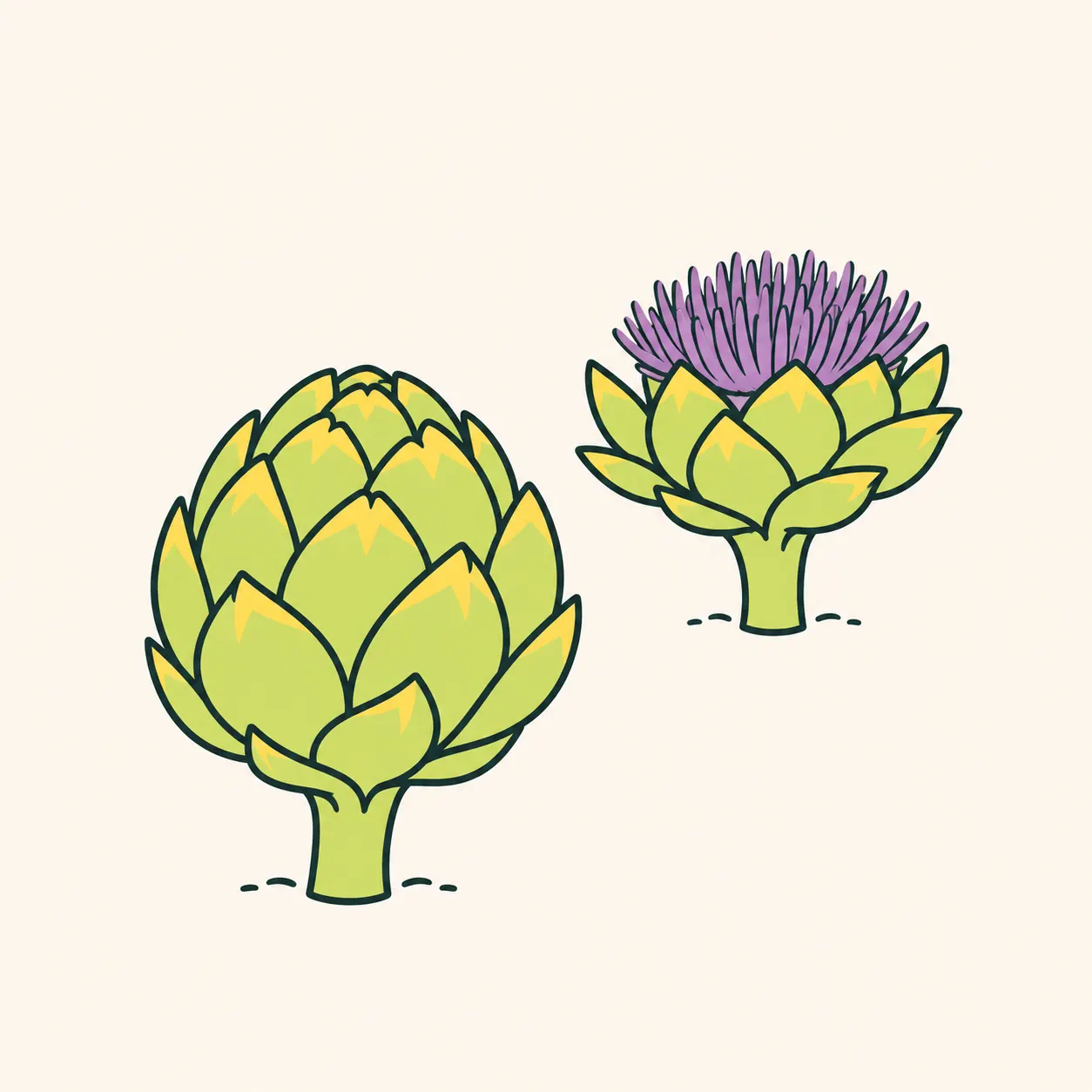
On a vegetable stall, a globe artichoke looks like a finished object: closed, compact and ready for our cooking plans. For the plant, however, it is a stage along the way. Texas A&M AgriLife Extension identifies the harvested part as an immature flower bud and notes its relationship to thistles. The discovery is not a magical transformation from vegetable into flower: we are looking at a reproductive structure before opening, at the stage selected for eating certain parts. [1][3]
The outer scales are called bracts. The university’s account distinguishes their fleshy bases from the receptacle to which they attach, known in the kitchen as the heart. These names help separate positions and roles without requiring a pocket botanical dictionary at the market. Calling them “leaves” at the dinner table may be understandable, but a more precise botanical description shows that we are not simply removing petals from a green rose, one layer at a time. [1]
What happens if the head remains on the plant? The Royal Horticultural Society describes it opening into large purple thistle-like flowers visited by bees and other pollinating insects. It advises harvesting while the heads are still tightly closed. Time changes what we can observe: a head selected for cooking and one allowed to flower represent different stages. No miraculous variety or invented story is required to explain the change between these two familiar appearances. [2]
Try our own exercise with a photograph of a whole artichoke and another of the flowering plant. Identify what looks similar, what opens and which part we have learned to call the receptacle. We are not reconstructing the growth of the same individual: the pictures might show different cultivars and growing conditions. The comparison changes our question from “what shall I cook?” to “which moment in the plant’s development has arrived on this stall?”. [1][2]
The common name also covers artichokes of different sizes and colours: the RHS records varieties with green or purple buds and differing growing requirements. A British gardening guide cannot establish one worldwide harvest calendar. For this reading, the useful discovery is a verifiable relationship between shape and the moment of harvest. The artichoke offers a concrete way to see food as part of a cycle, without attaching special health promises to the observation. [2]
Take this with youWhen you encounter an artichoke, notice the bases of its bracts and imagine the open stage described by the sources. Our botanical exercise requires no new recipe, unfamiliar tasting or claim of special benefits.
One idea, in simple words
The globe artichoke we buy is harvested before its flower head opens. A flower head contains a group of small flowers. The outer scales are called bracts. Texas A&M explains that the edible parts include their fleshy bases and the receptacle, the structure supporting them, called the heart in cooking. If the head remains on the plant, it can open into a large purple thistle-like flower head. It does not suddenly become another species: it continues developing. Imagine comparing two photographs, one showing a closed artichoke and one the flowering plant. This is our exercise for recognising different stages. Colour and size also vary between cultivars. The discovery concerns the plant and makes no promise of special health effects. [1][2][3]
A little discovery to keep
What did you discover?
Read the sources (3)
- Globe Artichoke — specialty vegetables Texas A&M AgriLife Extension · accessed 6 Nov 2026
- How to grow globe artichokes Royal Horticultural Society · accessed 6 Nov 2026
- Cynara cardunculus Scolymus Group NC State Extension Gardener Plant Toolbox · accessed 6 Nov 2026
Original writing and illustration made with AI assistance. Our editorial method
More in Food