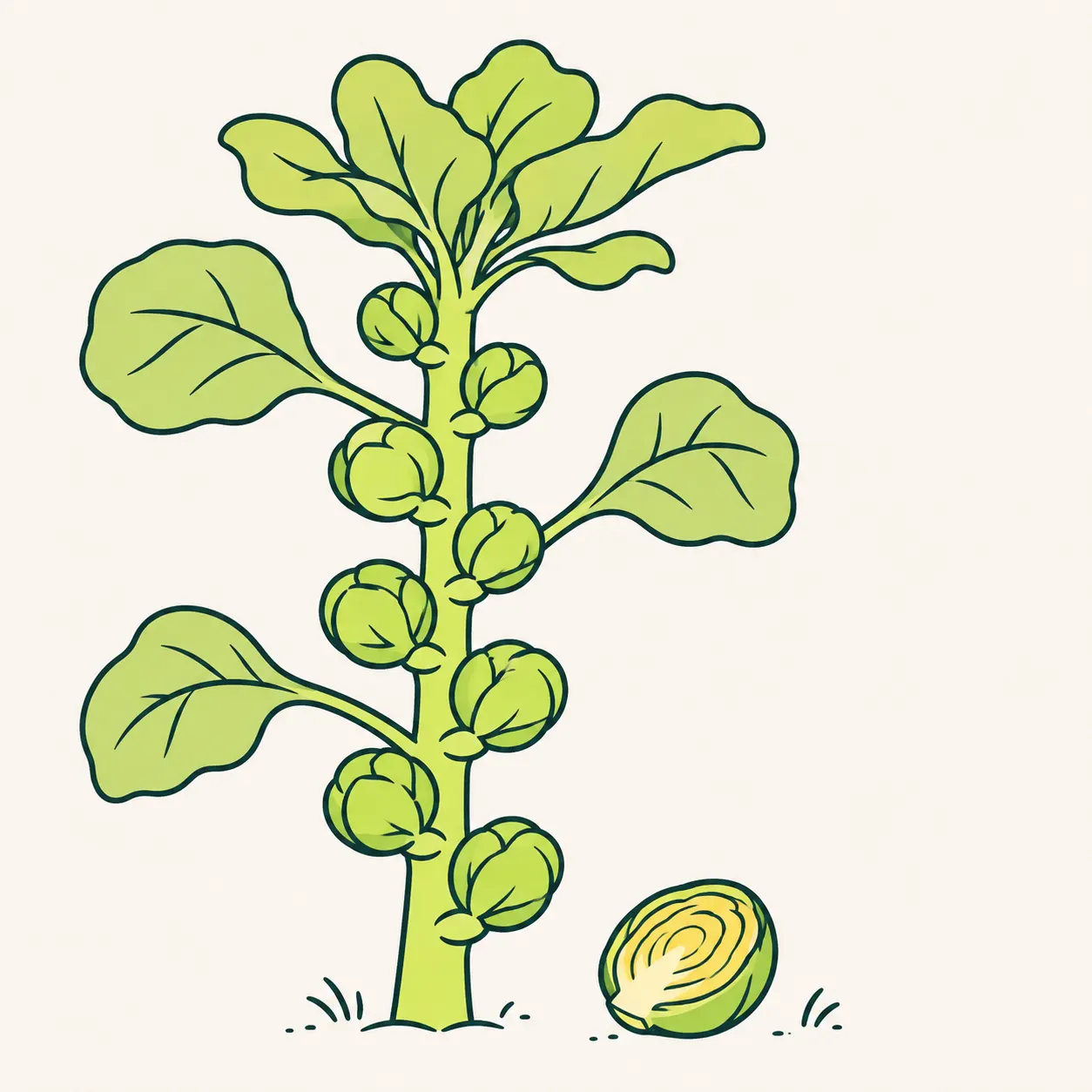
In a bag, Brussels sprouts look like miniature cabbages. It is easy to imagine small plants being harvested individually from the ground. The whole plant reveals a different geometry: numerous compact heads line a stalk, associated with the points where leaves attach. The central detail is not how small they are, but where they grow. Before becoming a serving on a plate, they occupied identifiable positions on the same larger plant. [2]
The Royal Horticultural Society calls them axillary buds. Axillary means the angle between a leaf and the stem; it is not an anatomical comparison to take literally. A sprout is a bud with tightly packed leaves, neither a fruit nor an entire small plant with roots of its own. The sources give the botanical name Brassica oleracea var. gemmifera. Here, the technical vocabulary mainly helps restore an ingredient's address on the plant that produced it. [1]
University of Minnesota Extension describes development from bottom to top: the first sprouts form beside lower leaves, and the sequence continues up the stalk. Buying the vegetable already separated hides that order. As an editorial exercise, imagine placing each piece beside a leaf drawn on paper. We would not be reconstructing the actual history of our shopping, but moving from a collection of little balls to a structure whose relationships can be seen. [2]
A second exercise only requires attention during normal food preparation. Notice the tightly gathered leaves of one sprout and the cut point at its base. Compare it with a whole-plant photograph from a horticultural source. The comparison does not establish variety, freshness or food quality; it helps identify which part we are examining. There is no need to give the vegetable a hidden nutritional secret. Discovering exactly what is in front of us is already interesting. [2]
Seasons also need context. The Minnesota guide describes an autumn crop under its own climatic conditions; the RHS discusses cold weather and changes to the plant's reserves. We should not turn those descriptions into a universal calendar for gardens elsewhere. This reading concerns the form of food, without prescribing sowing dates or watering amounts. A source's location is not a decorative detail: it helps us judge how far we can extend its practical advice. [1][2]
The discovery is simple: something that looks like an individual on our plate can be a repeated part of a larger organism. As an editorial reflection, we can use a sprout to ask a question about other ingredients too: is this a leaf, seed, root, fruit or bud? The answer needs checking each time rather than being inferred from a resemblance. The small size might make us smile; the position on the plant helps us understand it. [1]
Take this with youNext time, look for a picture of the whole plant too. An ingredient changes meaning when you recognise both its shape and the place from which it came.
One idea, in simple words
Brussels sprouts look like tiny cabbages, but they do not grow as lots of separate little plants on the ground. They form along the stalk of a tall plant, where leaves join the stem. Botanists call them axillary buds: axillary refers to that angle. Each sprout contains tightly packed leaves. It is not a fruit and does not have the roots of an independent plant. Sprouts develop first lower down and then farther up the stalk. When we buy them already separated, this order disappears from view. As an exercise, compare one sprout with a photograph of the whole plant. You will understand not only your ingredient's shape, but also where it grew before harvest. [1][2]
A little discovery to keep
What did you discover?
Read the sources (2)
- Brussels sprouts problems Royal Horticultural Society · accessed 12 Nov 2026
- Growing Brussels sprouts in home gardens University of Minnesota Extension · accessed 12 Nov 2026
Original writing and illustration made with AI assistance. Our editorial method
More in Food