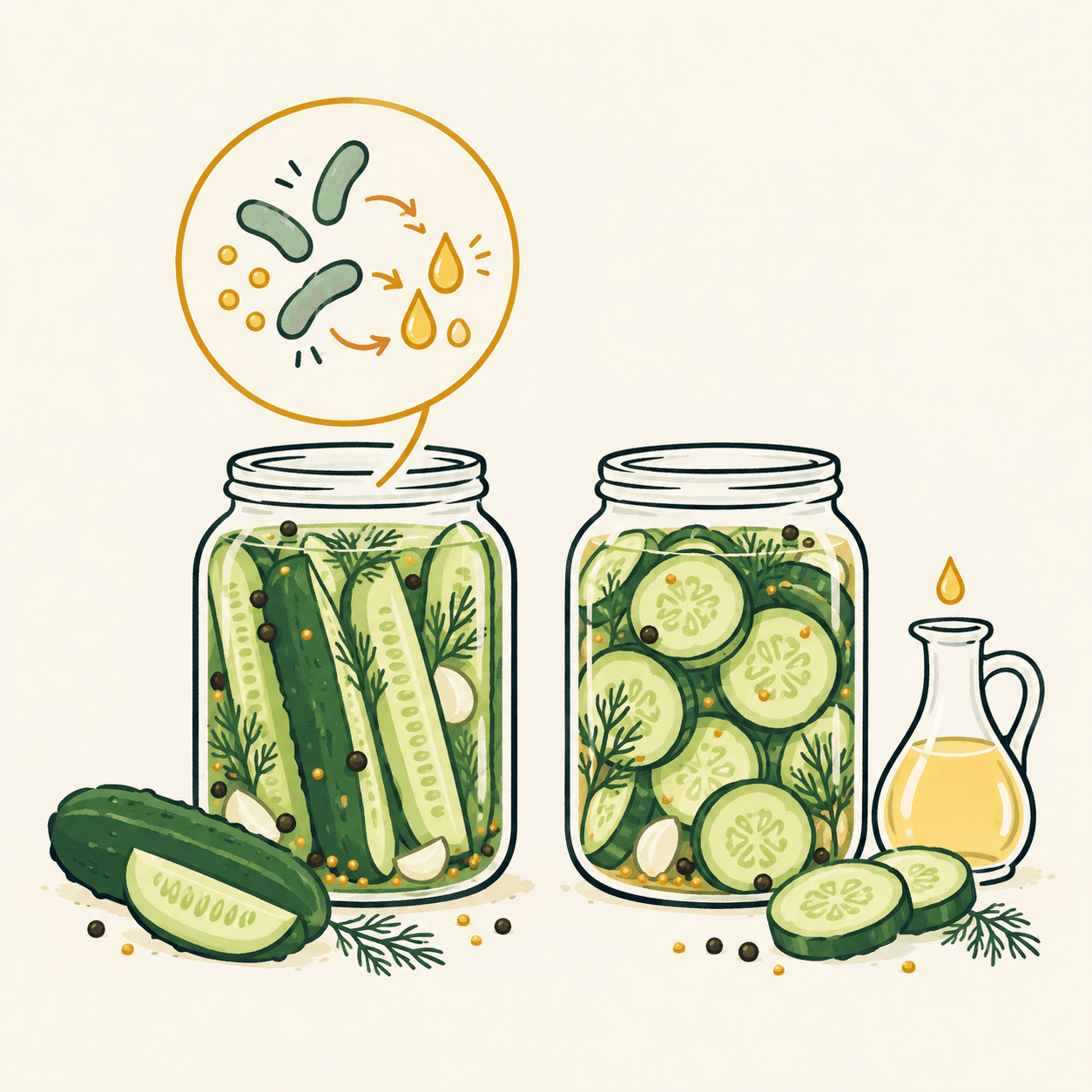
Two pickled cucumbers can taste sour yet have reached that point by different routes. The National Center for Home Food Preservation distinguishes fermented preparations from those quickly acidified with vinegar. Here is the central discovery: the result we taste does not by itself reveal all the work that happened beforehand. The word pickles covers products made by different methods, rather than one universal recipe shared by every jar. [3]
During vegetable fermentation, certain bacteria use sugars already present in the food and produce lactic acid. The Exploratorium describes this change as microbial activity guided by the surrounding conditions. The word lactic does not mean that milk must be added to cucumbers: it identifies the acid produced during the process. This is a principle of food science, not a recent announcement or a promise of health benefits for somebody eating the product. [1]
Salt in the brine does more than add flavour. The Exploratorium explains that its concentration influences which microorganisms can grow; temperature and other conditions also matter. Putting a vegetable in water and waiting is therefore not enough. Thinking of the jar as a small environment helps explain the phenomenon, but our illustration with enlarged bacteria is only a conceptual diagram: microorganisms cannot be seen like this with the naked eye. [2]
In quick-process products, by contrast, vinegar supplies acidity as specified by the preparation method. The University of Georgia centre explains that these preparations do not require the cucumber to ferment. This distinction describes two families of methods; it does not allow us to identify every jar reliably from its colour or a photograph. Nor is finding vinegar in an ingredient list enough to reconstruct every stage of a particular production process ourselves. [3]
Here is an example invented by the editors: two cards describe the same object as green, crunchy and sour. The first says bacteria have transformed some of its sugars; the second says vinegar has been added. The three initial qualities did not distinguish the processes, but the information about preparation did. This exercise helps us read explanations; it is not an invitation to taste unfamiliar preserves or judge whether they are safe. [1][3]
This article gives no quantities, timings or instructions for preserving food at home. The university centre calls for recipes with tested proportions and warns that acidity also affects safety. The discovery remains simpler and useful: similar sensations can result from different transformations. Understanding the difference requires a question about the process, rather than just a glance at the finished food sitting inside a glass jar. [3]
Take this with youLook for the preparation method on a label or description. Separate what the text actually says from what you are guessing based only on appearance or taste.
One idea, in simple words
A pickled cucumber can become sour in different ways. During fermentation, certain bacteria use sugars in the vegetable and produce lactic acid. Bacteria are living things too small to see with the naked eye. In quick pickling with vinegar, acidity is added instead: the cucumber does not need to ferment. [1][3]
Imagine this example from the editors: two cards say only “green and sour”. They do not yet explain how the cucumbers were prepared. To find out, we need information about the method. Salt and temperature can influence fermentation. This page explains the difference between processes, but it is not a recipe. Preserving food at home requires tested instructions and precise proportions: a jar’s appearance is not enough to decide whether it is safe. [2][3]
A little discovery to keep
What did you discover?
Read the sources (3)
- Fermentation and Food Exploratorium · accessed 6 Oct 2026
- The Race of Microorganisms Exploratorium · accessed 6 Oct 2026
- General Information on Fermenting National Center for Home Food Preservation · University of Georgia · accessed 6 Oct 2026
Original writing and illustration made with AI assistance. Our editorial method
More in Food