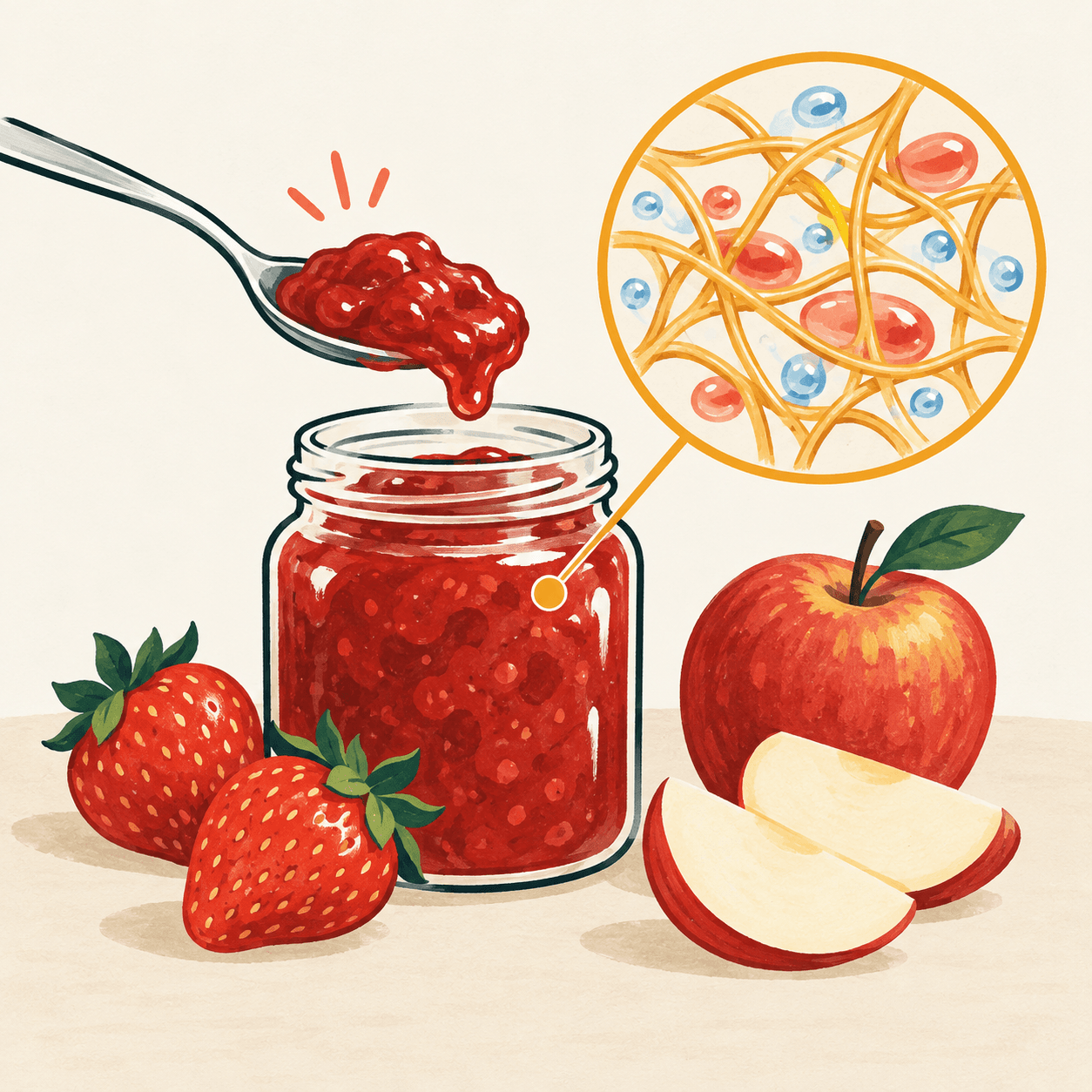
Jam can sit on a spoon while still containing plenty of liquid. Pectin, a substance found in plant cell walls, helps give it structure. In fruit, the Exploratorium describes it as a material that helps hold cells together. When its long molecules form a network within the mixture, liquid is held in the spaces: a gel develops. The texture inside a jar therefore does not require all its water to have disappeared during cooking. [1]
In the traditional preparations described by the sources, pectin, acidity and sugar work together. Sugar does more than make the result sweet: it draws some available water away from pectin molecules, helping them come together. Acidity also affects the formation of the network. Fruit contributes substances already present, but the species and stage of ripeness matter. Fruits therefore differ in their pectin content, and counting spoonfuls of sugar alone cannot explain the outcome. [1][2]
There is, however, more than one route to this gel. The University of Georgia distinguishes pectins that need sugar and acidity from others that can connect with the help of calcium ions. In the latter, calcium makes bridges between the chains. Formulations for preparations containing less sugar can therefore use a different kind of pectin. This changes how the structure works: it is not simply a matter of imagining the same recipe with one ingredient crossed out. [3]
Here is a drawing model proposed by the editors. Draw long threads crossing one another and add a few connecting points; draw small drops in the spaces. The threads stand for chains, the connections for the network and the drops for retained liquid. The drawing makes visible an idea that a spoon cannot show. It remains an analogy: a jar contains neither textile threads nor droplets neatly arranged in boxes. It helps us remember the relationship between connections and texture. [1][3]
A packet of pectin now becomes a small document worth reading carefully. The university centre distinguishes powdered and liquid products and explains that they cannot automatically replace each other in preparations; some products are also intended for specific formulations. The interesting question is what network a particular product makes possible and under what conditions. Reading this way shifts attention from an ingredient’s generic name to its role: two packets can both say “pectin” while requiring different directions for use. [2][3]
Take this with youAn editorial suggestion: look at some jam and describe what you observe — it flows, bends or stays on the spoon — then try explaining it through pectin’s network. Texture offers a clue; by itself, it cannot reveal the formulation.
One idea, in simple words
Jam still contains liquid even when it stays on a spoon. A substance called pectin helps give it shape. Pectin occurs in fruit and can create a network of long molecules. Liquid remains in the spaces within this network, forming a gel. All the water does not have to disappear for the mixture to become firmer. [1]
Here is an editorial example: draw connected threads with small drops in the spaces. Real threads do not exist inside jam as they do in the picture, but they help us imagine the network. Some kinds of pectin work with sugar and acidity; others use connections made with calcium. Pectins therefore do not all work in the same way. Reading the type on the packet helps us understand which product we have. [3]
A little discovery to keep
What did you discover?
Read the sources (3)
- Science of Cooking: Pectin & Preserves Exploratorium · accessed 9 Oct 2026
- Jellied Product Ingredients National Center for Home Food Preservation · University of Georgia · accessed 9 Oct 2026
- Pectin for Home Food Preservation: Types, Uses, and Tips University of Georgia Cooperative Extension · accessed 9 Oct 2026
Original writing and illustration made with AI assistance. Our editorial method
More in Food