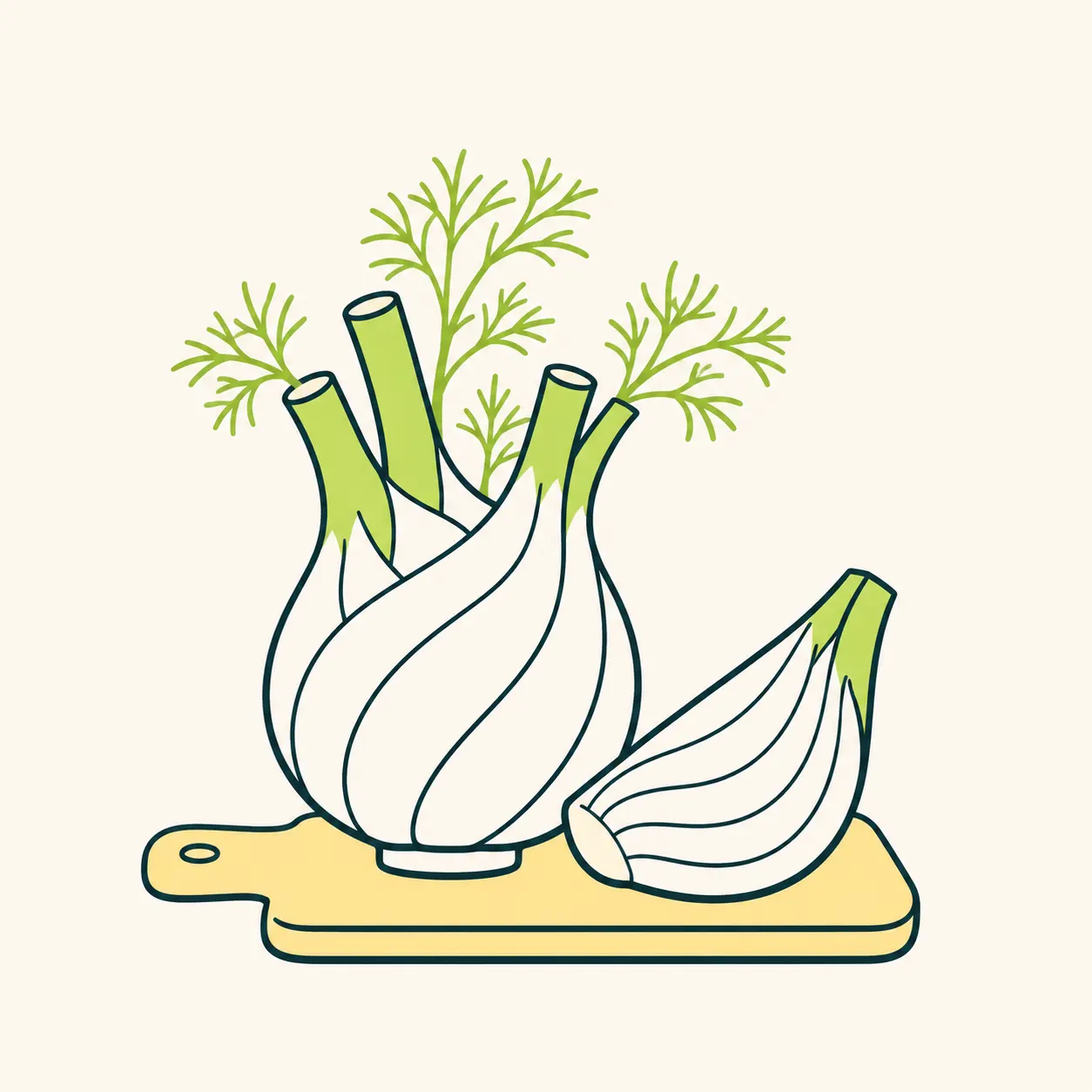
What are we cutting when we divide a fennel head? Its white swelling is often called a bulb, including in recipes. The Royal Horticultural Society explains that it is not a true bulb: it consists of enlarged, overlapping leaf bases. This discovery need not change lunch, but it can change what we notice. Under the knife is a structure made from parts of leaves, rather than one large root. [1]
We need to distinguish Florence fennel, grown for this vegetable, from herb fennel. They are closely related, but cultivated for different purposes. Iowa State describes Florence fennel as the type grown for its swollen leaf bases, while common fennel primarily supplies aromatic leaves and seeds. Recognising the delicate foliage therefore does not mean we should always expect the same broad, compact white swelling at the bottom. [3]
Our editorial example begins on a chopping board. Look at a whole fennel head and then a half already cut by an adult. Follow one white section upwards towards a green stalk. That continuity helps us connect the ingredient with the plant. There is no need to turn the kitchen into a laboratory: describe layers, texture and connections without expecting every specimen to have precisely the same shape. [2]
The result is not automatic in the garden either. The RHS guide highlights the risk of bolting, meaning the move towards flowering: the swelling may fail to develop properly or become woody. This usefully separates our food-growing objective from the plant’s life. What counts as a less desirable harvest for a gardener is not necessarily a botanical mistake. The plant and the cook are pursuing different outcomes. [1]
Purdue suggests straightforward uses: fennel can be sliced thinly and eaten raw, or cooked; its leaves and stalks can also enter preparations. These possibilities do not make every texture identical. Our small comparison is to observe a raw slice and a cooked piece prepared in the same kitchen. Recording the differences is a sensory exercise, rather than evidence of health benefits or a universally superior recipe. [2]
The word bulb remains convenient in cooking, provided we do not mistake it for an exact botanical definition. We can use a market name and then add a more precise explanation. Next time we buy fennel, looking for the connection between its white base and leaves reveals a story that the label leaves out. The vegetable has not changed identity: we have simply improved our description of what was in front of us. [1]
Take this with youFollow a white section towards its stalk. Recognising the leaf bases makes the structure behind a familiar kitchen name visible.
One idea, in simple words
The white part of Florence fennel is often called a bulb in recipes, but the RHS explains that it is not a true bulb. It consists of enlarged, overlapping leaf bases. Herb fennel is related to Florence fennel, but is not grown for the same white swelling. Imagine looking at a fennel half already cut by an adult: you can follow one white section upwards towards a green stalk. This is our observation exercise. Fennel can be eaten raw or cooked. Learning about its structure does not prove health benefits. It simply helps us describe a plant that often reaches the table, and distinguish a convenient kitchen name from a more precise botanical description. [1][2][3]
A little discovery to keep
What did you discover?
Read the sources (3)
- How to grow Florence fennel Royal Horticultural Society · accessed 10 Nov 2026
- Fennel — FoodLink Purdue University Extension · accessed 10 Nov 2026
- All About Dill and Fennel Iowa State University Extension and Outreach · accessed 10 Nov 2026
Original writing and illustration made with AI assistance. Our editorial method
More in Food