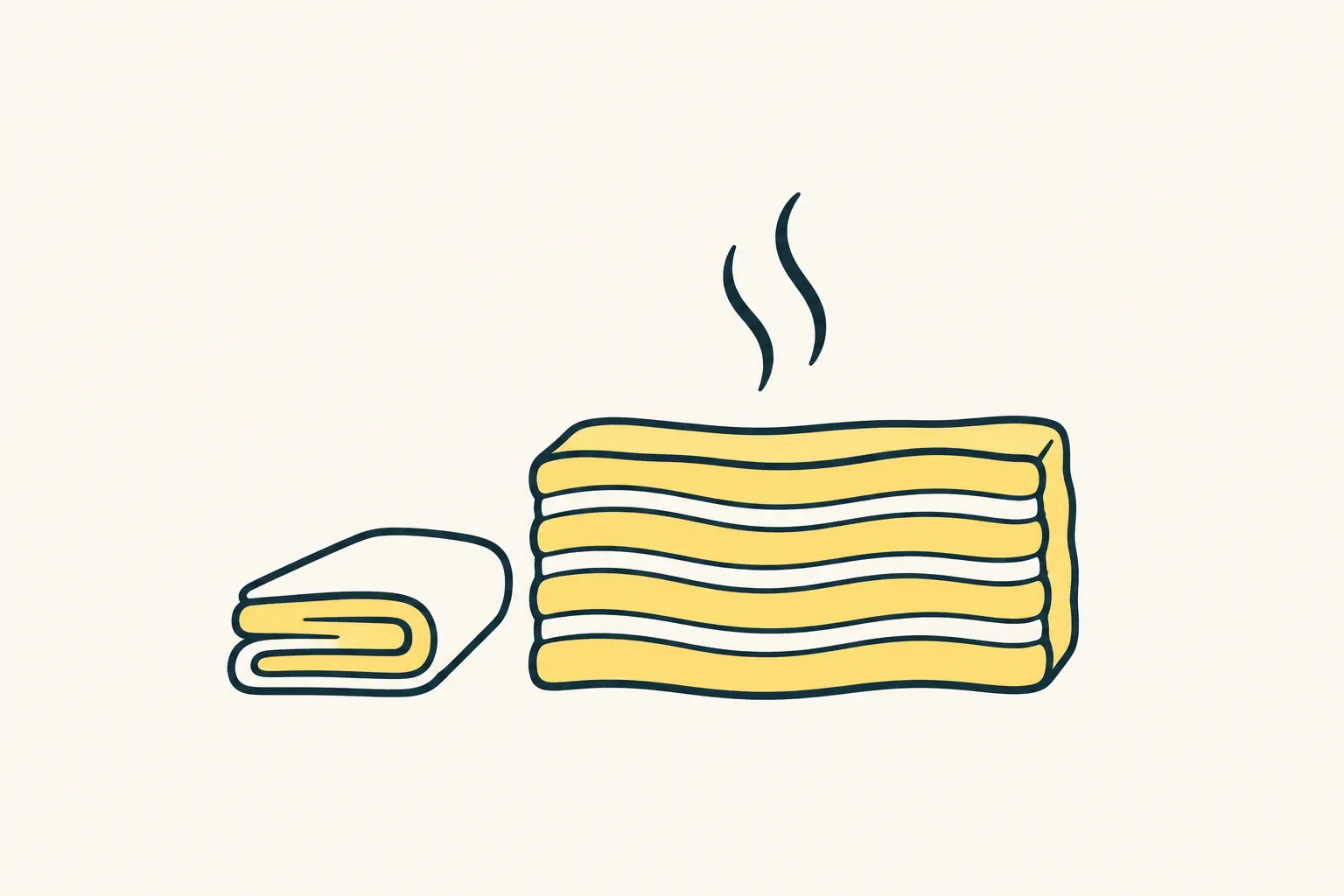
Looking at baked puff pastry, the question almost asks itself: where did all that space come from? Before the oven it was a low sheet of dough; afterwards it shows many separated layers. Columbus State Community College’s teaching material distinguishes classic puff pastry from yeasted laminated doughs such as croissants and Danish pastries. In puff pastry, the lift depends on steam and the structure prepared before baking, rather than a secret ingredient appearing inside the oven. [2]
Lamination creates alternating dough and fat through rolling and folding. The Baking Industry Research Trust explains that the fat must remain sufficiently separate rather than becoming absorbed into a uniform mass. This separation is the central detail. We are doing more than combining a list of ingredients: we are arranging their relationship to one another. As an editorial analogy, think of the difference between stacked sheets of paper and a compressed paper ball. [1]
With heat, some of the water in the dough becomes steam. The college material describes steam expanding between the layers, helping to lift them. Folding has prepared a structure on which heating can act. The image of a small lift between two floors is only our comparison: there is no cabin, and real layers do not have the perfect regularity of a schematic drawing. The mechanism does not require the pastry to contain yeast. [2]
Practical instructions help explain why the process alternates work and waiting. King Arthur’s recipe uses cold ingredients and includes rests during folding; BIRT also relates resting to relaxation of the dough structure. We should not turn this into a universal number of folds, layers or minutes: recipes and methods differ. The small discovery is that pausing can belong to the technique, instead of simply being time taken away from the work. [1][3]
You do not need to remake a complete recipe to observe the result. A baked, cooled piece of puff pastry lets you compare its surface with a broken edge. Look for places where layers remain close and where a gap opens. This is our observation exercise, not a test reconstructing every baking condition. The illustration deliberately reduces the layers to a few shapes; their number does not measure the layers in an actual pastry. [2]
The kitchen therefore offers a more precise question than “what is in it?”: in what order, and with what separation, was it arranged? The same ingredients treated differently do not automatically describe the same structure. Here we are following the specific case of classic puff pastry. Other doughs may use yeast, chemical raising agents or different methods. Identifying steam’s role in this case does not justify a single explanation for everything that rises in an oven. [2]
Take this with youLook at the edge of cooled, baked puff pastry: which spaces were prepared before the heat even arrived?
One idea, in simple words
Classic puff pastry can rise in the oven without yeast. The useful secret to observe is its structure. During preparation, dough and fat form alternating layers through rolling and folding. This process is called lamination. The fat helps keep the layers separate. In the oven, some water in the dough becomes steam. It expands between the layers and helps lift them. As a comparison, imagine stacked sheets moving apart: this is not an exact copy of what happens in pastry. Pauses and cold conditions are part of the preparation in the recipes consulted. There is no single number of folds that applies to every method. Look at the edge of baked, cooled pastry: it is not one uniform block. [2][1]
A little discovery to keep
What did you discover?
Read the sources (3)
- Puff pastry Baking Industry Research Trust · accessed 22 Oct 2026
- 6.1: Laminated Doughs Columbus State Community College, The Bakeshop · accessed 22 Oct 2026
- Classic Puff Pastry (Pâte Feuilletée) King Arthur Baking · accessed 22 Oct 2026
Original writing and illustration made with AI assistance. Our editorial method
More in Food