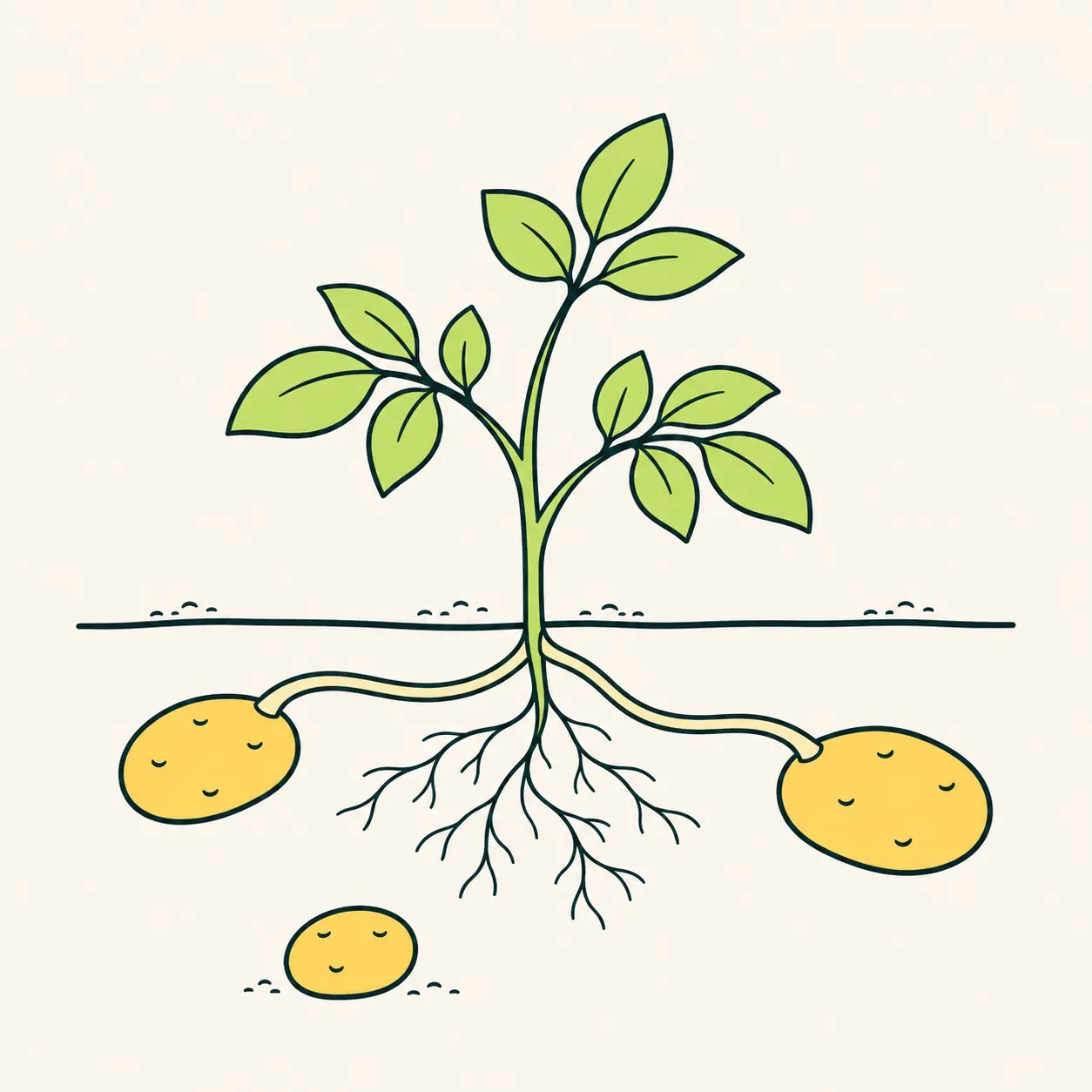
A potato on a chopping board seems very different from a branch. Yet the tuber familiar in the kitchen is a modified stem, not a root. The distinction does not depend on growing underground: different kinds of plant organs can occupy that space. In Solanum tuberosum, tubers develop at the ends of stolons, slender underground stems. This is a story of connections that the harvested potato, detached from its plant, no longer shows in full. [1]
Clues remain on the surface. The so-called eyes are buds, points from which new growth can begin when conditions become favourable. The University of Minnesota’s botany textbook connects them with nodes on the tuber: they belong to its organisation as stem tissue. They are not holes for seeing, nor hidden seeds. The everyday metaphor is convenient, but the botanical name explains something that the word eyes merely encourages us to picture. [2]
The tuber also serves as a store. The International Potato Center describes how new tubers formed during growth remain after the above-ground plant dies back and can support later regrowth. This helps explain vegetative propagation: a plant can begin from a tuber or a piece carrying buds. That differs from reproduction through true seeds, which belong to the cycle of flowers and fruits. A piece used for propagation is not transformed into a botanical seed by its purpose. [3]
The University of Maryland guide notes that potatoes produce flowers and sometimes fruits containing seeds. Those seeds are not tubers, and they do not guarantee the same uniformity as the cultivated variety. The expression seed potato can therefore be misleading: in cultivation it normally describes vegetative material used for planting. The name tells us the role it plays in an agricultural task; botany asks which organ we are looking at. Both questions are useful, but different. [1]
Try an editorial observation before cooking. Examine a whole potato and find a few small depressions in its skin, then compare their pattern with the photograph of a sprouted tuber in the source. Understanding the principle does not require sprouting it or eating a deteriorated potato. For a moment, the chopping board becomes a collection of plant parts. Things loosely grouped together as vegetables can conceal structures with quite different relationships to the plants they came from. [2]
One comparison shows the limits of resemblance: the Minnesota textbook describes sweet potato as a storage root, unlike the common potato’s stem tuber. Both can be swollen and grow in soil without being the same organ. This does not establish equivalent nutritional properties or provide instructions for eating them. The central discovery concerns structure: shape, location and a culinary name are insufficient on their own. Looking at buds and connections changes the classification. [2]
Take this with youA potato’s eyes are buds on a storage stem. To identify a plant part, consider how it grows and what it connects to, as well as its appearance.
One idea, in simple words
The common potato we eat is a tuber: a swollen part of an underground stem. It is not a root. It grows at the end of slender stems called stolons and stores reserves for the plant. Its skin has eyes. This name means buds, which can produce new shoots. They are not seeds. A potato plant can also make flowers and fruits containing true seeds: these belong to another part of its life cycle. Imagine looking at a photograph of the whole plant and following the connection between stem, stolon and tuber. This helps you find your bearings. Sweet potato is different: its swollen part is a storage root. Growing underground does not make every plant organ the same. [2][1]
A little discovery to keep
What did you discover?
Read the sources (3)
- Growing Potatoes in a Home Garden University of Maryland Extension · accessed 13 Nov 2026
- The Science of Plants, 1.3 Plant Parts we Eat University of Minnesota Libraries · accessed 13 Nov 2026
- How Potato Grows International Potato Center (CIP) · accessed 13 Nov 2026
Original writing and illustration made with AI assistance. Our editorial method
More in Food