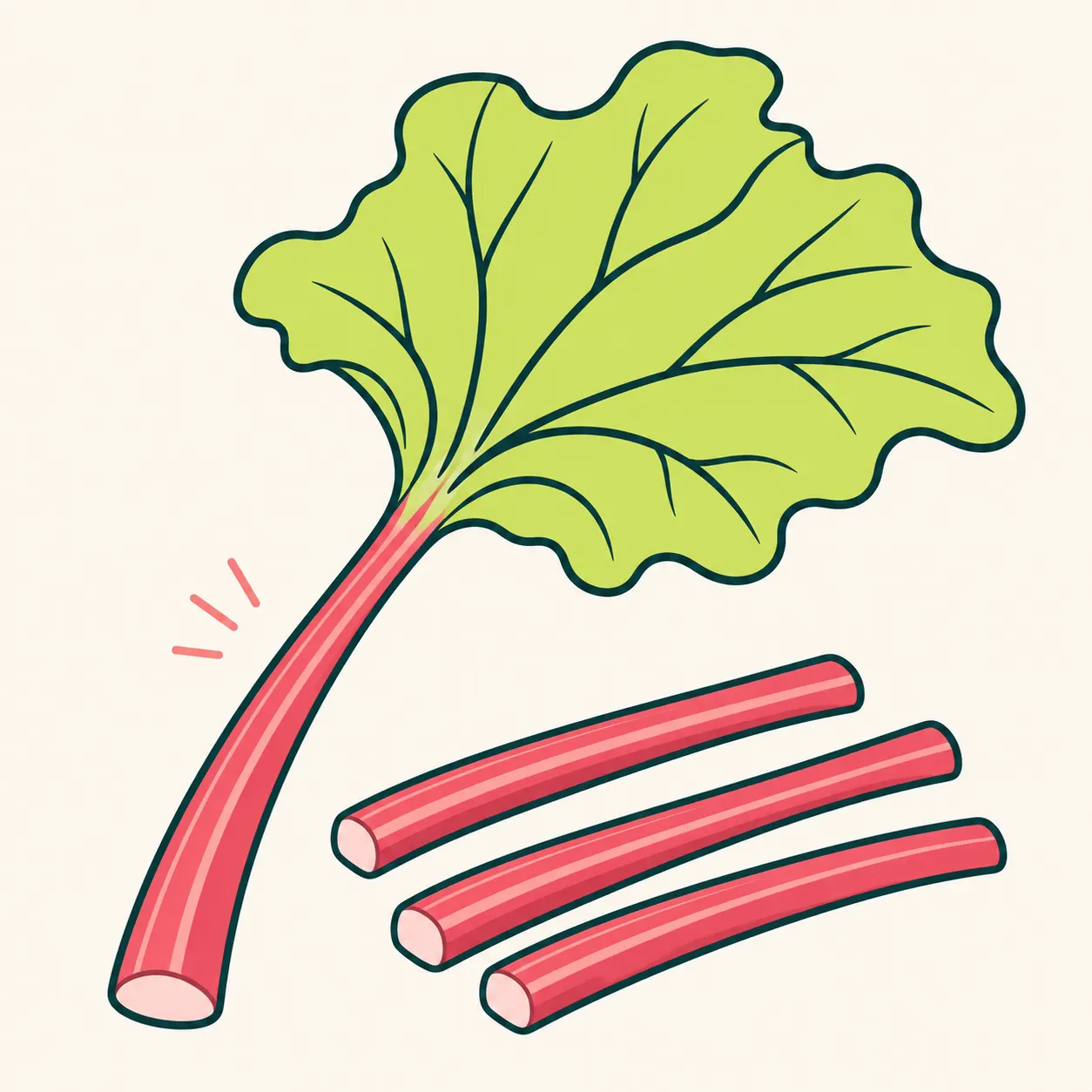
A rhubarb dessert can immediately suggest the category “fruit”. The Royal Horticultural Society instead presents rhubarb as a perennial vegetable harvested for its fleshy leaf stalks, or petioles. The surprise is not a contest between right and wrong labels. Cooking and botany are describing different things: one considers an ingredient’s role in a dish, while the other identifies which part of the plant we have in front of us, before any recipe begins. [1]
The long piece sold for cooking is therefore not a fruit: it is a petiole. University of Minnesota guidance clearly distinguishes this from the broad leaf blade. That distinction has a precise practical consequence too: rhubarb leaves are toxic and must not be eaten. The food use of the part being sold must not be extended to the whole plant. Botanical observation here becomes more than learning a name; it identifies a concrete difference. [2]
Colour can tell an oversimplified story as well. Varieties have red, pink or green stalks; green alone does not establish that rhubarb is unripe. Minnesota’s account also cautions that colour does not determine a particular flavour. At a market stall, we can therefore avoid an automatic scale from green “not ready” to red “very sweet”. Variety, appearance and taste are not perfectly interchangeable descriptions, even when a familiar colour tempts us to treat them that way. [1][2]
The RHS also describes forcing: covering the plant to exclude light can bring the harvest forward and produce paler, more tender stalks. This is a growing practice, not a new species. It adds a second question when reading an ingredient: not only “which part is this?”, but also “how did it grow?”. Visible colour can reflect variety and production conditions; it cannot tell the entire story of the work preceding the harvest. [1]
Try this editorial market exercise: imagine two labels beside the same product. One says how to use it in cooking; the other names the part of the plant. “For a dessert” and “petiole” can sit together without contradiction. There is no need to taste leaves or unfamiliar parts to make this observation. Ask the seller and separate culinary description from botanical description, avoiding any attempt to turn a colour resemblance into a safety test. [2]
Rhubarb offers a small lesson in classification. A category is useful when we know which question it answers. We can enjoy an ingredient in a dessert while recognising its plant anatomy, without requiring it to become a fruit. Next time you read a recipe, try naming the part being used. Precision need not remove pleasure from cooking; sometimes it simply adds one worthwhile question before taking the first bite of a familiar dish. [1][2]
Take this with youAsk two different questions: how is an ingredient used, and which part of the plant is it? Both answers can coexist.
One idea, in simple words
Rhubarb is often used in desserts. But the part eaten is not a fruit: it is the petiole, meaning the leaf’s stalk. These stalks are long and fleshy. Depending on the variety, they can be red, pink or green. Green alone does not mean unripe, and red does not guarantee a particular flavour. The broad leaf blade is different from the stalk: it is toxic and must not be eaten. Imagine two labels beside the same ingredient. One says “for a dessert” and the other says “leaf stalk”. They do not contradict each other. The first describes a use in cooking; the second describes a part of the plant. Do not taste unfamiliar parts to identify them. Observing and asking questions helps us learn the difference. [1][2]
A little discovery to keep
What did you discover?
Read the sources (2)
- How to grow rhubarb Royal Horticultural Society · accessed 11 Nov 2026
- Growing rhubarb in home gardens University of Minnesota Extension · accessed 11 Nov 2026
Original writing and illustration made with AI assistance. Our editorial method
More in Food