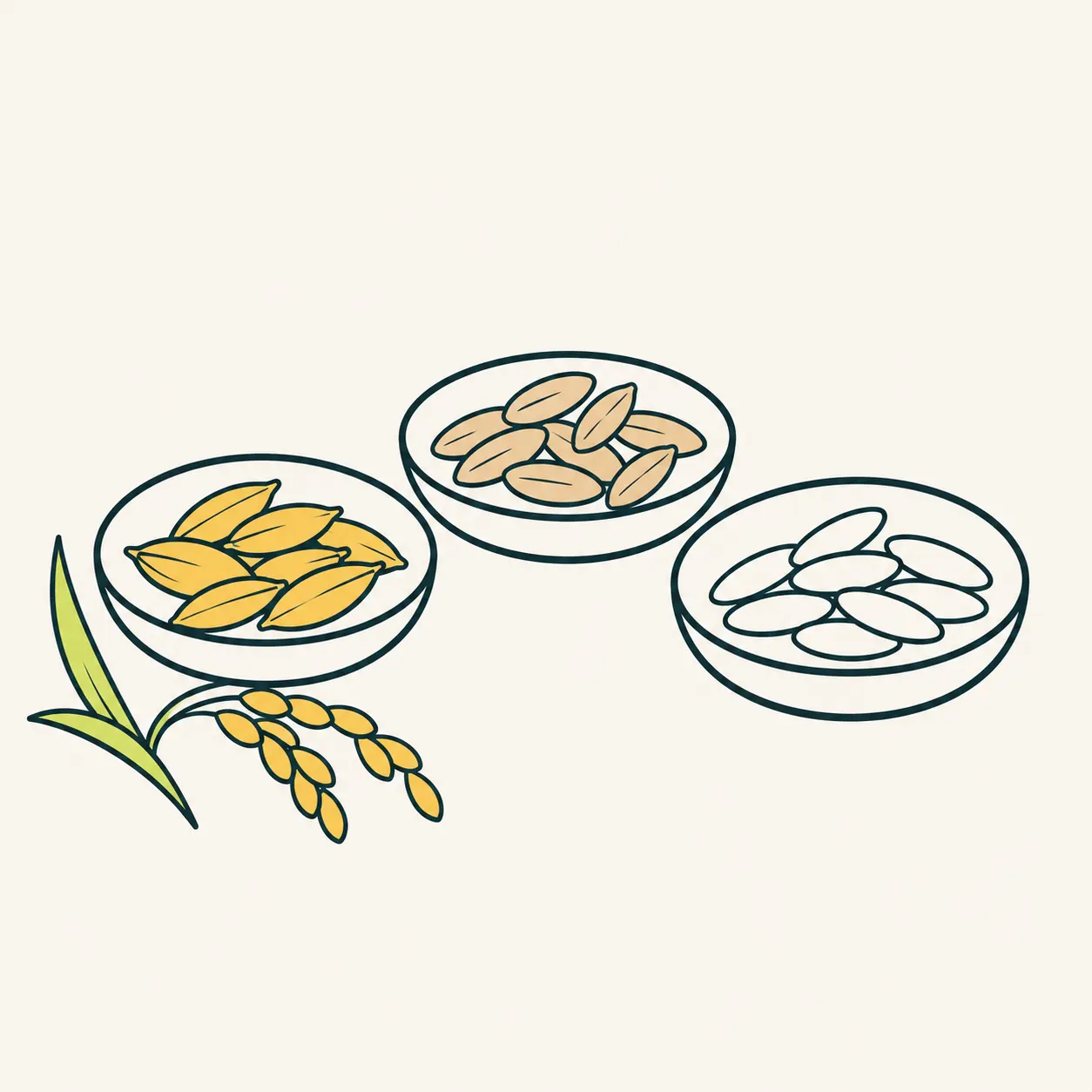
Two bowls of rice, one brown and one white, may immediately suggest two entirely different plants. Before looking for the variety, however, it is worth asking which parts of the grain have been retained. The International Rice Research Institute’s laboratory distinguishes two operations: dehulling removes the outer husk of paddy rice to produce brown rice; further milling removes the outer bran layers and produces white rice. Colour can therefore tell us about a process, rather than only a different botanical origin. [1]
The distinction is concrete because husk and bran are not the same thing. Stopping after removing the husk leaves a brown rice grain with its outer layers; continuing the process changes what remains. There is no need to imagine white paint being added to the rice. The laboratory guide describes mechanical removal. This does not mean that any two packets necessarily contain the same variety. It means that brown and white, on their own, describe processing and are not sufficient names for identifying a plant. [1]
IRRI’s consumer guide also distinguishes parboiled rice. Here, treatment takes place while the grain remains in its husk and involves partially cooking its starch before further processing. It is not simply another word for brown rice. We can therefore encounter words that answer different questions: which variety, which treatment, how many layers retained? Mixing them up makes a label harder to read. Separating them helps us understand what we are looking at without turning every packet into a ranking exercise. [2]
The FAO notes that rice quality includes different characteristics for the grower, the processor and the cook. Variety, environmental conditions and processes after harvest can influence different properties of the grain. We do not turn this observation into a universal health recommendation. Colour alone does not describe texture, aroma or behaviour during cooking either. The useful discovery is simpler: the final product has a history of transformations, and that history deserves to be read alongside the name on its packet. [3]
Try a small editorial exercise: compare two packets and look for three separate pieces of information, the declared variety, the word brown or wholegrain, and a parboiled description. Note what you find, leaving blank anything the label does not tell you. There is no need to taste uncooked grains or invent a laboratory test. The aim is to recognise which questions already have answers and which remain open. A white grain is not an erased mystery: it is an everyday object from which particular parts have been removed during processing. [1][2]
Take this with youRead a packet by separating variety from treatment: brown, white and parboiled do not all answer the same question.
One idea, in simple words
Rice goes through several steps before reaching the table. Paddy rice has an outer husk. Removing that husk produces brown rice. If the outer bran layers of the grain are also removed, the result is white rice. IRRI, an institute that studies rice, describes these as separate steps in its laboratory guide. The grain is not painted white. Imagine an example: removing the first covering does not mean every layer beneath it has already been removed. Brown and white therefore also describe how rice has been processed. They do not tell us its variety by themselves. Parboiled refers instead to a treatment while the grain is still in its husk. Looking at words on a packet helps separate different questions, without judging a food only by its colour. [1][2]
A little discovery to keep
What did you discover?
Read the sources (3)
- Rice grain sample preparation and submission guide International Rice Research Institute · accessed 15 Nov 2026
- A consumer’s guide to rice International Rice Research Institute · Rice Today · accessed 15 Nov 2026
- Rice in human nutrition — Grain quality Food and Agriculture Organization of the United Nations · accessed 15 Nov 2026
Original writing and illustration made with AI assistance. Our editorial method
More in Food