A slender dark fruit is opened in a kitchen, revealing tiny seeds. The scene suggests a spice, rarely an orchid. Yet Vanilla planifolia belongs to the orchid family, Orchidaceae, and grows as a climbing vine. What we commonly call a vanilla bean or pod is botanically a capsule, not a legume. The first surprise is already in the name of the object in our hand, before we even smell it. [1]
The University of Florida’s guide describes fleshy leaves, pale flowers and elongated fruits developing after pollination. Each flower remains open only briefly, for about one day; hand pollination plays an important role in commercial cultivation. This does not mean that every flower automatically becomes a fruit, or that the dark shop-bought product is simply plucked from the vine in that condition. A sequence of work connects those different moments. [1]
Kerala Agricultural University distinguishes the harvested green fruit from vanilla after curing, the treatment following harvest. The familiar aromatic character develops during this processing. Florida’s guide explains a central chemical change: vanillin is released from glucovanillin. It would be misleading to present this as the magic of drying alone, or reduce the entire aroma to one isolated substance. Transformation and water loss are related aspects of processing, but they are not identical. [3][2]
Methods can include an initial heating stage, a period kept warm and moist, drying and conditioning. Details depend on the process and the material being treated. We are examining the general sequence, not providing a home recipe: time, moisture and storage conditions influence quality. The dark colour and texture of a capsule sold in a shop therefore tell us about processing as well as about a plant grown in a field. [2]
Try an editorial exercise: draw three boxes on paper and label them flower, fruit and processing. Where would you place the object you recognise in a supermarket? The question does not test cooking ability. It makes visible a part of the supply chain that our mental picture often leaves out. A spice can seem like a small, already finished object, although its most familiar appearance is only one stage in its story. [1][2]
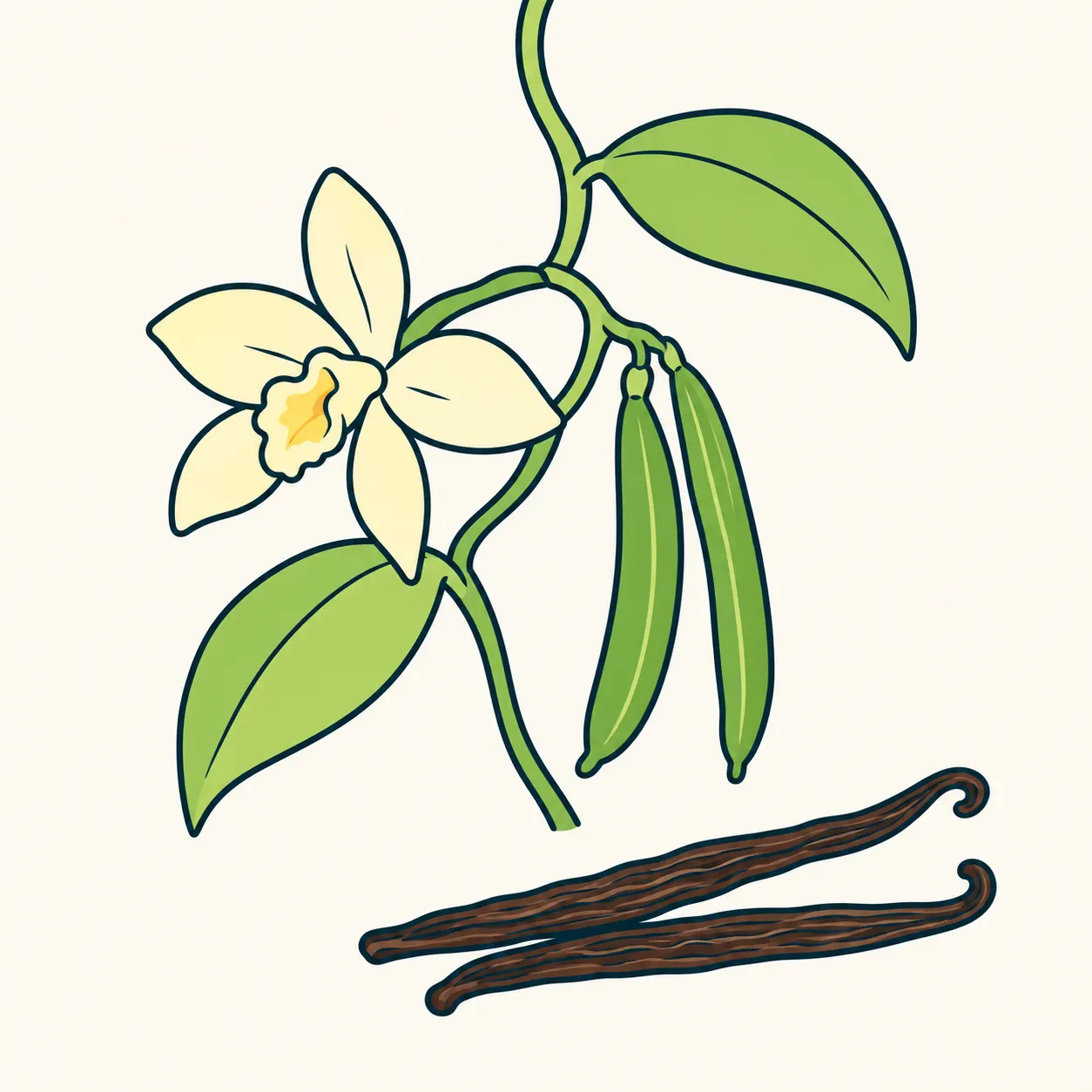
In our illustration, green capsules on the plant and separate dark capsules represent different stages placed together for explanation. This is not a photograph of freshly harvested fruits sharing the aroma of the cured product. Next time you encounter vanilla, you can recognise both botany and transformation. Its fragrance does not erase the work needed to obtain it; it gives us a reason to ask what happened before the jar was opened. [3][2]
Take this with youBehind a dark capsule are an orchid, a fruit and a process: separating those stages makes even a kitchen curiosity more precise.
One idea, in simple words
Vanilla comes from a climbing orchid called Vanilla planifolia. After pollination, a flower can develop into a long fruit. We often call it a bean or pod, but botanists call it a capsule: a type of fruit different from a bean’s. The dark vanilla sold in shops is not harvested in exactly that condition. The fruit undergoes processing called curing. Changes during this process develop its aroma; a substance called glucovanillin releases vanillin. Drying means removing water, but curing is not simply drying. Imagine three pictures in order: the flower, the green fruit and the cured capsule. They show different stages, not three different plants. Recognising these stages helps us understand the familiar ingredient. [1][3][2]
A little discovery to keep
What did you discover?
Read the sources (3)
- Vanilla Growing in South Florida University of Florida — IFAS Extension · accessed 3 Nov 2026
- Natural Vanilla Extract Production University of Florida — IFAS Extension · accessed 3 Nov 2026
- Vanilla — Harvesting and curing Kerala Agricultural University — Centre for e-Learning · accessed 3 Nov 2026
Original writing and illustration made with AI assistance. Our editorial method
More in Food