An open book can explain a great deal. But for Jean-Jacques Rousseau, education is not identical to what an adult tells a pupil. In Book I of Emile, he distinguishes education from nature, from other people and from things. The first concerns the development of our faculties; the second concerns learning how to use them; the third concerns what we gain through our own experience of objects around us. [1]
The same book contains the French sentence “Vivre ce n’est pas respirer, c’est agir”. Our translation is “To live is not to breathe, but to act.” Rousseau continues by discussing the use of our senses and faculties. This is an educational argument, not a competition to remain constantly busy. The sentence centres on living through personal engagement, rather than simply preserving an individual from every encounter with the world. [1]
The distinction between three educations includes an interesting limit. Rousseau acknowledges that we cannot entirely control natural development, circumstances or every word spoken by people around a child. An educational project therefore meets something that resists its direction. Our reading finds a reason here to leave room for questions: explaining an experience does not mean that we have already undergone it on behalf of the person learning. [1]
Imagine an editorial example, absent from the book: two leaves on a table. We can read that they differ and repeat the description. Or we can observe their edges, compare their veins and explain which detail changed our mind. Neither action makes the book useless. The scene concerns a move from receiving an answer to making a comparison we can justify, without insisting that every discovery must be made alone. [1]
Emile remains a historical philosophical work, not an educational protocol tested through contemporary methods. It contains judgements and prescriptions shaped by its period, which we do not automatically adopt. Here we discuss one particular distinction, without extracting medical advice from its pages on childhood. Acting should also be understood without turning the sentence into a judgement about the worth of people who rest, have a disability or need assistance. [1][2]
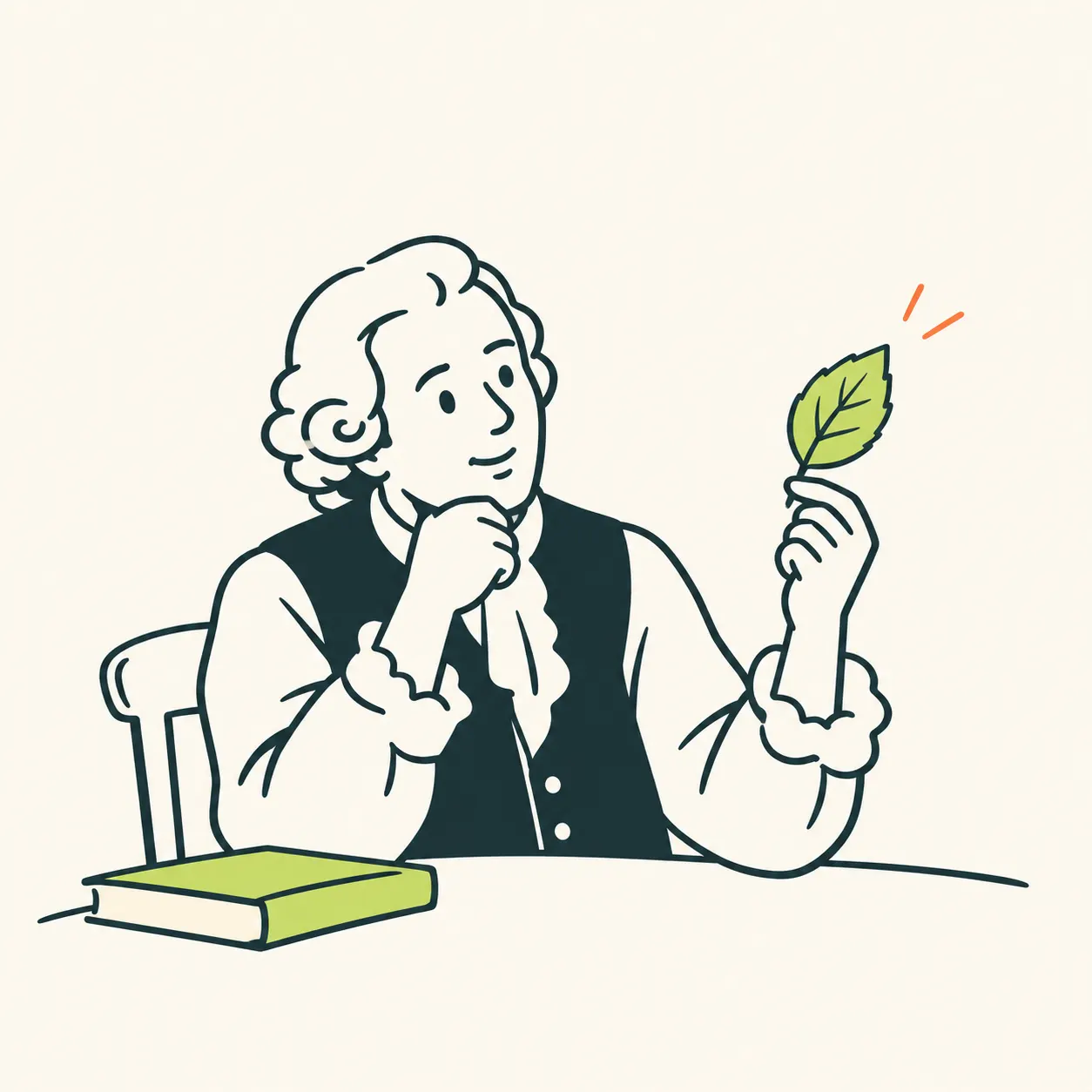
Our illustration shows a figure inspired by Rousseau looking at a leaf: an imagined editorial scene, not a documented episode. It makes a simple question visible: which part of what I know can I explain through an observation? The book can stay on the table. It need not resign; it can become a partner in conversation rather than permanently occupying our own place in front of things. [1]
Take this with youChoose a nearby object and describe one observable detail before looking up its name: what does checking add to your first impression?
One idea, in simple words
Rousseau was a philosopher. In Emile, he asks how we learn. He distinguishes three kinds of education: the development of our abilities, what other people teach us, and what we discover by experiencing things. For example, you can read a description of two leaves and then examine their edges yourself. This example comes from our editors. It does not mean that books are useless: reading and observing can support each other. The sentence “To live is not to breathe, but to act” concerns using our senses and abilities in that passage. It does not demand endless work. This is a historical philosophical idea, not a scientific law or medical advice. We can discuss it and ask what we have actually observed. [1][2]
A little discovery to keep
What did you discover?
Read the sources (2)
- Émile, ou De l’éducation, livre I — édition de 1782 Jean-Jacques Rousseau · Wikisource · accessed 4 Nov 2026
- Emile, Book I — translation by Barbara Foxley Jean-Jacques Rousseau · Project Gutenberg · accessed 4 Nov 2026
Original writing and illustration made with AI assistance. Our editorial method
More in Philosophy