An explanation ends and someone nods. Have they understood, or are they simply protecting their reputation? This is our editorial question, but it opens the problem Plutarch examines in On Listening to Lectures. The text does not offer a technique for taking more notes: it considers the conduct of a learner. Its final sections address both embarrassment about admitting difficulty and the opposite habit of asking others to do all the work. [1][2]
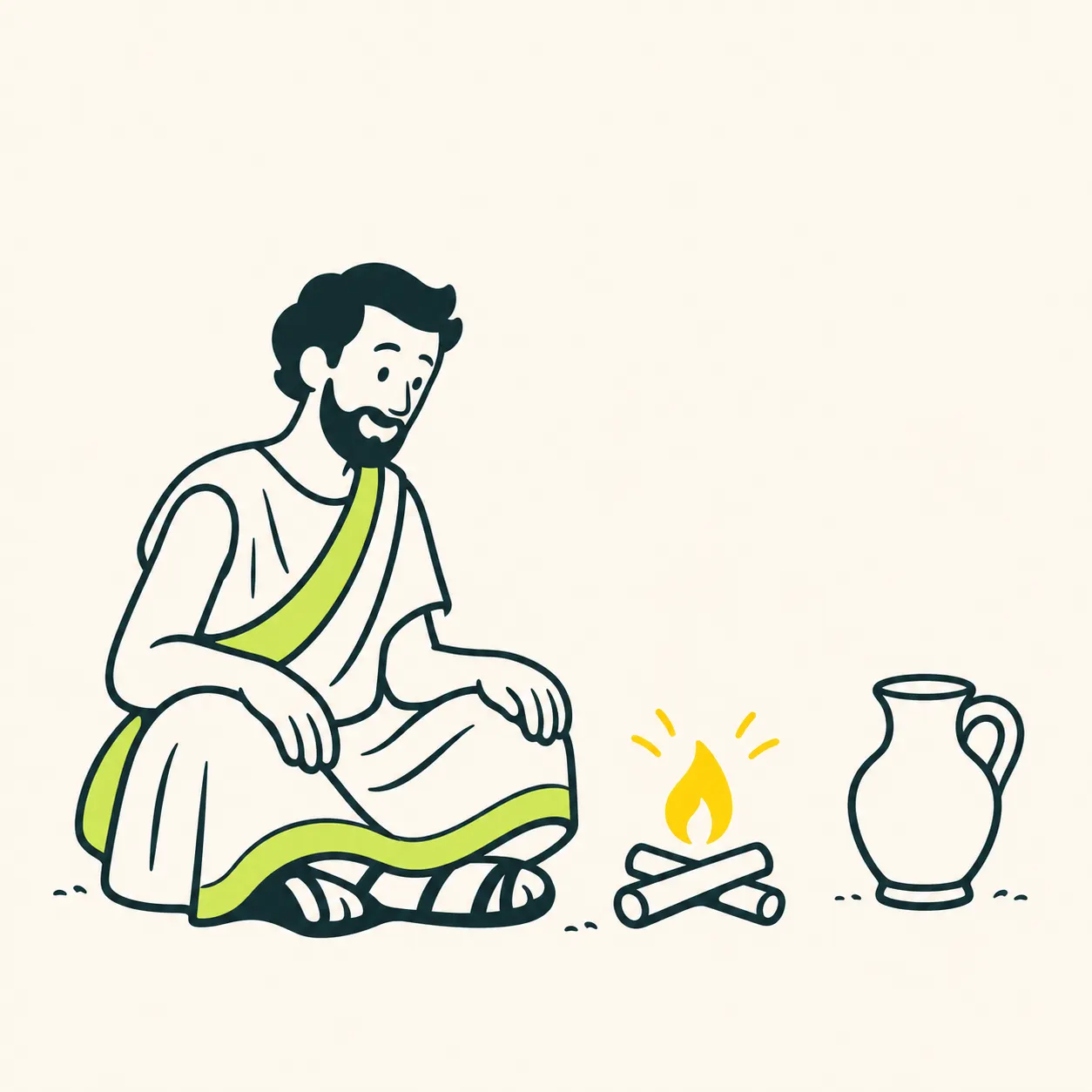
Section 18, Moralia 48C, contains today’s phrase: “οὐ γὰρ ὡς ἀγγεῖον ὁ νοῦς ἀποπληρώσεως ἀλλʼ ὑπεκκαύματος μόνον ὥσπερ ὕλη δεῖται”. Our translation is: “The mind does not need filling like a vessel; like wood, it needs only kindling.” We consulted the Greek of Vernardakis’s edition through Perseus and compared F. C. Babbitt’s 1927 English translation. The excerpt preserves the images of wood and a vessel instead of turning the thought into a free-floating saying with no identifiable work or author. [1][2]
Immediately afterwards, Plutarch develops the comparison. Someone who visits a neighbour to borrow fire should not remain there warming themselves forever. Likewise, listeners should kindle a light of their own instead of merely enjoying another person’s words. This is a metaphor for intellectual work, not a biological description of the mind. The central discovery is that receiving an explanation and beginning to reason are different actions, even when they happen closely together. [1][2]
The passage criticises two different behaviours. One person wants every answer already prepared, avoiding the effort of investigation; another interrupts with unnecessary difficulties to seem clever. That does not mean asking questions is wrong. The issue is their purpose: clarify what matters, then continue working on it. A sincere question may begin by admitting ignorance, something the treatise contrasts with the wish to appear capable and informed at every moment. [1][2]
Imagine, as an example supplied by our editors, a friend explaining a recipe. Repeating the ingredients is not yet understanding why one step comes before another. Trying to explain that choice in your own words may reveal a specific uncertainty. This contemporary example is not Plutarch’s and does not prove a universal teaching method. It simply makes visible the difference between retaining an answer and using it to build understanding. [1][2]
The metaphor does not license contempt for memory, study or teachers. The treatise is precisely about learning from someone, and it asks learners to combine instruction with investigation of their own. Nor must we import every social rule of its ancient setting without examination. We can keep a narrower question: after listening, which step could I reconstruct myself, and which still needs clarification? The vessel can rest; the question finally has a job. [1][2]
Take this with youAfter an explanation, try forming one useful question and a short account of your own. These are editorial reading exercises, not a test of personal worth.
One idea, in simple words
Plutarch wrote a text about listening to someone who teaches. He uses a comparison: the mind is not simply a container to fill, but resembles wood that needs kindling. This is a metaphor, an image that helps explain an idea. It does not mean there is a real fire inside our heads. Listeners should use an explanation to begin reasoning for themselves. Plutarch criticises both people who want every answer ready-made and those who ask needless questions to show off. Useful questions still matter. Imagine hearing a recipe: you can repeat the ingredients, or try to understand why one step comes before another. The second action starts some thinking of your own. [1][2]
A little discovery to keep
What did you discover?
Read the sources (2)
- Περὶ τοῦ ἀκούειν, §18, Moralia 48C — testo greco, ed. G. N. Vernardakis (1888) Plutarco · Perseus Digital Library, Tufts University · accessed 3 Nov 2026
- On Listening to Lectures, §18 — traduzione F. C. Babbitt (1927) Plutarch · LacusCurtius, University of Chicago · accessed 3 Nov 2026
Original writing and illustration made with AI assistance. Our editorial method
More in Philosophy