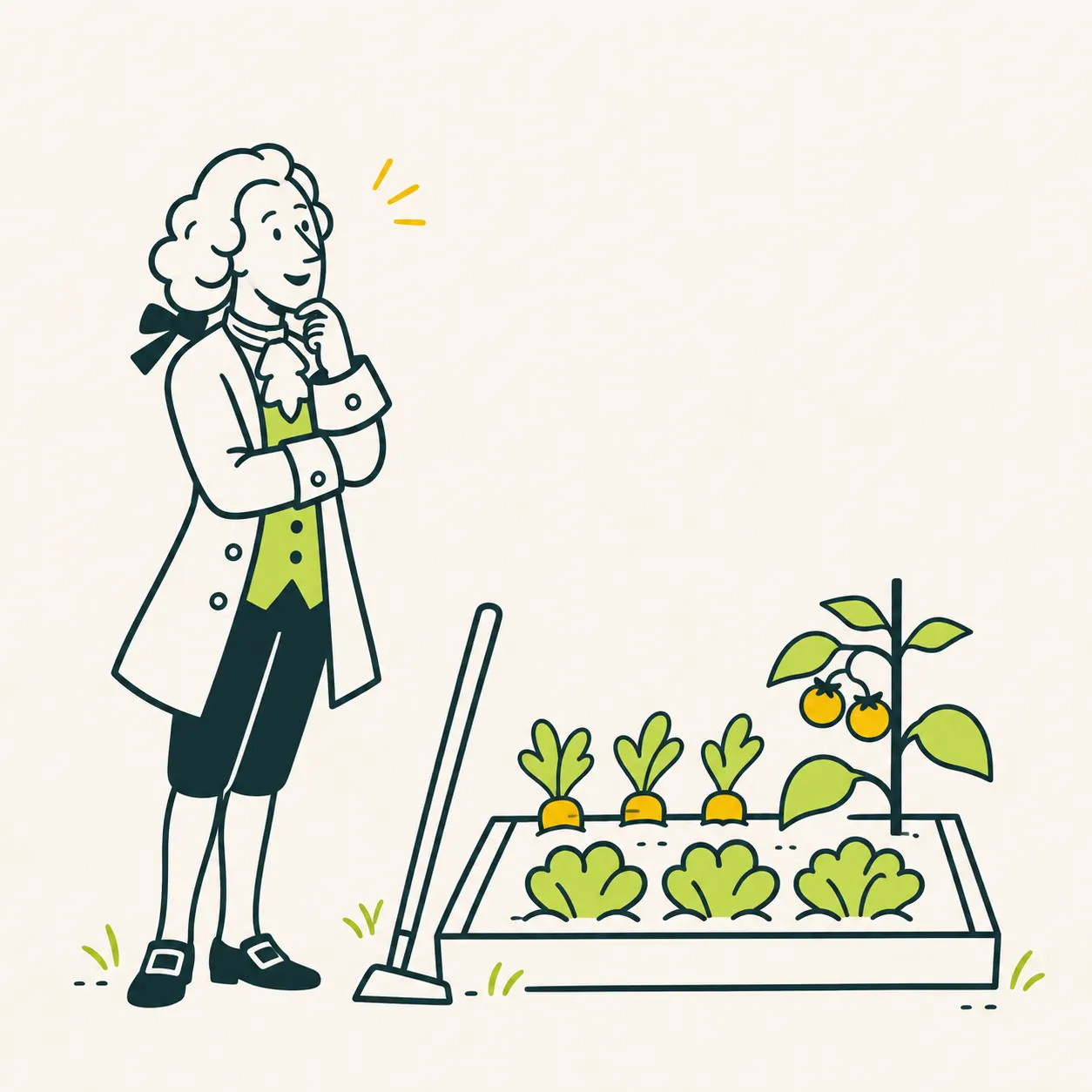
At the end of Candide, no theory arrives to put absolutely everything right. A garden does. In Chapter XXX of Voltaire’s tale, the protagonist is still answering Pangloss, who keeps fitting every adventure into an overarching order. The closing sentence contains “il faut cultiver notre jardin”. Our translation is “We must cultivate our garden.” These are words spoken by the character Candide, rather than an anonymous proverb or an isolated piece of gardening advice. [1]
The context matters. The companions have experienced violence, losses and disillusionment; living together at the end does not automatically make them content. An encounter with a man who works the land with his children gives Candide another point of observation. When the group organises its life, each person puts a skill into practice. The story thus places very broad discussions beside limited activities: the distance between them is part of its irony. [1]
Our reading is that the garden introduces a measure of practical responsibility. It does not show that the world’s problems are small, or that ignoring them makes them disappear. We can read it as a question about available means: what needs attention here, with these people, today? The word “our” also leaves room for a shared reading. This is an interpretation of the ending, not a scientific formula promising happiness through labour. [1]
Imagine an editorial example: a shared courtyard has a broken bench. People could discuss the decline of neighbourly life for hours; they could also establish responsibility, report the damage and arrange a repair. The second approach does not make discussion of causes pointless. It asks that discussion to connect with something that might change. This courtyard does not appear in Candide: it simply helps us try out the suggested reading without turning it into an absolute rule. [1]
The ending does not erase every earlier difficulty or distribute a perfect happy conclusion. That is why the motivational calendar version deserves some resistance. Voltaire places the phrase inside a conversation, with characters and contradictions; extracting it calls for remembering the scene. A small activity can interrupt a loop of explanations without justifying suffering. In our reading, the garden remains a place for attention and cooperation, rather than a wall that releases us from every other responsibility. [1]
Take this with youBefore treating a quotation as a universal answer, return to the conversation containing it. Then identify one practical task that can be shared: a modest question to keep beside the large ones, without claiming it can replace them.
One idea, in simple words
Candide is the main character in a tale by Voltaire. In the final chapter he talks to Pangloss, who seeks a general explanation for everything that has happened. Candide says in French, “il faut cultiver notre jardin”. Our translation is “We must cultivate our garden.” In the story, the group begins using its abilities in practical work. The sentence therefore belongs to a story, rather than an anonymous proverb. We can read it as an invitation to care for something alongside other people. This is an interpretation, not a promise of happiness. An example invented by our editorial team is working together to improve a courtyard. Doing so does not remove all the world’s problems, but it addresses one particular problem. [1]
A little discovery to keep
What did you discover?
Read the sources (1)
- Candide, ou l’optimisme, chapitre XXX — texte français Voltaire · Project Gutenberg · accessed 5 Nov 2026
Original writing and illustration made with AI assistance. Our editorial method
More in Philosophy