Needs attention
How to care for it, step by step
Care guide checked on
Is it for you?
Suitable for someone with a very bright place protected from frost. Moderate difficulty is an editorial assessment based chiefly on drainage and matching watering to plant activity. [1][2]
Where to put it
Provide strong light and a sheltered position; avoid frost. Gradually acclimatise an indoor-grown specimen when moving it into outdoor sun to limit scorching. [1][2]
Step by step
Read the label and observe the form: nursery Aeonium plants may include hybrids with imprecise names. [1][2]
Before watering, consider growing-medium moisture and whether the plant is actively growing. [1][2]
Allow water to drain without keeping the pot standing in accumulated water. [1][2]
Inspect rosettes and stems, distinguishing loss of old leaves from rapid, widespread changes. [1][2]
If something looks wrong
Old leaves fall at the base of a rosette
Check
Check whether only the oldest leaves are affected and the stem remains healthy: this can be part of growth. [1][2]
What to do
Observe before increasing water; if the change is widespread, inspect growing medium and conditions too. [1][2]
Marks appear after moving into sunshine
Check
Check whether the plant moved abruptly from indoors to strong direct sunlight. [1][2]
What to do
Return to a more gradual exposure and acclimatise progressively; do not automatically treat the problem as thirst. [1][2]
Read the sources (2)
- Aeonium arboreum Royal Horticultural Society · accessed 8 Nov 2026
- Aeonium University of Wisconsin–Madison, Extension · accessed 8 Nov 2026
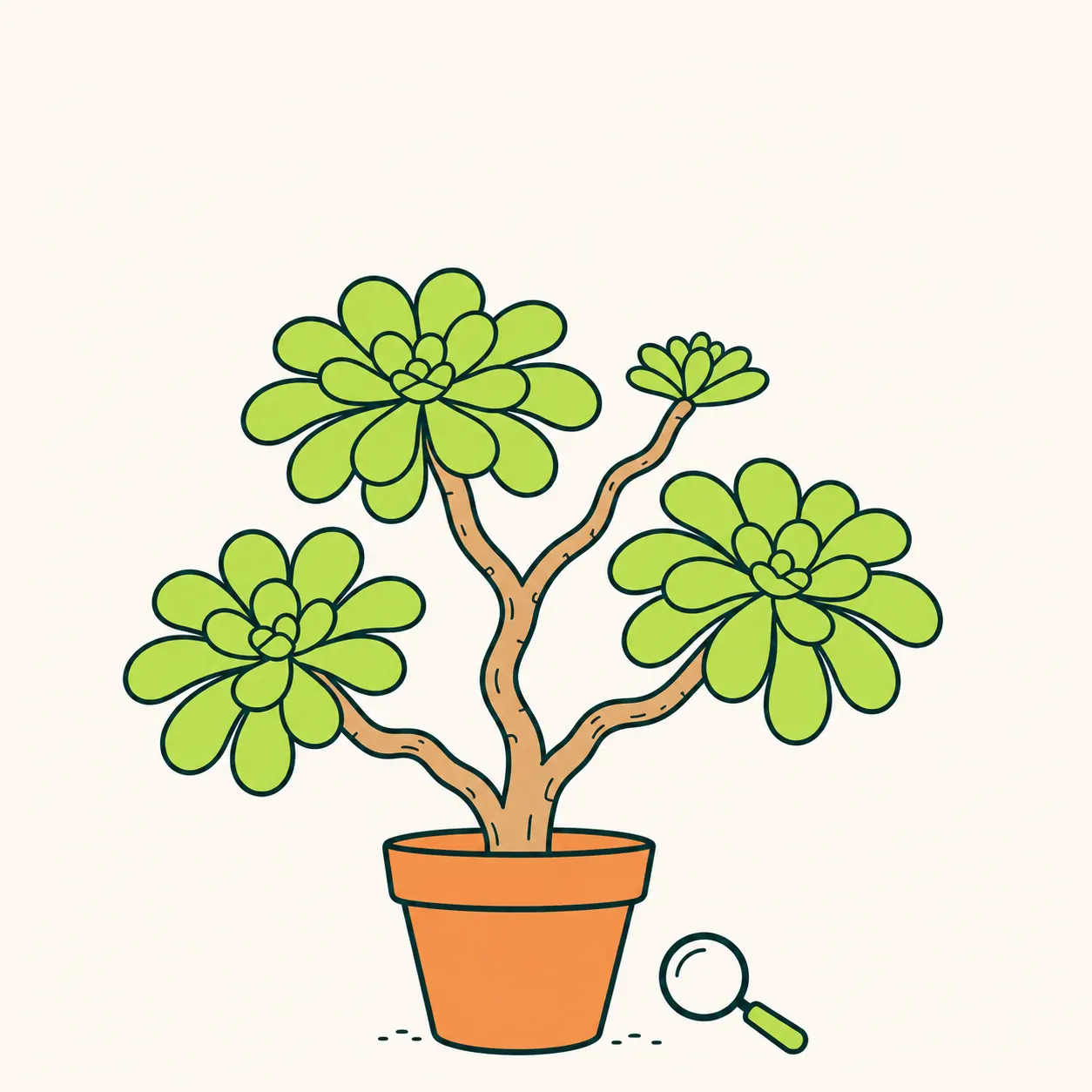
It resembles a little tree that has placed a green rose at the end of every branch. Aeonium arboreum invites that comparison, provided we keep it in its proper place: a visual resemblance, not a relationship to roses. The Royal Horticultural Society describes a branching succulent shrub with fleshy, spoon-shaped leaves arranged in terminal rosettes. The orderly shapes that first catch our attention are therefore groups of leaves, rather than unusually large green flowers. [1]
Its actual flowers are small and yellow, gathered into a cone-shaped inflorescence. Inflorescence means a group of flowers organised on a stem: a useful word for separating two structures our eyes might confuse. In a pot, a rosette remains a leafy structure even when it resembles a flower’s ring of petals. No sophisticated lens is required for this discovery. We can simply ask which parts we have been calling petals and check whether they are leaves instead. [1]
The University of Wisconsin’s Extension account notes that the genus contains different forms and that nursery plants can be hybrids or carry imprecise names. A label is worth reading without treating it as conclusive identification. In branching forms, older leaves fall away and expose stems. The end of an individual rosette after flowering does not necessarily mean the entire branching plant has died. The scale at which we observe, whether leaf, rosette or whole plant, changes the conclusion we can reasonably draw. [2]
Cultivation likewise asks us to observe the actual plant. The RHS recommends abundant light, protection from frost and well-drained growing conditions. Seasonal guidance should not become a universal calendar: climate and growing conditions affect activity. Wisconsin’s Extension recommends gradually acclimatising an indoor plant to sunshine outside. Pouring water because a certain weekday has arrived is a convenient routine for us. Looking at the growing medium and the plant’s activity is a more relevant basis for deciding what it needs. [1][2]
Here is a small editorial notebook exercise that requires removing nothing. Draw one branch, mark a rosette and return to observe it after some time. This is not a controlled scientific experiment, but a way to distinguish a shape from a process. RHS variety trials illustrate the value of observing specimens under stated conditions. A plant does not have to remain identical to its purchase-day photograph to be interesting. Sometimes change is precisely what teaches us to recognise it more accurately and to notice which parts belong together. [3][2]
Take this with youLook at a rosette before calling it a flower. In plants, resemblance can start an interesting question, but identification begins with the actual details.
One idea, in simple words
Aeonium arboreum is a succulent plant, meaning it has fleshy leaves. These leaves are shaped rather like spoons. They gather into groups called rosettes at the ends of branches. Rosettes can look like green roses, but they are not flowers. The real flowers are small and yellow and grow together on a stem. This group is called an inflorescence. Imagine drawing the plant using one colour for leaves and another for flowers. That can help you distinguish its parts. It is an observation exercise. The plant needs plenty of light, protection from frost and soil that allows water to drain. A fixed calendar alone cannot tell you when to water it. [1][2][3]
A little discovery to keep
What did you discover?
Read the sources (3)
- Aeonium arboreum Royal Horticultural Society · accessed 8 Nov 2026
- Aeonium University of Wisconsin–Madison, Extension · accessed 8 Nov 2026
- Aeonium trials 2022–2024 Royal Horticultural Society · accessed 8 Nov 2026
Original writing and illustration made with AI assistance. Our editorial method
More in Plants