Needs attention
How to care for it, step by step
Care guide checked on
Is it for you?
Suitable if you can provide indirect light, consistent moisture and a room protected from cold; less suitable for a dry corner beside a radiator. Moderate difficulty is an editorial assessment of the documented requirements. [2][1]
Where to put it
Choose bright, filtered light without strong sun on the fronds. Keep away from radiators and cold draughts; a bright room with humid air is preferable to a dark position. [2][1]
Step by step
Observe the light in the chosen position through the day and screen strong direct sunlight. [2]
Feel the compost to decide whether water is needed; after watering, check that it is not standing in pooled water. [2]
Gently remove only old or damaged fronds and inspect the undersides of the others. [3]
Handle the fronds carefully and reconsider the position if direct heat or draughts reach it. [1]
If something looks wrong
Fronds turning yellow
Check
Check whether they receive strong sun and inspect the moisture in the medium; colour alone does not identify a cause. [3][1]
What to do
If light is excessive, move to filtered light. Adjust watering according to the compost rather than automatically adding more water. [3][1]
Brown markings beneath a frond
Check
Compare their arrangement and appearance: regular stripes may be reproductive structures; spreading blotches, insects or damage need a different assessment. [3][1]
What to do
Do not remove or treat a frond simply because it shows regular rows of spores. Seek competent advice for progressive damage or unidentified pests before applying products. [3][1]
Read the sources (3)
- Asplenium nidus — Plant Toolbox NC State Extension · accessed 4 Nov 2026
- Asplenium nidus — bird’s nest fern Royal Horticultural Society · accessed 4 Nov 2026
- Bird’s Nest Fern — Gardening Solutions University of Florida · IFAS Extension · accessed 4 Nov 2026
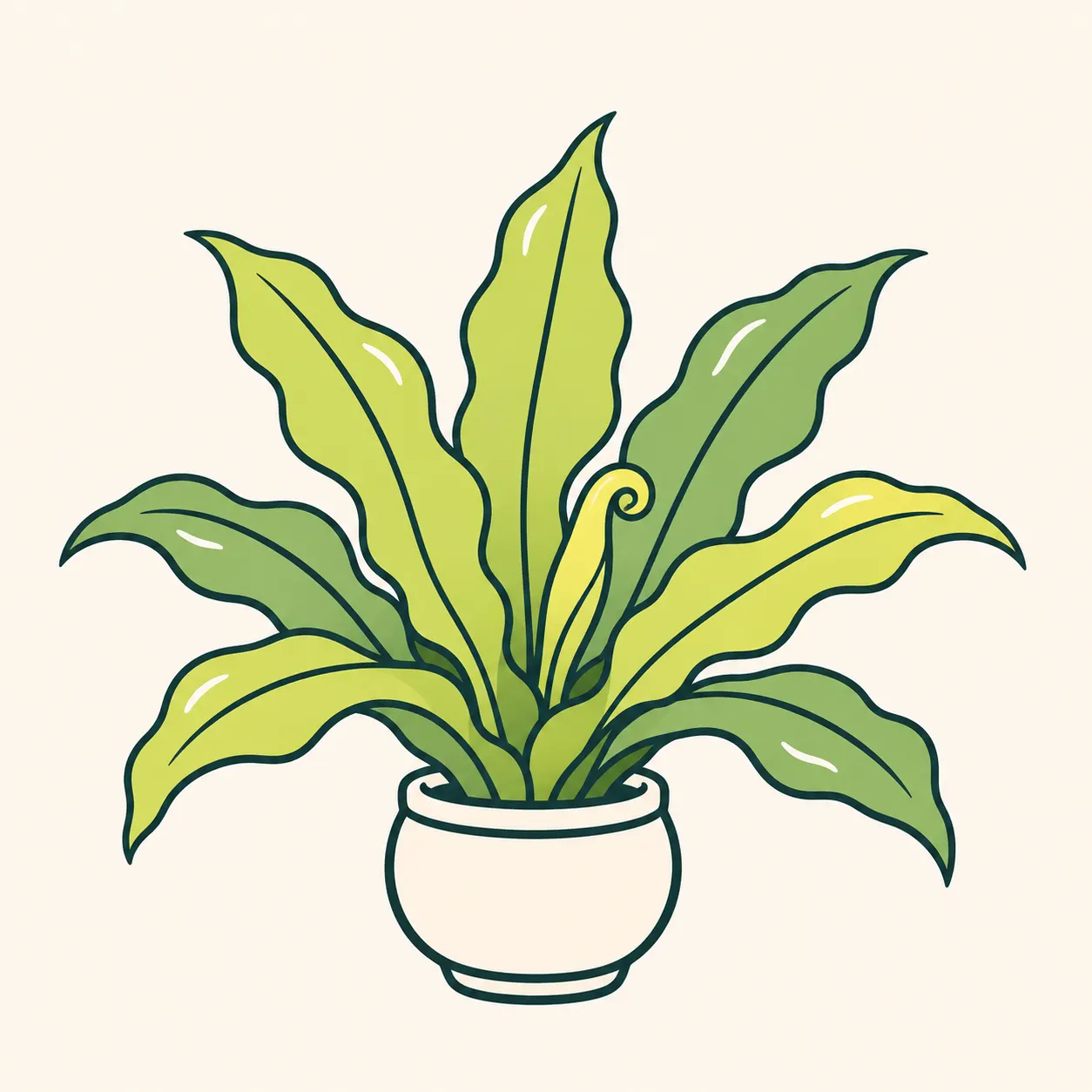
A fern does not have to resemble a feather. Asplenium nidus carries broad, undivided, strap-shaped fronds, with a dark central midrib and gently wavy edges. Gathered around the centre, they create the shape behind its common name, bird’s nest fern. It is a tropical evergreen plant: the nest describes its architecture, rather than promising that a bird will move in. Looking at that shape is a useful place to begin. [1][2]
In forests it often grows as an epiphyte, supported on trunks and branches. The rosette also acts as a collector: it intercepts fallen leaves and other debris, which accumulate and decompose, contributing nutrients to the plant. NC State’s account specifically describes this ability. A pot contains only a domestic version of the scene: the shape of the fronds retains a connection with the environment it comes from, even far from the forest. [1]
Gently turning over a mature frond may reveal rows of brown structures underneath. These are associated with the production of spores, through which ferns reproduce; they are neither seeds nor rows of concealed flowers. The University of Florida shows the stripes in its photographs. Recognising a regular arrangement can prevent us from automatically treating every dark mark as damage, without turning a photograph into a diagnosis that applies to every plant. [3]
At home, the aim is to provide suitable conditions, rather than stage a theatrical jungle. The RHS specifies bright indirect light and moist, rather than soggy, compost; NC State recommends a porous medium and protection from direct heat and draughts. A bright, screened position may therefore make more sense than an overheated windowsill. This is an editorial example: window direction, season and room change the outcome, so the word “light” alone is not enough. [2][1]
The name on the label also deserves attention. Florida describes numerous cultivated forms with divided tips, strongly crinkled edges or smaller dimensions, and inconsistent use of cultivar names. Here we are considering the undivided-frond form of Asplenium nidus, without assigning exactly the same appearance to every plant sold as a bird’s nest fern. Variation is not a plant defect: it is an invitation to look at the actual specimen before us. [3]
For a small observation, follow one frond from the centre outwards and compare the rosette with a simple funnel. The comparison is ours; the collection of debris is documented. There is no need to fill the pot with leaves from a park to imitate it. In the deliberately simplified AI illustration, there are no flowers or feathery leaflets: the essential detail is this broad, continuous surface, which helps create a space. [1][3]
Take this with youBefore asking a plant to decorate, notice what its shape does: this rosette tells a story about collecting and growing.
One idea, in simple words
Asplenium nidus is called bird’s nest fern. Its leaves, known as fronds, are broad and undivided: they do not have the many tiny leaflets seen on other ferns. They grow around a centre and form something like a funnel. In forests, the plant often lives on trunks and branches. Its rosette catches fallen leaves and other pieces of plant material. As these materials break down, they help feed the fern. Brown rows beneath some mature fronds are associated with spores, which are used for reproduction. They are not flowers. Imagine a bowl made from leaves: this comparison helps explain the shape, but nobody built it. Indoors, the fern needs indirect light and moist soil that drains well. [1][2][3]
A little discovery to keep
What did you discover?
Read the sources (3)
- Asplenium nidus — Plant Toolbox NC State Extension · accessed 4 Nov 2026
- Asplenium nidus — bird’s nest fern Royal Horticultural Society · accessed 4 Nov 2026
- Bird’s Nest Fern — Gardening Solutions University of Florida · IFAS Extension · accessed 4 Nov 2026
Original writing and illustration made with AI assistance. Our editorial method
More in Plants