Needs attention
How to care for it, step by step
Care guide checked on
Is it for you?
Suited to someone who can provide light and check the growing medium before watering. Stored water does not make the plant tolerant of waterlogging; moderate difficulty is our editorial assessment. [1][2]
Where to put it
Choose bright light, gradually acclimatising the plant to any direct sun. Protect it from frost; for indoor overwintering, Wisconsin recommends temperatures above about 16 °C. [1][2]
Step by step
Check light, temperature and moisture in the medium before choosing its permanent position. [1][2]
When the medium is dry, water and empty any water collected in the saucer. [1][2]
For optional propagation, rest an aerial tuber on growing medium while keeping it attached to the parent stem. [1][2]
Keep that small area slightly moist, not sodden; separate it only after roots develop. Do not impose a deadline: this can take weeks or months. [1][2]
If something looks wrong
Persistently wet medium or a rotting base
Check
Check drainage holes, water in the saucer and watering frequency. The RHS notes basal rot with excessive moisture, particularly in winter. [1][2]
What to do
Empty the saucer and correct drainage and watering; allow the medium to dry. Ask a plant nursery to assess already damaged tissue rather than promising recovery. [1][2]
Small white clusters on the stems
Check
Check whether these are mealybugs: Wisconsin and the RHS list them among possible pests. A symptom alone does not establish identification. [1][2]
What to do
Temporarily separate the plant from others and have the insect identified before choosing a suitable treatment; do not apply products at random. [1][2]
Read the sources (2)
- String of Hearts, Ceropegia woodii — revisione ottobre 2026 University of Wisconsin–Madison Extension · accessed 10 Nov 2026
- Ceropegia linearis subsp. woodii Royal Horticultural Society · accessed 10 Nov 2026
At first it looks like a living necklace: slender trailing stems and little heart-shaped leaves. The plant sold as Ceropegia woodii is also listed by the Royal Horticultural Society as Ceropegia linearis subsp. woodii. The name varies with the botanical treatment; that does not give us two different plants on the windowsill. The RHS describes a tuberous perennial originating in southern Africa. [2]
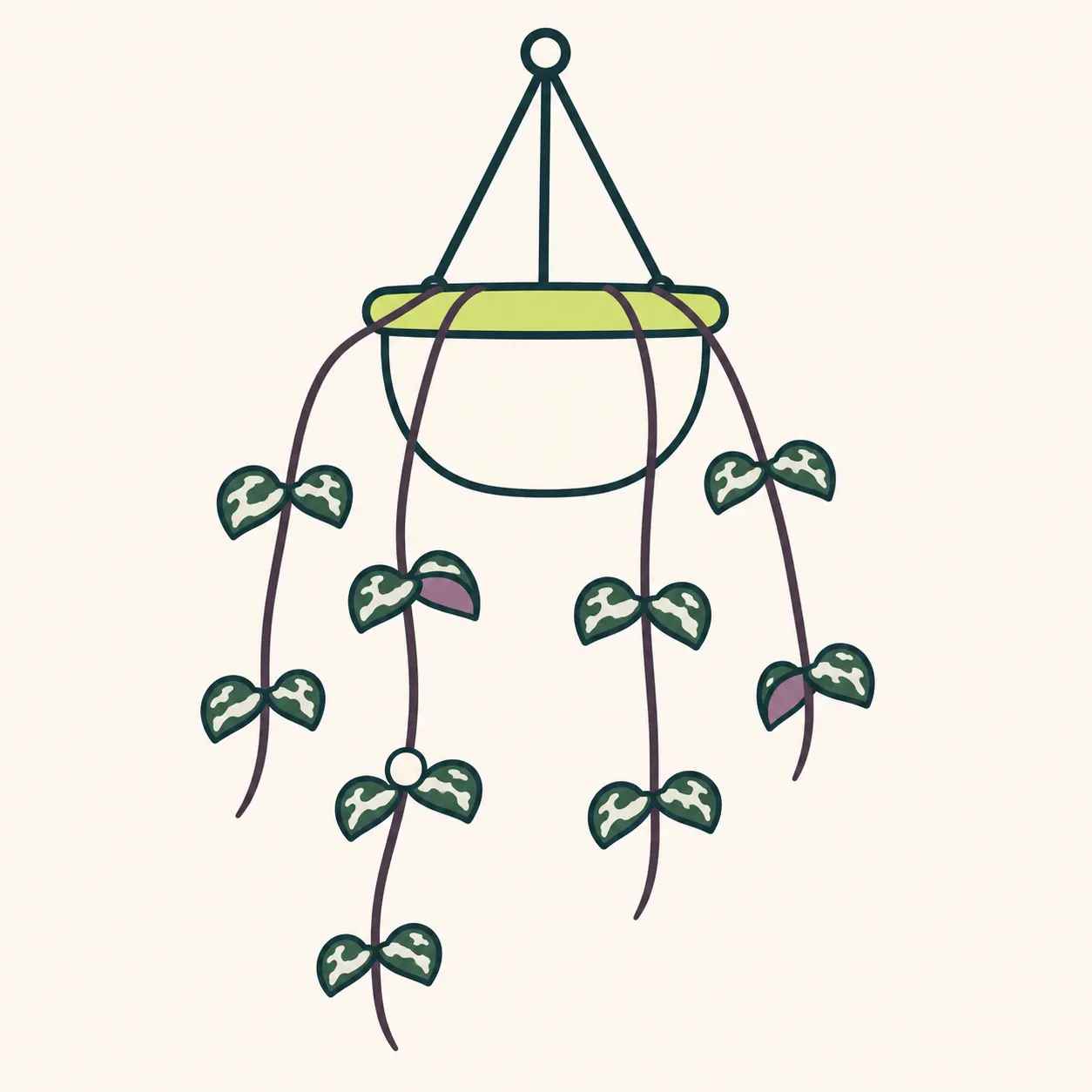
The discovery lies along the string, where the leaves join the stem. Small aerial tubers, resembling pale beads, can develop there. They are not fruits and should not be confused with flowers. Wisconsin Extension documents how these tubers can root and produce new vines. A node, then, is more than a place where a leaf begins: it can become a point of propagation. [1]
Notice the arrangement of the leaves too: they grow in opposite pairs, with silvery marbling on their upper surfaces. Their undersides may have purple tones. Here is an editorial exercise: follow a single stem with your eyes, without pulling it, and distinguish leaf, node and tuber. You do not need to find a bead beside every pair. Its absence along one section is not, by itself, a diagnosis of disease. [1]
It is tempting to think that all hearts look alike, yet this plant’s overall form depends on a few precise details. Stems are slender, leaves spaced apart and the whole plant trails; the RHS also describes pink and purple tubular flowers. Our illustration chooses leaves and one tuber instead of squeezing every feature into a single vignette. Simplifying a drawing should not mean inventing an organ. [2]
Cultivation begins with the growing medium. This plant needs excellent drainage and watering when its compost has dried. Wisconsin Extension advises reducing water in winter and repotting only when necessary. A decorative necklace may look delicate, but the most affectionate gesture is not to add water whenever you walk past. Frequency should follow the actual conditions in the pot, rather than the plant’s romantic common name. [1]
To propagate a tuber, the source suggests pressing it into the growing medium of another pot, preferably while still attached to the parent, and separating it only once established. This is a process to observe, not a guaranteed instant result. Our invitation is simpler: photograph the same node over time and record what changes. Distinguish a new root you actually see from the growth you hope to see. [1]
Take this with youFollow a stem without tugging it: identify paired leaves and look for a node with a tuber. Observation comes before scissors and watering cans.
One idea, in simple words
Ceropegia woodii has slender trailing stems. Its heart-shaped leaves grow in opposite pairs. Their upper surfaces have pale markings, while the undersides can be purple. Little rounded structures appear on some stems: these are aerial tubers, not fruits. A tuber can make roots in suitable conditions, so it can help produce a new plant. Imagine following one stem with your eyes and pointing out a leaf, node and tuber without touching them. This is our observation exercise. The plant should not stand in constantly wet soil: its growing medium needs to drain and dry between waterings. Not every node carries a tuber, so there is no reason to expect beads everywhere along the stem. [1][2]
A little discovery to keep
What did you discover?
Read the sources (2)
- String of Hearts, Ceropegia woodii — revisione ottobre 2026 University of Wisconsin–Madison Extension · accessed 10 Nov 2026
- Ceropegia linearis subsp. woodii Royal Horticultural Society · accessed 10 Nov 2026
Original writing and illustration made with AI assistance. Our editorial method
More in Plants