Easy
How to care for it, step by step
Care guide checked on
Is it for you?
Easy in a bright home. Outdoors only without frost and protected from strong sun; bring it inside in cold climates. For cultivation, the RHS recommends temperatures ideally above 10 °C. [2]
Where to put it
Near a bright window, using a light curtain against strong rays. Avoid radiators, which dry the air. A dark room is not the same as indirect light. [1]
When and how to water
Feel the growing medium first: keep it lightly moist, not sodden. When it starts drying, water thoroughly and let it drain; empty the saucer. Winter often means less water: the pot decides, not the weekday. Rainwater or distilled water can help when tap water contributes to brown tips. [1][3]
Pot and growing medium
Use a pot with drainage holes and peat-free houseplant compost that lets excess water escape. When fleshy roots fill the pot and become crowded, move to a slightly larger pot. [1]
Step by step
Check the position’s light and temperature, especially before leaving the plant outdoors overnight. [2]
Feel the compost; if it is still properly moist, wait. After watering, remove water collected underneath the pot. [1]
For another plant, place an attached plantlet on compost in a small pot. Separate it only after it has rooted. [3]
If something looks wrong
Brown leaf tips
Check
Check very dry air, overly dry compost and the water used: colour alone cannot identify the cause. [3]
What to do
Correct the condition found, move away from radiators and consider rainwater or distilled water. Watch new leaves: an already dry tip will not turn green again. [1][3]
Yellowing leaves
Check
Check for too little light or strong direct sun, and whether the pot stays saturated. These are clues, not a diagnosis. [1][3]
What to do
Move into suitable indirect light and allow excess water to drain. Do not automatically add water or fertiliser just to change the colour. [1]
Read the sources (3)
- How to grow spider plants Royal Horticultural Society · accessed 8 Oct 2026
- Chlorophytum comosum green · cultivation Royal Horticultural Society · accessed 8 Oct 2026
- Spider plant · general care and propagation University of Wisconsin–Madison Extension · accessed 8 Oct 2026
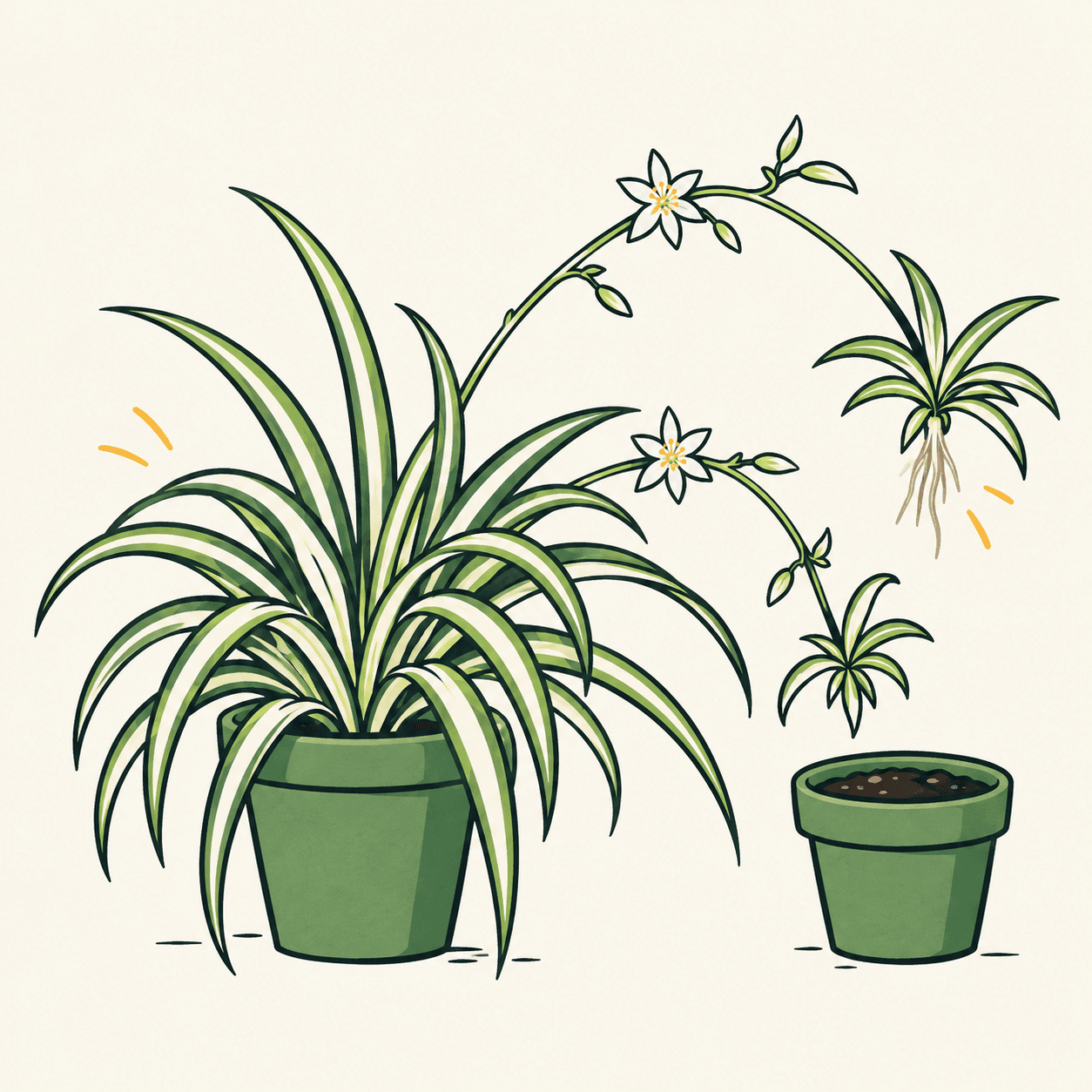
A spider plant, Chlorophytum comosum, can look like a fountain of green and pale ribbons. Look more closely and some thin strands carry little tufts repeating the shape of the larger plant. These are not leaves that have suddenly become complicated: they are new plantlets, produced along stems that can also carry small white flowers. NC State Extension describes these structures alongside the narrow leaves gathered at the base. Following a stem distinguishes parts that look similar from a distance. [2]
The central discovery is that a plantlet can develop roots while still connected to its parent. The University of Wisconsin guide suggests placing it on growing medium in another small pot and separating it only after rooting. This is one way to propagate the plant, meaning to produce additional plants. It does not require waiting for a seed. The same source distinguishes this method from growing seedlings, whose leaf colouring is not guaranteed to match the parent. [3]
The stripes deserve attention too. The cultivated selection “Vittatum”, represented in our illustration, has a pale central stripe and green margins; not every form of the species looks like this. Some plants are entirely green, while others arrange their variegation, or differently coloured areas, differently. Fleshy roots store water, but that does not make care irrelevant. Waterlogging and prolonged drought do not become good habits simply because a plant has a reputation for being easy. [3][1]
Try an editorial exercise without detaching anything: choose a leaf and follow it with your eyes to its base. Then choose a thin stem and look for flowers or little plantlets. Draw two different lines in a notebook. Your drawing does not measure growth or establish the plant’s age; it helps you observe connections. A leaf and an axis carrying new plantlets do not perform the same role merely because both appear long and green. [2]
To move from observation to care, the RHS recommends indirect light and lightly moist growing medium, with water left in the saucer poured away. “Easy plant” should therefore mean an opportunity to learn simple checks, not a promise of survival without suitable conditions. Our suggestion is to start with one plant and observe it before turning every plantlet into another pot. Propagating a spider plant is possible; finding space and attending to each pot remain the grower’s decisions. [1]
Take this with youFollow the stem before naming what you see. Recognising a leaf, flower and new plantlet in a spider plant also makes the practical action of propagation easier to understand.
One idea, in simple words
A spider plant is also called Chlorophytum comosum. It has long, narrow leaves. It also produces thin stems carrying small white flowers and new plantlets. These plantlets are not special leaves: they can develop roots. Propagation means producing additional plants. A plantlet can take root in a small pot while it is still connected to its parent plant. [2][3]
Here is an editorial example: without cutting anything, follow a leaf down to its base with your eyes, then follow a stem carrying a plantlet. Draw the two routes. This helps you see that the parts are different. A spider plant still needs suitable light and carefully managed water: being easy does not mean it can always live in a pot full of water. [2][1]
A little discovery to keep
What did you discover?
Read the sources (3)
- How to grow spider plants Royal Horticultural Society · accessed 8 Oct 2026
- Chlorophytum comosum · Plant Toolbox NC State Extension · accessed 8 Oct 2026
- Spider plant, Chlorophytum comosum · revised 6 January 2025 University of Wisconsin–Madison Extension · accessed 8 Oct 2026
Original writing and illustration made with AI assistance. Our editorial method
More in Plants