Needs attention
How to care for it, step by step
Care guide checked on
Is it for you?
Suitable for a home with bright light and a cooler winter location; it is not frost hardy. Growth is slow, and a young plant requires patience. [1]
Where to put it
Provide bright filtered light, shelter from strong summer sun and distance from radiators. For winter rest, consider a bright room around 10 °C, without cold draughts or frost. [1]
When and how to water
During growth, keep the free-draining compost just moist. Reduce water in winter without drying it completely; check the compost before watering and avoid waterlogging. [1]
Pot and growing medium
Use a free-draining, peat-free, loam-based potting mix with material that improves drainage. Avoid frequent repotting and oversized containers; disturb roots as little as possible. [2]
Step by step
Check that the location provides filtered light and protection from intense sun. [1]
In winter, arrange a cooler bright location and gradually reduce watering. [1]
As buds develop, gradually increase water while maintaining drainage. [1]
Remove the spent flower stalk at its base using gloves, because sap may irritate skin. [1]
If something looks wrong
The plant does not flower.
Check
Check the plant’s age, pot size and winter temperature: the guide identifies all of these possibilities. [1]
What to do
If winter conditions are too warm, arrange a cooler bright location for the next cycle; do not automatically respond with an even larger pot. [1]
Leaves turn yellow and the compost stays wet.
Check
Check for waterlogged compost and whether water can drain away; yellowing can also have nutritional causes. [1]
What to do
Correct waterlogging and reduce watering, especially in winter. If roots have rotted, follow RHS guidance to remove them and replace damaged compost. [1]
Read the sources (2)
- How to grow clivias Royal Horticultural Society · accessed 13 Nov 2026
- Clivia miniata — Plant profile Royal Horticultural Society · accessed 13 Nov 2026
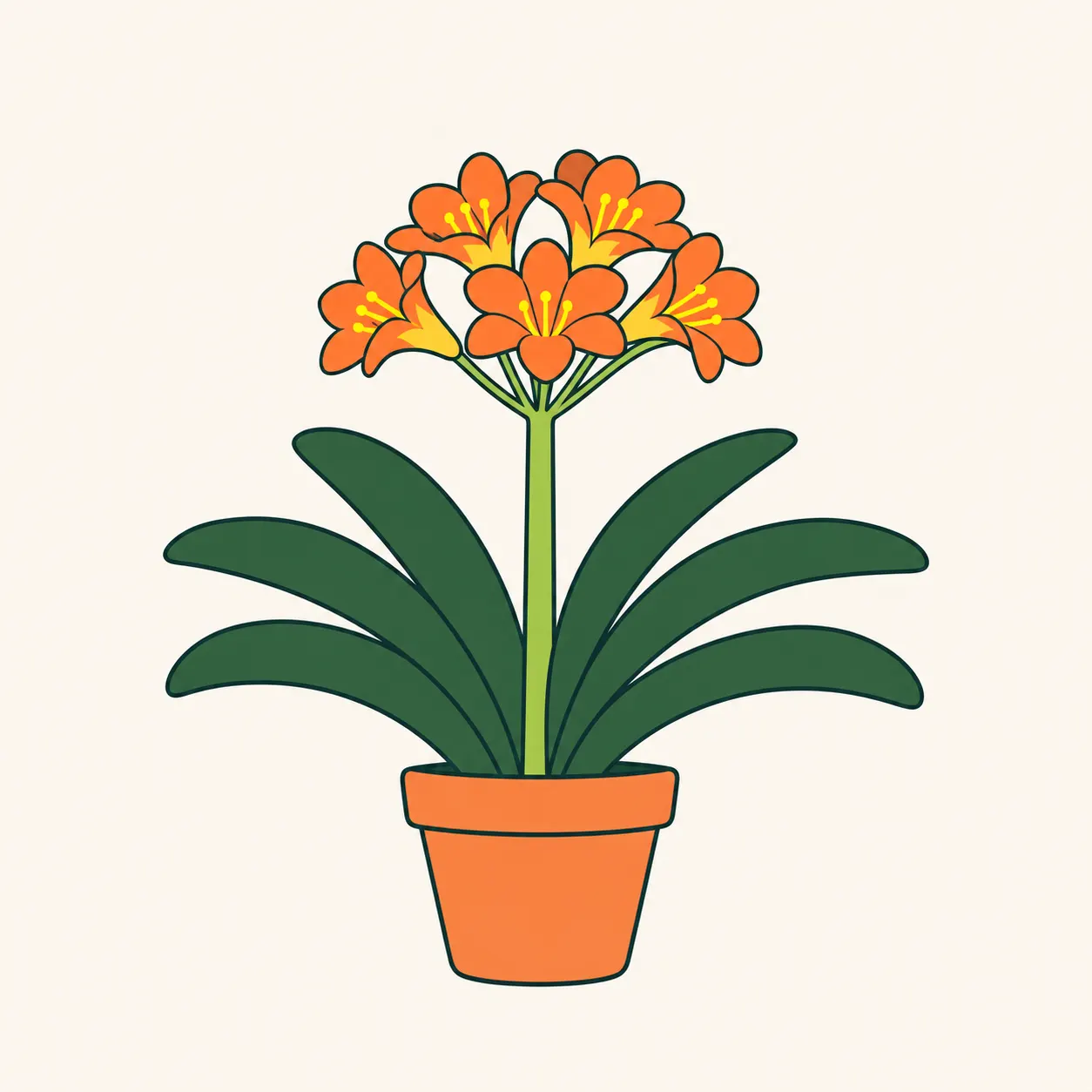
Clivia does not need flowers to be recognisable: its long, broad, leathery leaves form a dark green fan. Clivia miniata is an evergreen perennial from southern Africa, found in woodland environments. When it flowers, a sturdy stalk carries a cluster of funnel-shaped blooms, typically orange with yellow throats. The contrast is not between a plant switched off and one switched on. Its leafy structure already has a distinct, recognisable form throughout the year. [1]
The interesting discovery concerns timing. For cultivation under protection, the Royal Horticultural Society recommends a bright, cool winter period, around ten degrees Celsius, with reduced watering. That combination helps stimulate the following flowering. It is not a promise that activates on a fixed date: maturity, light and root conditions also matter. A very young plant may need several years before it is ready to bloom, even when its owner is considerably less patient. [2]
A room kept warm throughout the year may therefore suit us without providing the rhythm recommended for clivia. The RHS guide distinguishes rest from complete dehydration: winter compost should be neither waterlogged nor allowed to dry out entirely. As flower buds develop, watering increases gradually. Referring to seasons describes specific conditions. It does not mean every pot should receive an identical quantity of water every Sunday, regardless of what is happening inside it. [2]
The container also requires proportion. The RHS plant profile discourages frequent repotting and notes that clivia dislikes disturbance to its roots. An oversized pot is not automatically a gift. Light should be filtered, with protection from strong summer sun, and the potting mix must drain well. Clivia needs to be considered in relation to the home available: a bright window and a cooler winter location are requirements to assess together before choosing a place. [3]
As an editorial exercise, imagine keeping two brief observations beside the pot: where the light reaches and how the compost feels before watering. Comparing them over time tells us more than a photograph of the flower alone. This is not an experiment establishing a cause or a diagnosis for every yellow leaf: different problems may contribute. The guide distinguishes waterlogging, nutrition and excessive winter warmth, for example. Observation helps us form a better question before acting. [2]
Clivia is an ornamental plant: the RHS reports possible stomach upset if it is eaten and skin irritation from its sap. It is not a household ingredient. Our proposed lesson is quieter than instant flowering and more useful: a pause can be part of care. That metaphor concerns our way of looking; the botanical fact concerns particular seasonal conditions. We can appreciate the plant’s rhythm without imagining that it has human intentions. [3][2]
Take this with youBefore expecting new flowers, observe light, water and winter temperature. For clivia, consistent care includes a period that is cooler and drier than active growth.
One idea, in simple words
Clivia is a plant with long evergreen leaves. Its orange flowers grow in a cluster on a sturdy stalk. To encourage flowering, the RHS guide recommends a bright, cool winter, around ten degrees Celsius, with less water. The compost must not dry out completely, however. A young plant may take years to flower. Imagine keeping a small notebook: record where the light reaches and whether the compost is moist before watering. This is an example of observation, not an experiment that proves every cause on its own. An oversized pot and frequent repotting do not necessarily help. Clivia is ornamental: it should not be eaten. Its winter pause forms part of its care. [2]
A little discovery to keep
What did you discover?
Read the sources (3)
- Clivia miniata NC State Extension Gardener Plant Toolbox · accessed 13 Nov 2026
- How to grow clivias Royal Horticultural Society · accessed 13 Nov 2026
- Clivia miniata — Plant profile Royal Horticultural Society · accessed 13 Nov 2026
Original writing and illustration made with AI assistance. Our editorial method
More in Plants