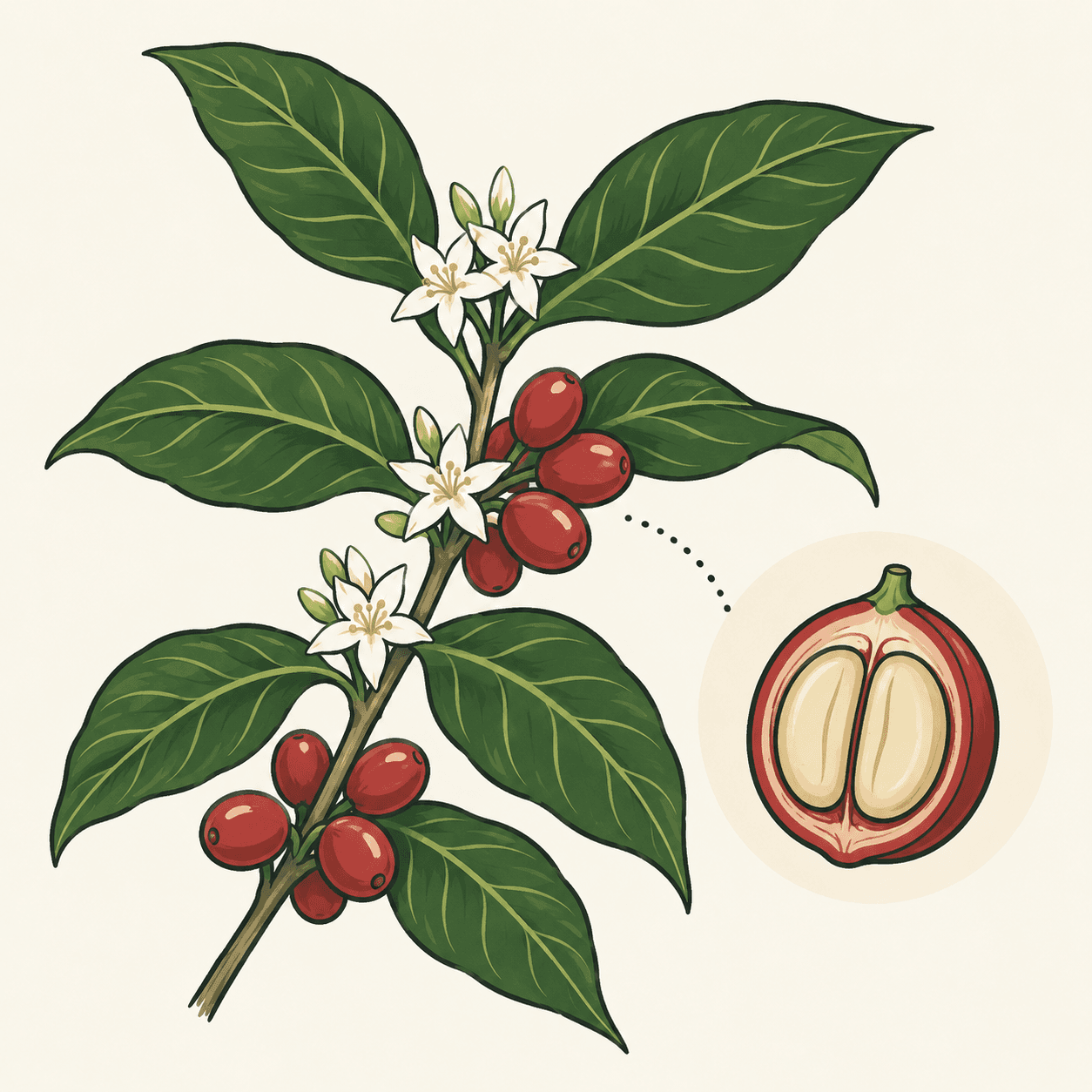
The coffee bean we recognise most easily is dark, dry and marked by a groove. On the plant Coffea arabica, however, the starting point looks different: the seed sits inside a fleshy fruit. Kew's botanical description distinguishes the seed's pale colour from the dark brown that appears after roasting. Our discovery begins by separating the living plant from the processed product we have learned to recognise. [1]
The Royal Horticultural Society describes an evergreen shrub or small tree, with glossy dark-green leaves arranged in opposite pairs. This means that two leaves sit across from one another on the stem. White flowers appear in the leaf axils: the angles between leaf and branch. These are details to observe together, rather than a single sign sufficient to identify any plant we might happen to encounter. [2]
The fruits turn from green to red as they ripen; Kew also records forms with yellow or purple ripe fruits. There are usually two seeds inside, although sometimes there is only one. Our illustration shows two, enlarged so that they can be seen: it is not a photograph drawn to scale. Calling the fruits coffee cherries helps us picture their appearance, but does not make them the same as cherries at a fruit stall. [1][2]
Here is an editorial example made entirely from drawings. On a sheet of paper, place a leaf, a flower, a closed fruit and an opened fruit. Then draw a separate seed. The question is not which picture looks prettiest, but what relationship connects them. This small exercise lets us pause over a distinction that everyday language can hide: a container and what it contains are not the same part of the plant. [1]
Names also deserve attention. Coffea arabica names the species we are examining; it cannot by itself describe every plant in the genus Coffea or every drink called coffee. The RHS record places this species in the Rubiaceae family. Describing the plant provides one clear point of reference, while the origin of a packet, its blend and its processing would require different, specific information of their own. [2]
The limit of this reading is deliberate: it is not a guide to eating unfamiliar fruits, nor a promise that harvesting coffee at home will be easy. The RHS's horticultural advice depends on the growing conditions described in its record. Here it is enough to change our question when looking at a bean: before asking how it tastes, we can ask which part of a plant we are seeing and what transformations have made it familiar. [2][1]
Take this with youDraw a closed fruit and the same fruit opened. Explain in your own words the difference between fruit and seed, without tasting unfamiliar plants.
One idea, in simple words
A coffee bean is a seed. On the plant Coffea arabica it grows inside a fleshy fruit, often called a coffee cherry. A fruit usually contains two seeds, although sometimes it contains only one. The seeds are pale: the dark brown colour we recognise appears after roasting, a heating process used when preparing coffee. [1]
The plant has glossy green leaves in pairs and small white flowers. Here is an editorial example: draw a red fruit, then show it opened in your drawing. Put two pale seeds inside. You have separated the fruit from what it contains. The picture is an enlarged model, not an actual measurement. This discovery helps us observe plant parts; it is not an invitation to taste unfamiliar fruits. [2][1]
A little discovery to keep
What did you discover?
Read the sources (2)
- Coffea arabica L. · general information Royal Botanic Gardens, Kew · Plants of the World Online · accessed 6 Oct 2026
- Coffea arabica · Arabian coffee Royal Horticultural Society · accessed 6 Oct 2026
Original writing and illustration made with AI assistance. Our editorial method
More in Plants