Easy
How to care for it, step by step
Care guide checked on
Is it for you?
Suitable for someone who can provide indirect light and inspect the compost before watering. The easy rating is an editorial assessment of the documented requirements. [2]
Where to put it
Choose bright, indirect light; avoid strong summer sun, deep shade and cold draughts. Keep the pot beyond the reach of children and pets. [2]
When and how to water
Let the top two centimetres of compost dry before watering. Allow surplus water to drain: frequency and amount depend on season, light and pot conditions. [2]
Step by step
If something looks wrong
Weak growth and reduced variegation
Check
Check whether the location stays in deep shade; do not identify a cause from one leaf alone. [2]
What to do
If light is insufficient, find a brighter position with filtered light and observe subsequent growth. [2]
Compost stays wet
Check
Check watering frequency, drainage and water in the saucer; excess moisture can damage roots. [2]
What to do
Remove standing water and wait for the surface to dry. If deterioration continues, seek qualified assessment before applying products. [2]
Read the sources (2)
- Epipremnum aureum — Extension Gardener Plant Toolbox NC State Extension · accessed 5 Nov 2026
- Epipremnum — Plant Guide Royal Horticultural Society · accessed 5 Nov 2026
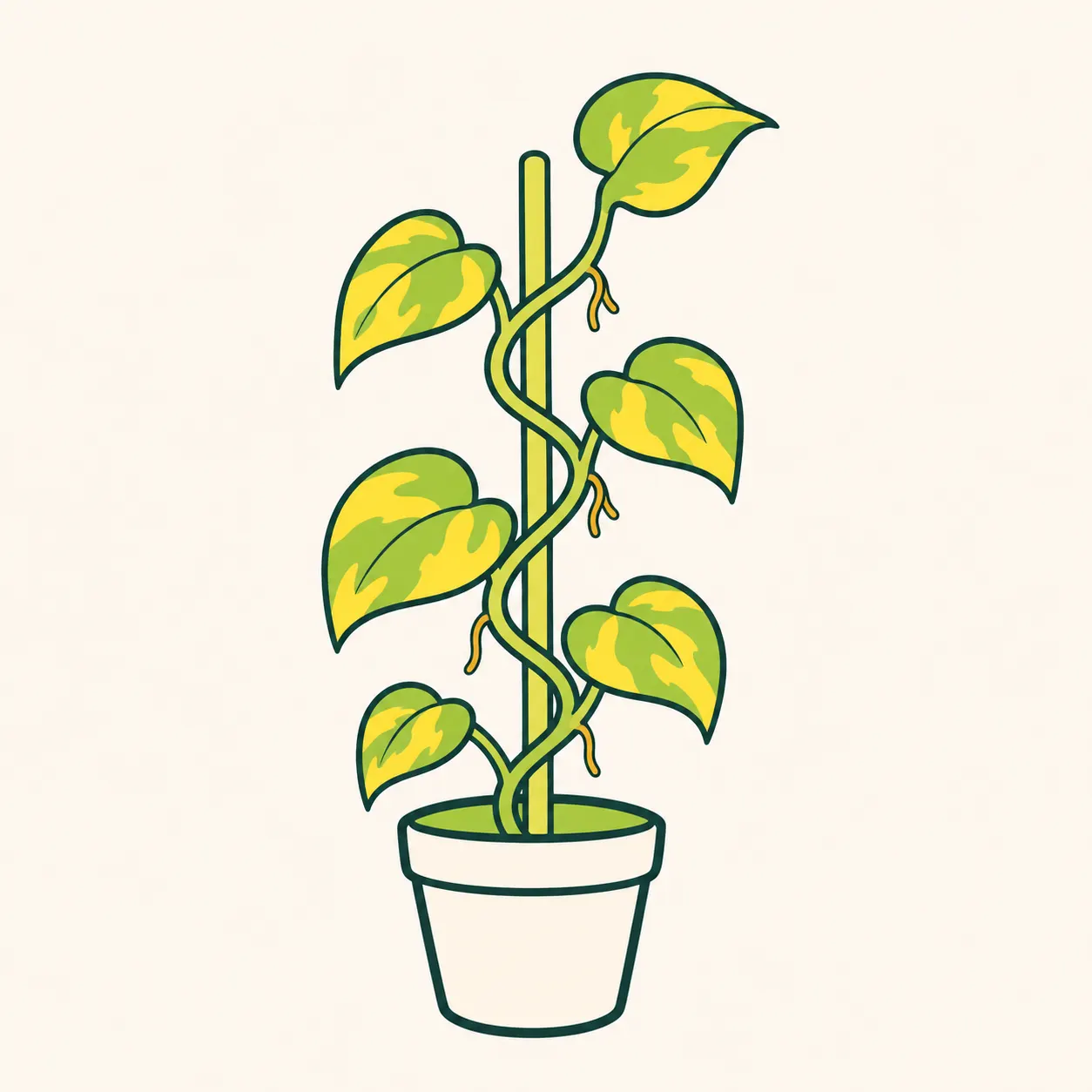
On a bookshelf, pothos seems to have found its profession: extending a stem and letting it trail downwards. Yet Epipremnum aureum is a climber, rather than a cascade created for the living room. North Carolina State University’s botanical record describes heart-shaped juvenile leaves and aerial roots that attach to supports. Here is the interesting point: the shape familiar to us in a pot does not, by itself, tell the plant’s entire life story. [1]
The same source distinguishes the juvenile phase, common in household cultivation, from the much larger leaves of mature plants growing in suitable conditions. Waiting for a small pot to celebrate enough birthdays does not automatically produce spectacular foliage. Support and environment matter. A hanging stem and one guided upwards can offer different views of the same climbing ability, without turning the plant into a different species or guaranteeing the same result in every room. [1]
The RHS recommends bright, indirect light and notes that deep shade may slow growth and reduce variegation. Yellow or cream patches do not therefore make every corner an equivalent location. Imagine a domestic example: two shelves both seem bright to us, but one remains far from the window throughout the day. Before accusing a pot of failing to cooperate, we could observe how much the light actually changes in those two positions over several hours. [2]
Water also calls for concrete observation. The RHS guide suggests allowing the upper two centimetres of compost to dry between waterings and avoiding waterlogging; it does not prescribe the same appointment for every home. A reminder can prompt us to check rather than force us to pour. This distinction is an editorial practical suggestion: keep the routine, but let the action depend on the condition of the pot, the season and the light available. [2]
Familiarity does not make pothos edible: the sources describe it as harmful if eaten and advise keeping it away from children and pets. Beyond that precaution, its story invites quiet attention to details: where a leaf emerges, a small root along the stem, the changing patterns of pale patches. There is no need to chase the giant leaf. Understanding which growth form we are seeing already offers a more precise way to care for the plant. [1][2]
Take this with youExamine a stem node and compare a new leaf with an older one. Record what you see without assigning intentions to the plant: growth, light and support offer better questions than imagining that it is being temperamental.
One idea, in simple words
Pothos, known scientifically as Epipremnum aureum, is a climbing plant. Indoors we often see its young, heart-shaped leaves with green and yellow areas. Aerial roots can grow along the stem. These roots are outside the compost and help the plant attach to a support. In suitable conditions, mature leaves can become much larger. Waiting alone is not enough, because the environment matters too. The plant prefers bright light without strong direct sunshine. Before watering, check whether the surface of the compost has dried, and avoid leaving the pot standing in water. A useful example is setting a reminder to inspect the pot, rather than always watering it. Its leaves must not be eaten, and the plant should stay away from children and pets. [1][2]
A little discovery to keep
What did you discover?
Read the sources (2)
- Epipremnum aureum — Extension Gardener Plant Toolbox NC State Extension · accessed 5 Nov 2026
- Epipremnum — Plant Guide Royal Horticultural Society · accessed 5 Nov 2026
Original writing and illustration made with AI assistance. Our editorial method
More in Plants