Needs attention
How to care for it, step by step
Care guide checked on
Is it for you?
For a sheltered garden corner or large container: it may reach 2.5–4 metres. The RHS rates it H5 (approximately −15/−10°C) in British conditions; assess frost in your own location. [1]
Where to put it
Prefer partial or full shade, sheltered from wind. Indoors choose a bright, cool, ventilated position, ideally 14–18°C. [2]
When and how to water
In a pot, feel below the surface and water as the compost starts to dry. Keep moisture without waterlogging; a newly planted shrub needs more attention than an established garden specimen. [2][3]
Pot and growing medium
Use a container that drains and fertile, soil-based, peat-free compost. Reassess the container arrangement as this shrub grows larger. [2]
Step by step
If something looks wrong
Leaves turning brown
Check
Check direct sun and wind exposure: both can damage foliage. [3]
What to do
Move the pot to a shady, sheltered position; the symptom alone does not identify its cause. [3]
Compost remains waterlogged
Check
Check drainage and watering: excessive moisture encourages root rot. [3]
What to do
Do not add water while it remains wet; restore drainage and reassess its position. [3]
Read the sources (5)
- Fatsia japonica · plant profile Royal Horticultural Society · accessed 9 Oct 2026
- How to grow Fatsia Royal Horticultural Society · accessed 9 Oct 2026
- Fatsia japonica · Extension Gardener Plant Toolbox North Carolina State University · accessed 9 Oct 2026
- Fatsia Japonica · Gardening Solutions University of Florida IFAS Extension · accessed 9 Oct 2026
- Fatsia · preferences and winter damage Royal Horticultural Society · accessed 9 Oct 2026
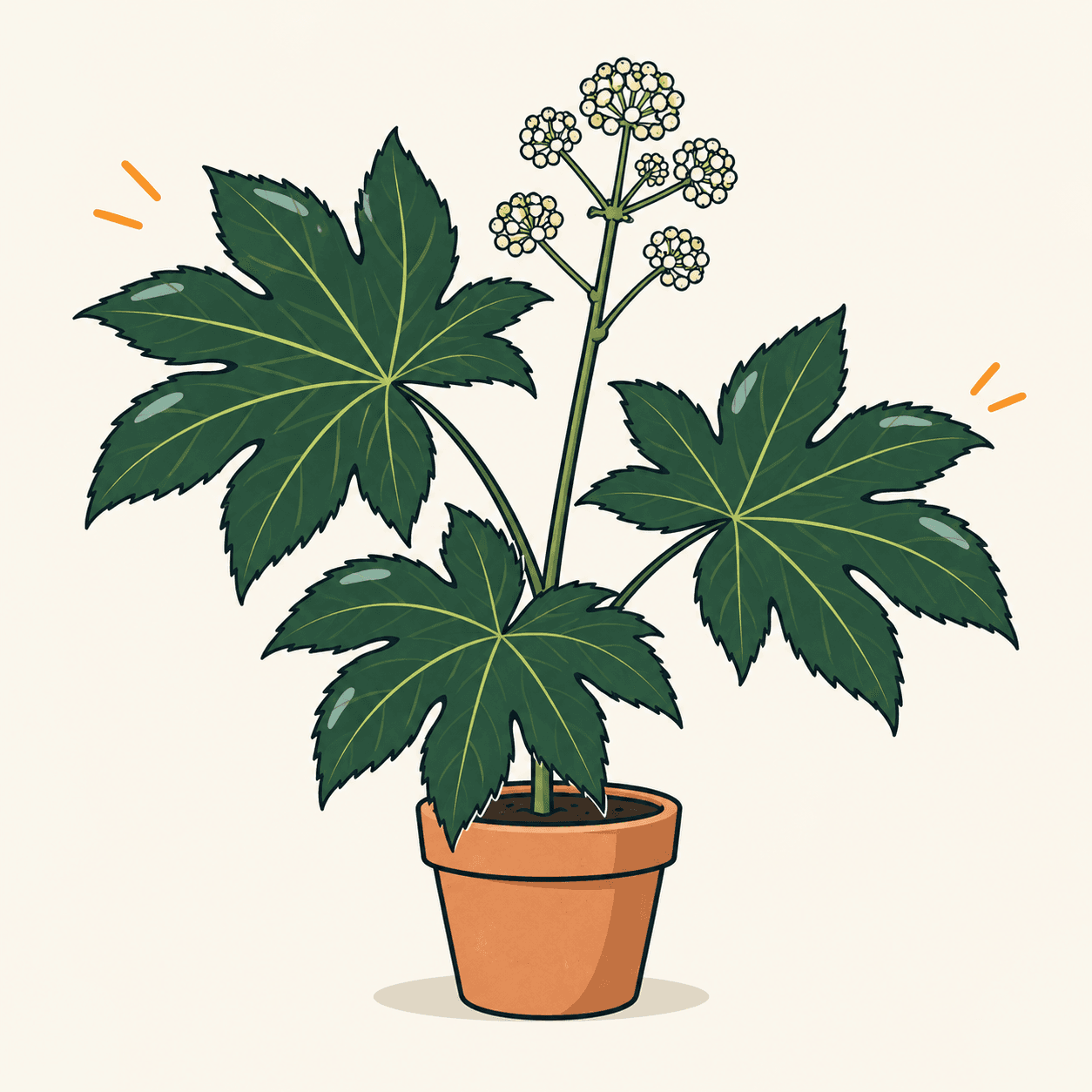
How many leaves can you see in a green hand of Fatsia japonica? The answer may surprise you: despite its divisions, that shape is one leaf. Oregon State University describes simple leaves with seven to nine toothed lobes. In botany, simple does not mean uncomplicated: it means that the blade is not separated into distinct leaflets. The word changes meaning as we move from everyday speech to the description of a plant. [1]
Kew accepts the name Fatsia japonica in the Araliaceae family; its native range includes South Korea, Japan and the Nansei Islands. It is a shrub rather than a palm, despite what some common names might suggest. This distinction is not a contest in difficult labels: it allows observations and information to be connected to the same species, preventing a visual resemblance from taking the place of identification. [2]
Its leaves are glossy, leathery and arranged alternately along the stems. The NC State entry records seven to eleven lobes, a wider range than Oregon State gives. We need not pick a magic number and reject every leaf that differs. Descriptions provide characters to compare together; shape, margin and arrangement are more useful than an isolated count. Even an apparently straightforward identification benefits from looking at several features at once. [3]
The plant contains more than its most conspicuous leaf. Groups of small cream flowers appear in autumn, followed by dark fruit in winter, as the University of Florida records. Looking at the same plant in different seasons therefore changes how we read its structure. The fruit is ornamental and inedible: our subject is plant form and seasonal cycles, without turning a botanical guide into an invitation to taste unfamiliar material. [4]
Space matters too. The RHS gives mature dimensions for Fatsia japonica of roughly 2.5–4 metres in both height and spread. Its first small pot does not tell its entire future. When planning a planted corner, asking how large it will grow is as practical as choosing a container colour. The separate care guide sets out cultivation conditions without assuming that every room or balcony will provide a suitable home. [5]
Try an editorial exercise: draw a leaf’s outline without imaginatively lifting your pencil, then follow a vein from the base towards one point. There is no need to pick it; observe it on the plant or in a botanical photograph. Beside the drawing, note what you have seen and what you are merely assuming. Drawing does not replace identification, but reveals the difference between counting points and recognising the unit that supports them. [1]
Take this with youBefore counting, decide what you are counting: a leaf, its lobes or the separate leaflets of a compound leaf. Looking at their connections can change your answer.
One idea, in simple words
Fatsia japonica is a shrub with large green leaves. A leaf may look like an open hand with several points. These parts are called lobes. They are not separate leaves: they belong to one blade, the broad part of a leaf. Botanists therefore call it a simple leaf. Simple does not mean small, smooth or lacking interesting parts to observe. [1]
Oregon State University describes usually seven to nine lobes. Follow the edge with your eyes to see where the different parts remain connected. Here is an exercise from our editors: draw only the outline, then one vein leading towards a point. You do not need to remove the leaf from the plant. Drawing helps distinguish the whole leaf from its parts, instead of counting every point as a separate object. [1]
A little discovery to keep
What did you discover?
Read the sources (5)
- Fatsia japonica · Landscape Plants Oregon State University · accessed 9 Oct 2026
- Fatsia japonica (Thunb.) Decne. & Planch. Royal Botanic Gardens, Kew · Plants of the World Online · accessed 9 Oct 2026
- Fatsia japonica · Extension Gardener Plant Toolbox North Carolina State University · accessed 9 Oct 2026
- Fatsia Japonica · Gardening Solutions University of Florida IFAS Extension · accessed 9 Oct 2026
- Fatsia japonica · plant profile Royal Horticultural Society · accessed 9 Oct 2026
Original writing and illustration made with AI assistance. Our editorial method
More in Plants